Who is responsible for a slip-and-fall accident in Texas?
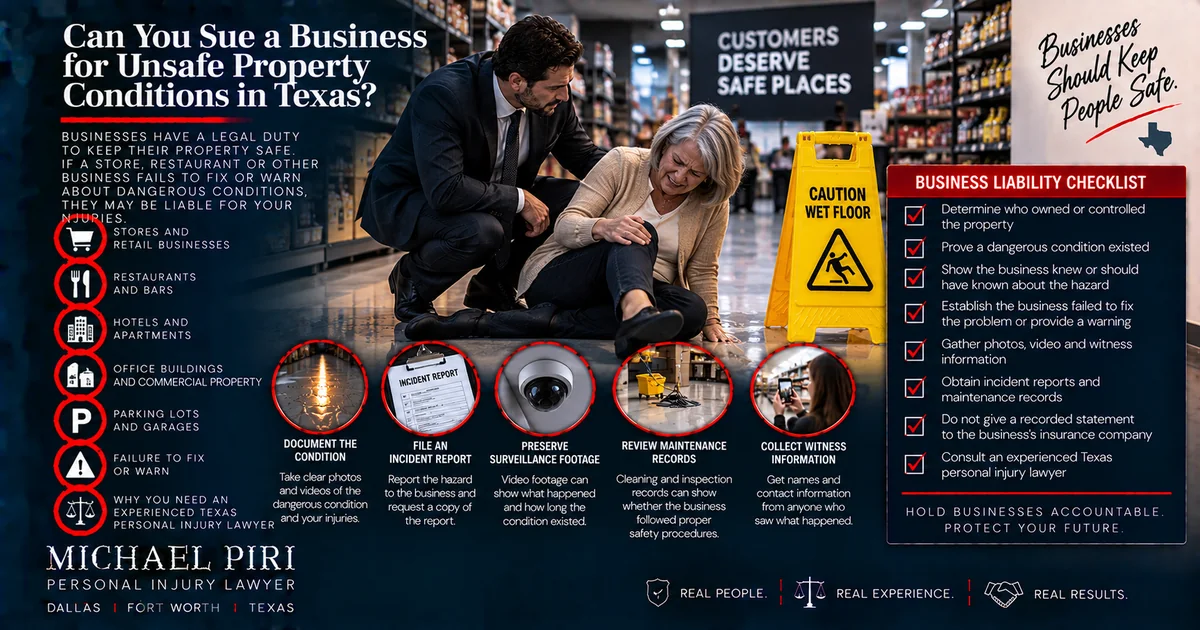
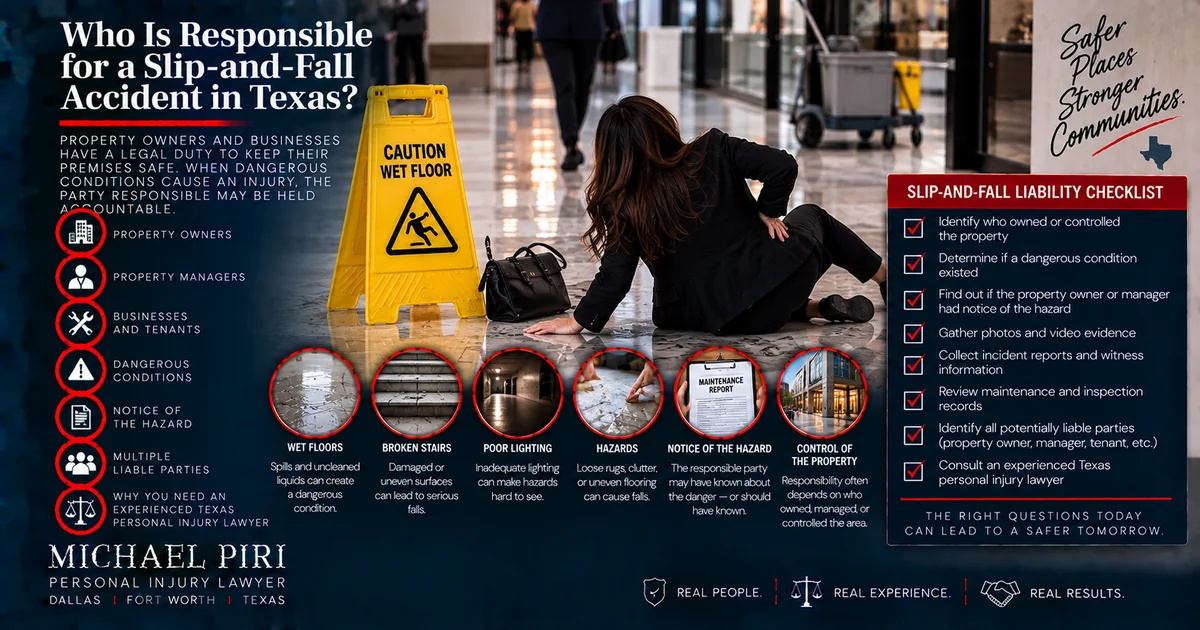
Responsibility for a Texas slip-and-fall depends on the property relationship, the injured person’s legal status, the condition that allegedly caused the fall, what the responsible party knew or should legally be charged with knowing, and whether reasonable steps were taken under the circumstances. A fall on someone else’s property does not automatically make the owner or business liable.
What Is Premises Liability?
Premises liability concerns injuries allegedly caused by a condition of real property. Slip-and-fall claims are a common example, but not every fall establishes negligence.
The applicable duties can depend on the injured person’s status and the facts surrounding the dangerous condition.
What Conditions Can Cause Slip-and-Fall Accidents?
Potential hazards can include:
- Wet or slippery floors
- Spills
- Uneven walking surfaces
- Broken flooring
- Unsafe stairs
- Holes or surface defects
- Loose mats
- Other dangerous property conditions
The existence of a condition alone does not answer the liability question.
Why Does Notice Matter?
In many premises-liability disputes, an important question is whether the defendant had actual or legally sufficient constructive knowledge of the condition.
Evidence concerning how the condition arose, how long it existed, inspection practices and employee observations can therefore matter.
Does a Warning Sign Automatically Eliminate Liability?
Not necessarily. The adequacy and effect of a warning depend on the facts, including what was warned about and whether the warning reasonably addressed the condition.
A sign should be evaluated in context rather than treated as an automatic answer.
What Should You Do After a Slip-and-Fall?
Obtain appropriate medical care and report the incident to the property owner, manager or business.
If possible, document the condition before it changes. A spill may be cleaned, merchandise moved or a defective area repaired soon after an incident.
Take Photographs of the Actual Hazard
Photographs showing only an injury may not establish what caused the fall.
When it can be done safely, photograph the walking surface, substance or defect, surrounding area, lighting, warning signs and other relevant conditions.
Identify Witnesses
Witnesses may include customers, employees or other people who observed the fall or condition.
Obtain names and contact information when possible.
Ask That Relevant Video Be Preserved
Retail stores and other businesses frequently use surveillance systems. Video may show the fall, the condition, employee activity or how long a hazard was present.
Because video can be overwritten, timely preservation can be important.
Dallas and Fort Worth Slip-and-Fall Claims
For local information, see the firm’s Dallas slip-and-fall page and Fort Worth slip-and-fall page.
Frequently Asked Questions
Is a store automatically responsible if I fall inside?
No. Liability depends on the applicable legal duty and evidence concerning the property condition and other elements of the claim.
Should I complete an incident report?
Reporting the incident can help document when and where it occurred. Provide accurate factual information and keep a copy when available.
Why is surveillance footage important?
Video may show the condition, the incident, employee activity or other facts relevant to whether the business had notice.
What if the dangerous condition was cleaned immediately?
Photographs, witnesses, surveillance footage, incident records and other evidence may become particularly important when the physical condition no longer exists.
Injured in a Texas Slip-and-Fall?
The Piri Law Firm can investigate the property condition, notice evidence, surveillance footage and other issues relevant to a premises-liability claim.
This article provides general information and is not legal advice. Texas premises-liability duties depend on the circumstances and legal status of the parties.