Can you sue a business for unsafe property conditions in Texas?
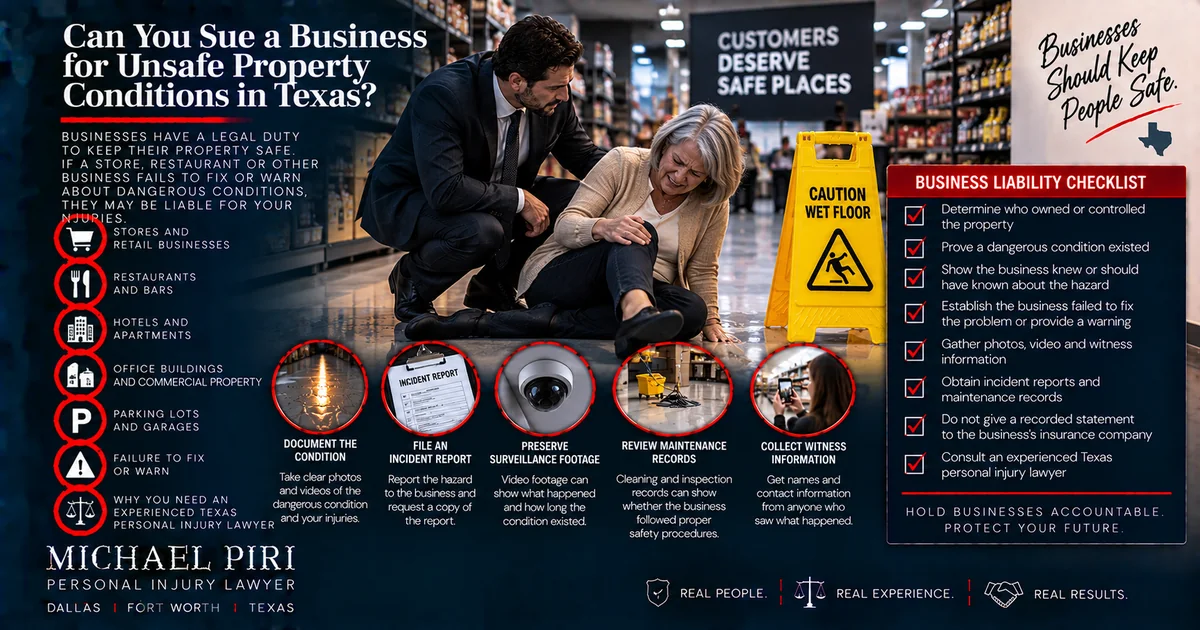
Potentially. A person injured by an unsafe condition at a Texas business may have a premises-liability claim when the legal requirements applicable to the property relationship and condition are satisfied. The fact that an injury happened at a business is not enough by itself; evidence concerning the hazard, notice, duty, causation and damages can be critical.
What Types of Businesses Can Have Premises-Liability Issues?
Claims can arise at grocery stores, restaurants, retail stores, hotels, apartment properties, parking facilities and many other commercial locations.
The relevant issue is not the type of business alone but the legal relationship and circumstances surrounding the condition that allegedly caused the injury.
What Is an Unsafe Property Condition?
Potentially dangerous conditions can include spills, defective flooring, unsafe stairs, holes, loose materials, falling hazards or other conditions creating an unreasonable risk under the circumstances.
Whether a particular condition satisfies the legal requirements for liability depends on the evidence.
Why Is Notice Important?
Premises cases frequently involve whether the business knew or should legally be charged with knowledge of the condition.
Relevant evidence can include employee observations, inspection records, surveillance footage, prior reports and information concerning how long the condition existed.
What If an Employee Created the Condition?
Evidence showing how the condition was created can affect the notice analysis. Employee testimony, surveillance footage and business records may become important.
Report the Incident
Notify the business or property manager after an injury and provide accurate factual information.
Ask how to obtain a copy of any incident report, although the business may have its own procedures concerning internal documents.
Preserve Photographs and Video
Take photographs of the actual condition and surrounding area when possible.
Also identify visible surveillance cameras. A written preservation request may become appropriate because routine video-retention systems can overwrite footage.
Preserve Evidence of Your Visit
Receipts, transaction records, parking records, photographs and other documentation can help establish when and why you were at the property.
What If the Business Fixes the Hazard?
A changed condition makes contemporaneous evidence even more important. Photographs, witnesses, reports and available video may preserve information about what existed at the time of the incident.
Can Comparative Responsibility Matter?
Depending on the case, a defendant may argue that the injured person bears some responsibility. Texas proportionate-responsibility principles can affect recoverable damages when applicable.
For Dallas premises claims, see the firm’s Dallas slip-and-fall page. Fort Worth information is available on the Fort Worth slip-and-fall page.
Frequently Asked Questions
Can I sue simply because I was injured inside a store?
No. An injury occurring at a business does not by itself establish premises liability. The applicable legal elements must be supported by evidence.
What if there was no warning sign?
The absence of a warning may be relevant, but it does not by itself establish every element of the claim.
Should I photograph the floor or hazard?
Yes, if it can be done safely. Photographs taken near the time of the incident can preserve a condition that may soon change.
Can store surveillance video help?
Potentially. Video may provide evidence concerning the condition, timing, employee activity and the incident itself.
Injured Because of an Unsafe Business Property?
The Piri Law Firm can investigate dangerous property conditions, notice evidence and other facts relevant to a Texas premises-liability claim.
This article provides general information and is not legal advice. Premises-liability requirements depend on the particular property relationship, condition and evidence.