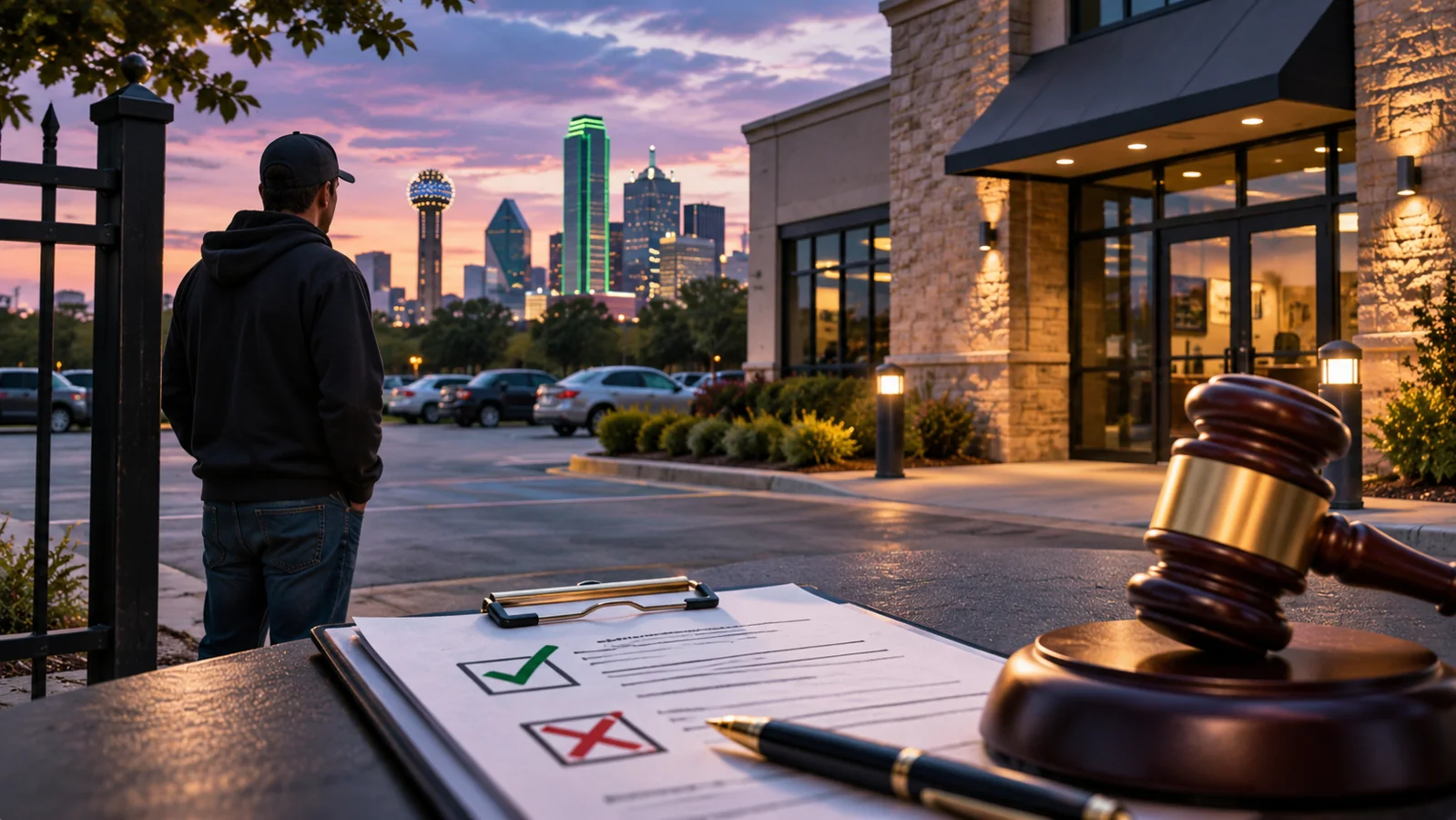
What counts as criminal trespass at a Dallas business or parking lot?
Question: What counts as criminal trespass at a Dallas business or parking lot?
Answer: Texas criminal trespass generally involves entry or remaining without effective consent after legally sufficient notice. Business access, parking-lot boundaries, and the notice given are often decisive.
Understanding the issue in Northwest Dallas
The legal analysis depends on the specific encounter, not simply on proximity to Harry Hines Boulevard, the Medical District, or Dallas Love Field. Those locations provide useful context for residents and travelers, but the incident location, arresting agency, and charge determine the relevant court process. This discussion is general Texas legal information; it cannot establish what happened in any particular case.
The basic legal elements of criminal trespass
Texas Penal Code § 30.05 generally addresses entering or remaining on another's property without effective consent after receiving notice that entry is forbidden or notice to depart and failing to do so. The legal meaning of entry, notice, and property can be important. A dispute with an employee or the fact that police were called does not by itself establish every element. The state must prove the particular charge, and the defense should examine exactly what notice was given and by whom.
A business open to customers can still revoke permission
A retail store, restaurant, or office may invite the public onto certain areas during business hours. That invitation is not unlimited. An authorized representative may tell a visitor to leave, subject to applicable law and the facts. Whether the person heard, understood, and had an opportunity to comply may matter. A customer's belief that a complaint is unfair does not necessarily create a right to remain. At the same time, an accusation should be tested against the actual notice and conduct.
Parking lots raise questions about boundaries and control
A parking lot may be privately owned, shared by several tenants, or connected to areas with different access rules. A posted restriction might apply to one section but not another. The defense may need photographs of entrances, signs, barriers, and property lines. The authority of the person issuing notice can also be relevant. Do not assume that a lot is public property because cars can enter it, or that every adjacent parcel is covered by the same warning.
What counts as legally sufficient notice?
Section 30.05 recognizes different methods of notice under specified circumstances, including oral or written communication and certain signs or markings. Which method applies depends on the property and statutory requirements. The size, placement, visibility, and wording of a sign may be important. If notice was oral, video, witness accounts, and the sequence of events can matter. A lawyer should compare the allegation with the precise statutory notice provision rather than relying on a generic description.
Leaving promptly and returning later are different issues
A person who is asked to depart may have a different legal situation from someone who knowingly returns after receiving a valid trespass warning. Timing matters: did the person begin leaving, ask for transportation, or remain for another reason? Were police present before the request? Was a prior warning documented and still applicable? The defense should reconstruct the sequence rather than treating every encounter as identical. A previous warning is not a substitute for proving the elements of the charged event.
Evidence worth preserving
Security-camera recordings, body-camera footage, receipts, parking records, signs, property maps, and witness accounts may be relevant. Some commercial video is overwritten quickly, so preservation requests may be time-sensitive. Do not enter property against instructions to collect evidence yourself. A lawyer can consider lawful methods of obtaining records and identifying who had authority to restrict access. Any audio or video should be preserved in its original form without editing or selective deletion.
Charge severity depends on particular circumstances
Criminal trespass punishment can vary based on the location, type of property, and statutory enhancements. It is unsafe to assume every accusation carries the same classification. The precise charging instrument and version of Texas Penal Code § 30.05 applicable to the alleged date should be reviewed. The presence of another alleged offense may also change the overall case. A defense lawyer should distinguish the trespass charge itself from unrelated allegations or civil property disputes.
Harry Hines business corridor context
Harry Hines Boulevard and nearby commercial areas contain retail properties, offices, medical facilities, and parking areas with different access arrangements. The fact that an incident occurred near Dallas Love Field or the Medical District does not determine court venue by itself. Preserve notices and court paperwork, and comply with any order to stay away while legal questions are addressed. The Piri Law Firm's Northwest Dallas office is a local contact point for reviewing the facts and available defenses.
Related legal resources
For background, see The Piri Law Firm’s criminal defense overview, its related practice information, and the Northwest Dallas / Harry Hines office page. These links are informational and do not substitute for an assessment of the charging document and evidence.
Frequently asked questions
Can I be trespassed from a store that is open to the public?
Potentially. Public access does not necessarily prevent an authorized person from withdrawing permission to remain.
Is a verbal warning enough?
Oral communication can qualify as notice in appropriate circumstances; the exact facts and statute matter.
Does a parking lot count as private property?
It can. Ownership, boundaries, consent, and notice should be examined.
What if I was already leaving?
The timing and evidence of compliance may matter to whether the charged elements are met.
Should I return to photograph the signs?
Do not violate a warning or order. Discuss lawful evidence preservation with counsel.
This article is general Texas legal information, not individualized advice. Laws, procedures, and interpretations may change. Attorney review, statutory verification, and editorial approval are required before publication.