Should you talk to the insurance adjuster after an accident?
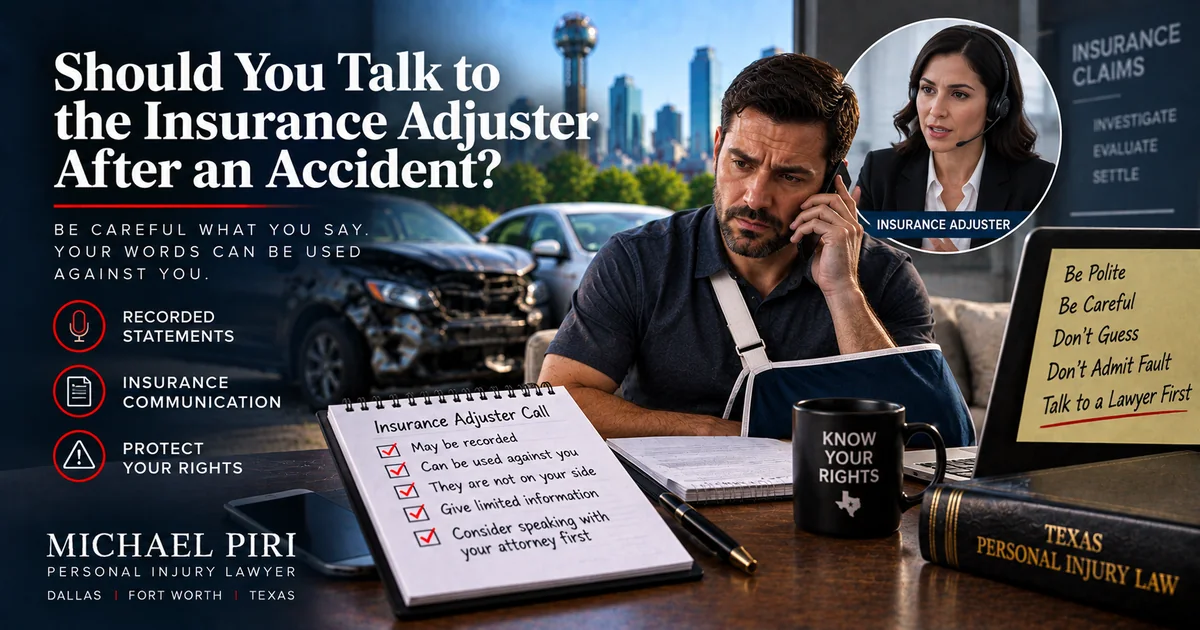
You may need to communicate with insurers after an accident, but you should be careful about detailed or recorded statements—particularly to the other party’s insurer. Provide accurate information and comply with legitimate obligations under your own policy, but avoid guessing about fault, minimizing injuries, or agreeing to a settlement before you understand the accident, your medical condition and the available coverage.
What Does an Insurance Adjuster Do?
An adjuster investigates a claim on behalf of an insurance company. The adjuster may gather statements, review records, examine property damage, evaluate liability and determine the insurer’s position concerning payment.
The adjuster is not your attorney and does not represent your legal interests.
Is Reporting an Accident the Same as Giving a Recorded Statement?
No. Reporting basic information about a collision is different from participating in a detailed recorded interview about how the accident happened, your medical history, symptoms and damages.
Your own policy may contain notice and cooperation requirements. An adverse insurer occupies a different position because it is evaluating a claim being asserted against its insured.
Why Can Recorded Statements Matter?
A recorded statement preserves exactly what was said. Problems can arise when a person is asked to estimate speed, distance or timing without knowing the answer, or when someone describes an injury as minor before the medical condition has been fully evaluated.
The safest approach is accuracy. If you do not know something, do not guess.
Should You Discuss Your Injuries Immediately?
You can truthfully report known injuries, but avoid making medical predictions. Some conditions become clearer only after evaluation, diagnostic testing or follow-up treatment.
Statements such as “I’m fine” can later create unnecessary disputes if significant symptoms emerge.
Should You Sign a Medical Authorization?
Read any authorization carefully before signing it. Determine what records it permits the insurer to obtain, from whom and for what period.
Medical information relevant to an injury claim may be necessary, but an authorization can sometimes be broader than expected.
What If the Adjuster Offers a Quick Settlement?
A quick offer can be appealing, particularly when medical bills or vehicle expenses are accumulating. Before accepting, understand what claims the release resolves.
A settlement release can permanently end covered claims. That matters if additional treatment, lost income or other consequences have not yet been fully identified.
Can the Insurance Company Use Social Media?
Publicly available posts, photographs and videos may become relevant to disputed claims. Avoid posting inaccurate or misleading information about an accident, injuries or activities.
Do not delete existing material simply because a claim exists without first considering evidence-preservation obligations.
What Should You Keep From Insurance Communications?
- Claim numbers
- Adjuster names and contact information
- Letters and emails
- Copies of forms and authorizations
- Settlement offers
- Insurance policy documents
- Notes showing dates and subjects of important conversations
Dallas and Fort Worth Car Accident Resources
For additional information, see the firm’s Dallas car accident page and Fort Worth car accident page.
Frequently Asked Questions
Do I have to talk to the other driver’s insurance adjuster?
Your obligations to an adverse insurer are not necessarily the same as the contractual duties you may have to your own insurer. Consider the circumstances before providing a detailed or recorded statement.
Can I tell an adjuster I do not know the answer?
Yes. You should not guess about facts you do not know or remember.
Should I accept the first settlement offer?
There is no universal answer. Before accepting a settlement, understand your injuries, claimed losses, available coverage and the scope of any release.
Can an adjuster determine who was legally at fault?
An insurer can take a position concerning fault, but that position is not necessarily the final legal determination when responsibility is disputed.
Contacted by an Insurance Company After an Accident?
The Piri Law Firm can evaluate a Texas injury claim and communicate with insurers when representation is appropriate.
This material provides general information and is not legal advice. Insurance duties and coverage depend on the applicable policy and circumstances.