Who can be liable for a Texas truck accident?
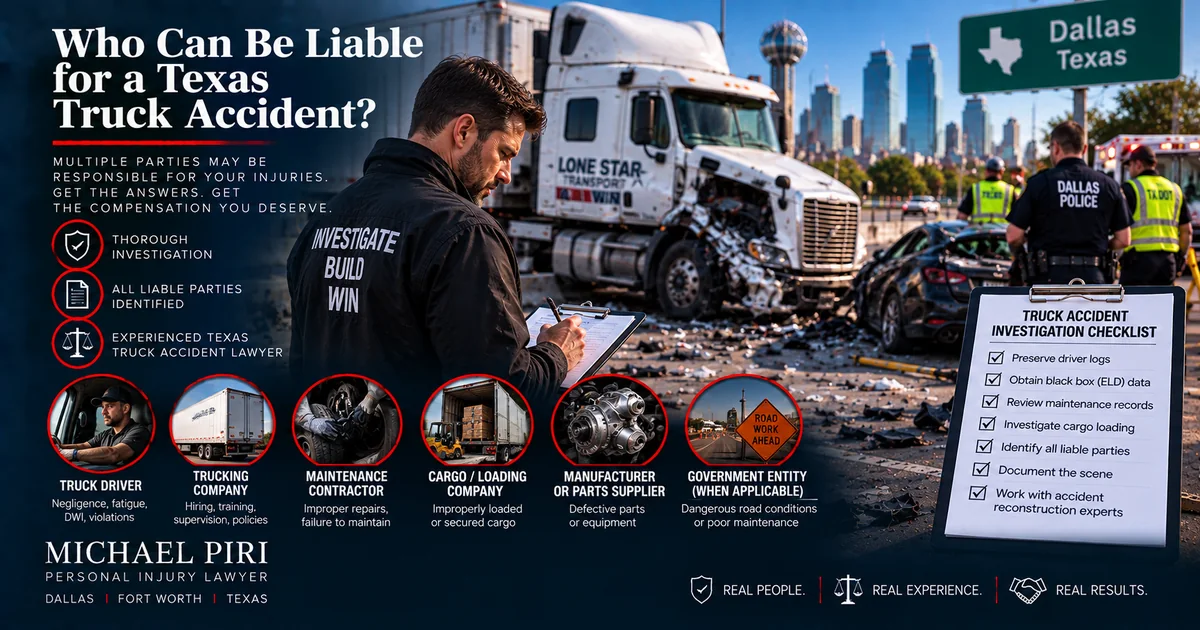
Potentially liable parties in a Texas truck accident can include the truck driver, motor carrier or employer, another motorist, and—when supported by the facts—other businesses involved in maintenance, loading, equipment or operations. Liability is not determined merely by a company’s connection to the truck; each party’s conduct and legal relationship must be investigated.
The Commercial Truck Driver
A truck driver’s conduct is often a central part of the investigation. Potential issues can include speed, following distance, lane changes, distraction, fatigue, impairment, failure to maintain control or violation of applicable safety requirements.
Whether any violation actually caused or contributed to the collision must still be established by evidence.
The Motor Carrier or Employer
A trucking company may face potential responsibility under different legal theories depending on the facts.
Issues can include whether the driver was acting within the course and scope of employment and whether the company’s own conduct contributed to the occurrence.
Company records may become important to determining the actual relationship between the driver and business.
Maintenance and Repair Providers
Mechanical problems can contribute to some commercial-vehicle crashes. Depending on the evidence, an investigation may examine brakes, tires, steering, lighting, coupling equipment and other systems.
If negligent maintenance or repair contributed to a collision, the entity responsible for that work may require further investigation.
Cargo Loading and Securement
Improperly loaded or secured cargo can affect vehicle stability and create hazards.
When cargo shift, weight distribution or securement appears relevant, records identifying who loaded, inspected or controlled the cargo may matter.
Vehicle or Component Issues
Some crashes involve allegations concerning a defective vehicle or component. Product-related claims involve distinct legal and evidentiary requirements and should not be assumed merely because a component failed.
Other Drivers
A passenger-car driver or another commercial driver can also contribute to a truck collision. A complete investigation should account for all vehicles involved rather than assuming the largest vehicle necessarily caused the accident.
Why Company Relationships Matter
Commercial transportation can involve several entities: a motor carrier, tractor owner, trailer owner, shipper, broker, contractor or other business.
The existence of multiple company names does not mean every company is liable. Contracts, operational control, employment relationships and actual conduct may need to be examined.
What Evidence Helps Identify Responsible Parties?
- Crash reports
- Driver and carrier identification
- USDOT information
- Driver logs and electronic logging data
- Dispatch and trip records
- Maintenance and inspection records
- Employment and qualification records
- Cargo documents
- Electronic vehicle data
- Video and witness evidence
For local information, see the firm’s Dallas truck accident and Fort Worth truck accident resources.
Frequently Asked Questions
Is the trucking company always liable when its truck crashes?
No. Liability depends on the driver’s relationship with the company, the applicable legal theories and evidence showing whose conduct caused or contributed to the collision.
Can more than one party be responsible?
Yes. Some collisions involve alleged conduct by multiple people or businesses. Texas proportionate-responsibility rules may become relevant.
Can a maintenance company be liable?
Potentially, when negligent maintenance or repair is supported by the evidence and is legally connected to the collision and resulting harm.
Why identify the motor carrier quickly?
Correct identification can help determine which company records, insurance policies and evidence may need to be obtained or preserved.
Multiple Parties Involved in a Texas Truck Accident?
The Piri Law Firm can investigate the driver, carrier and other entities whose conduct may be relevant to a serious commercial-truck collision.
This article provides general information and is not legal advice. Potential liability depends on the evidence, legal relationships and circumstances of each collision.