
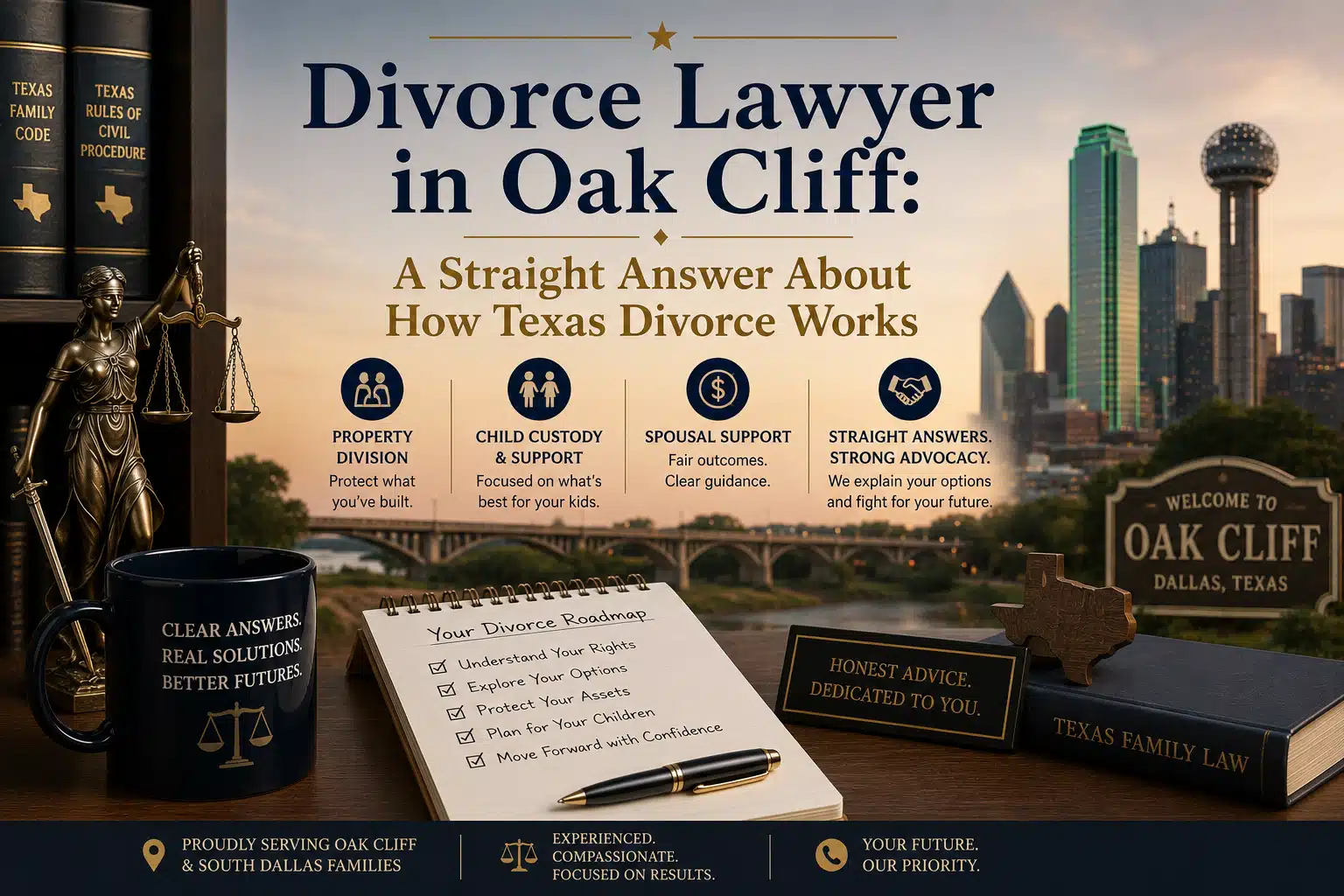
Deciding to end a marriage is hard enough without the legal process being a mystery. If you live in Oak Cliff — whether near Bishop Arts, Wynnewood, Kessler Park, or along the Hampton corridor — you don’t have to drive downtown to get real answers. The Piri Law Firm’s Oak Cliff office at 602 S Hampton Rd puts an experienced Dallas divorce team in your own neighborhood, with consultations available in Spanish and French. This guide walks through what a Texas divorce actually involves: the requirements, the timeline, the money, the kids, and the decisions that matter most.
The Basic Requirements: Who Can File and Where
To file for divorce in Dallas County, at least one spouse must have lived in Texas for the last six months and in Dallas County for the last 90 days. You do not need your spouse’s permission, you do not need to prove wrongdoing, and you do not need to be a U.S. citizen — immigration status is not a barrier to filing or finalizing a divorce in Texas.
Texas is a no-fault state: most divorces are granted on “insupportability,” meaning the marriage has become unworkable. Fault grounds — adultery, cruelty, abandonment, felony conviction — still exist and can affect how property is divided, but you are never required to prove them just to get divorced.
Once filed, Texas imposes a mandatory 60-day waiting period before a divorce can be finalized, with narrow exceptions for family violence. Sixty days is the floor, not the average: an agreed divorce might finish shortly after the waiting period, while a contested one commonly runs six months to a year or more.
Uncontested vs. Contested: The Fork in the Road
The single biggest driver of cost, time, and stress is whether you and your spouse can agree.
An uncontested divorce means agreement on everything — property, debts, and all child issues. These cases can often be handled on a flat fee, finalized shortly after the 60-day mark, and completed with one brief court appearance (a “prove-up”). If that’s your situation, our uncontested divorce lawyer team can paper the agreement correctly the first time — which matters, because a badly drafted decree causes years of enforcement problems.
A contested divorce means disagreement on at least one material issue. That triggers temporary orders, discovery, and usually court-ordered mediation before any trial. Most contested cases still settle — but on terms shaped by preparation. Our contested divorce lawyer page covers that process in depth. And many couples land in between: for spouses who disagree but want to avoid war, divorce mediation can resolve disputes at a fraction of trial cost.
We tell Oak Cliff clients honestly which lane they’re in at the first consultation — paying contested-case fees for an agreeable divorce is a waste, and treating a genuinely contested case as “simple” is worse.
Dividing Property: Community Property in Plain Terms
Texas is a community property state. In plain terms: what either spouse earned or acquired during the marriage generally belongs to both, no matter whose name is on the paycheck, title, or account. What you owned before the marriage, or received by gift or inheritance, is separate property — if you can prove it with records.
The court’s job is a “just and right” division of the community estate, which is not automatically 50/50. Judges weigh fault, earning gaps, health, and who has primary custody of the children. For many Oak Cliff families the biggest questions are concrete ones: who keeps the house near Kiest Park, how a small business or food truck gets valued, what happens to a 401(k), and who pays which debts. Each has an established legal answer, and each is negotiable with the right leverage.
One warning: debts don’t disappear at divorce. A decree can order your spouse to pay the credit card, but the card company isn’t bound by your decree — if the account has your name, protect yourself with refinancing or closure terms in the settlement.
Children: Custody and Support Inside the Divorce
If you have children, the divorce decree will include conservatorship (decision-making), a possession schedule (parenting time), and child support. Texas presumes parents should be joint managing conservators, applies a best-interest standard, and calculates support by guideline percentages of the paying parent’s net resources — 20% for one child, 25% for two, and up from there. These issues get full treatment on our child custody lawyer and child support lawyer pages; inside the divorce, the key strategic fact is that the temporary orders entered early in the case tend to become the final template. Take the first hearing seriously.
Divorce and Immigration Status: What Oak Cliff Families Ask Us Most
Oak Cliff is one of Dallas’s great immigrant neighborhoods, and no firm in the area hears these questions more than we do. The honest answers:
- You can divorce regardless of status. Courts do not report parties to immigration authorities, and status does not affect your right to property division, custody, or support.
- Conditional residents (two-year green card through marriage) can still pursue permanent residence after divorce through an I-751 waiver — but timing and evidence of the marriage’s good faith matter enormously, so the divorce should be planned with the waiver in mind.
- Pending petitions based on the marriage generally cannot survive the divorce, but other paths sometimes exist, including VAWA self-petitions for spouses who experienced abuse.
Because The Piri Law Firm runs a full immigration divorce practice alongside its family law practice, we plan both cases together — the way they actually interact — rather than sending you to a second firm mid-crisis.
What a Divorce Costs — and How to Keep It Down
Filing fees in Dallas County run a few hundred dollars (fee waivers exist for those who qualify — see TexasLawHelp.org for forms and eligibility). Attorney’s fees depend almost entirely on conflict level. Three things keep costs down more than anything else: organize your financial documents before the first meeting, keep communication with your spouse civil and off social media, and be realistic about what’s worth fighting over — spending $5,000 in fees over a $2,000 couch is a decision, not a necessity. We offer flat fees on uncontested matters and payment plans on most others, and the initial 30-minute consultation is free.
Filing in Dallas County: The Mechanics
Divorces for Oak Cliff residents are filed with the Dallas County District Clerk and assigned to one of the county’s family district courts at the George Allen Sr. Courts Building downtown. Our office handles filings electronically; you rarely need to appear except for key hearings, and virtual appointments are available if getting to our Hampton Road office is difficult.
Why Oak Cliff Families Choose The Piri Law Firm
Michael Piri is a Texas attorney practicing Family Law, Criminal Defense, Personal Injury, and Immigration — verify his licensure on his State Bar of Texas profile. He holds a J.D. from St. Mary’s University School of Law and a B.A. from the American University of Paris, and he is fluent in Spanish and French. The firm offers free 30-minute consultations, flat fees and payment plans, and 24/7 phone availability. Visit our Oak Cliff office page for directions, and read client reviews on our Google Business Profile and testimonials page.
Frequently Asked Questions
How much does a divorce cost in Oak Cliff / Dallas?
Filing fees are a few hundred dollars; attorney’s fees depend on conflict. Uncontested divorces can often be handled on a flat fee, while contested cases cost more. The Piri Law Firm offers payment plans and a free first consultation.
How long does a divorce take in Texas?
At least 60 days by law. Agreed divorces often finish shortly after that; contested cases typically run six months to a year or longer.
Can I get divorced in Texas if I’m undocumented?
Yes. Immigration status does not affect your right to file for divorce, divide property, or seek custody and support, and family courts do not report parties to immigration authorities.
Do I have to prove my spouse did something wrong?
No. Texas allows no-fault divorce based on insupportability. Fault grounds like adultery exist but are optional, used mainly to argue for a larger share of property.
My spouse won’t sign — can they stop the divorce?
No. A spouse can slow a divorce down by contesting issues, but no one can be forced to stay married in Texas. The case simply proceeds as a contested divorce.
The Piri Law Firm — Oak Cliff Office
602 S Hampton Rd, Dallas, TX 75208 · (833) 600-0029 · Free 30-minute consultation, 24/7 · Nosotros hablamos español
Contact us | Find us on Google
This article is for general information only and is not legal advice. Reading it does not create an attorney-client relationship.