
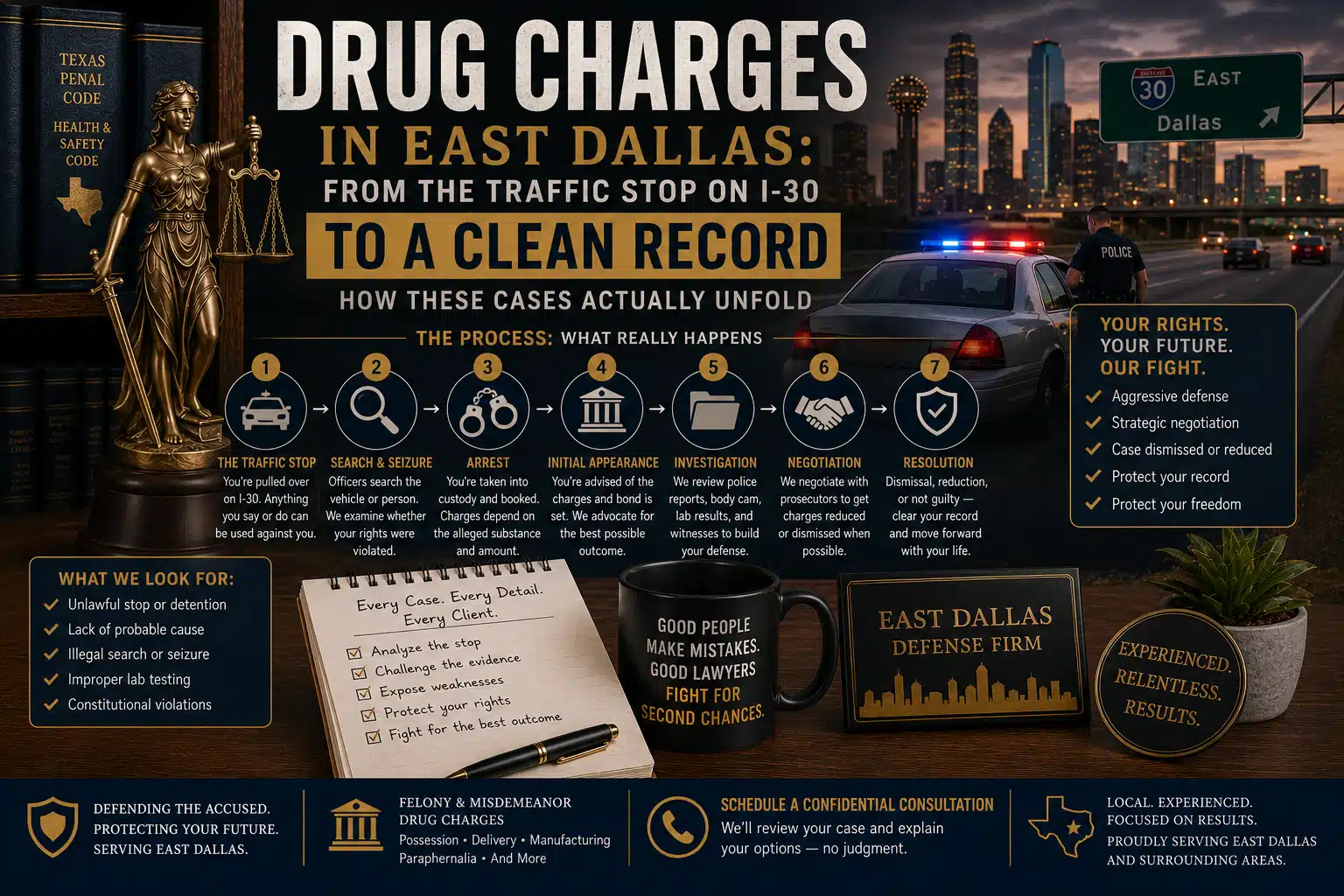
Most East Dallas drug cases don’t begin with a drug investigation. They begin with a taillight on Buckner Boulevard, a lane change on I-30, an expired registration on Garland Road — and end forty minutes later with a search, a field test, and a booking at Lew Sterrett. What happens between the flashing lights and the final disposition is a sequence of legal checkpoints, and the state has to clear every one of them. A drug possession defense lawyer at The Piri Law Firm’s East Dallas office at 8021 I-30 Frontage Rd — sitting directly on the corridor where many of these arrests happen — walks through that sequence in every case, because somewhere in it is usually the case’s weak point.
First, Know What You’re Charged With: The Penalty Group Ladder
Texas grades drug offenses under the Controlled Substances Act, Health & Safety Code Chapter 481, by substance category and weight. The short version:
- Marijuana (plant form): under 2 ounces, Class B misdemeanor; 2–4 ounces, Class A; over 4 ounces, felony territory.
- THC concentrates — vapes, wax, edibles: Penalty Group 2, a felony at any amount. The cartridge that would be a citation in half the country is a state jail felony in Texas, and the weight counts the whole gummy or cartridge fluid, not just the THC. This single rule generates more shocked phone calls to our I-30 office than any other in the drug code.
- Penalty Group 1 — cocaine, meth, heroin, most opioids: under 1 gram, state jail felony (180 days–2 years); 1–4 grams, third-degree felony; 4–200 grams, second-degree. Fentanyl carries its own enhanced treatment.
- Penalty Groups 3 and 4 — Xanax, Valium, and other prescription drugs without a valid prescription: typically Class A misdemeanors at low amounts, felonies above.
Add-ons change everything: baggies, scales, cash, or texts can convert simple possession into possession with intent to deliver; a school zone enhances the range; and a firearm in the car creates both an enhancement and a separate federal exposure. Getting the charge accurately assessed — not just accepting the booking sheet — is step one.
Checkpoint One: Was the Stop Legal?
Police need reasonable suspicion of a traffic violation or crime to pull you over, and the stated reason is checkable against dash and body camera video. More important for the I-30 corridor: under U.S. Supreme Court precedent, an officer cannot prolong a completed traffic stop to wait for a drug dog or fish for consent without new, articulable suspicion. The stop that “should have been a warning” but stretched twenty minutes while a K-9 unit drove over is a suppression motion waiting to be filed. When the stop falls, everything found afterward falls with it — and the case usually dies on the spot.
Checkpoint Two: Was the Search Legal?
Most East Dallas possession cases rest on one of four search theories, each attackable:
- Consent — must be voluntary, and “consent” given at midnight with three squad cars behind you is litigable. You are never required to consent, and refusing is not evidence of guilt.
- Probable cause / odor — claimed smells and plain-view assertions get tested against the video.
- Search incident to arrest and inventory searches — both have scope limits officers routinely exceed.
- Warrants — reviewed for probable cause, particularity, and execution.
Passengers and shared spaces raise a separate defense entirely: Texas requires affirmative links proving you knowingly possessed the substance — proximity alone is not enough. The passenger in a borrowed car, the roommate whose guest left a bag, the driver who didn’t know what was in the trunk all have genuine, frequently winning defenses.
Checkpoint Three: Is the Evidence What They Say It Is?
Roadside field tests are presumptive and notoriously error-prone — they have flagged everything from candy to vitamins. The state must produce a lab analysis confirming substance and weight, and the lab’s methodology, calibration, chain of custody, and analyst credentials are all discoverable and challengeable. Weight matters enormously at the penalty-group thresholds: a lab weight that drops a case below a gram, or a mixture argument on an edible, can change the offense level outright. We do not discuss pleas until the lab file is in hand.
Protecting Your Future: Diversion, Deferred, and the Sealing Hierarchy
For most East Dallas clients the real question isn’t the maximum sentence — it’s what an employer, landlord, or licensing board will see in five years. Dallas County offers meaningful off-ramps, and eligibility windows close early, which is why positioning starts at the first setting:
- Suppression or dismissal → full expunction; the arrest is erased and you may legally deny it.
- Pretrial diversion / specialty court programs → dismissal on completion, often with treatment components that judges and prosecutors respect.
- Deferred adjudication → no final conviction if completed, and many drug offenses later qualify for an order of nondisclosure sealing the record from most private background checks.
- Conviction — sometimes probated, sometimes not, and permanent.
Which rung is realistic depends on the charge, your history, the strength of the suppression issues — and, critically, your immigration status, because the rungs are not equally safe for non-citizens. Our criminal defense FAQs explain how expunction and nondisclosure differ, and our criminal defense attorney team maps the options at the free first consultation.
The Non-Citizen Warning That Belongs in Bold
Under federal immigration law, a conviction for virtually any controlled substance offense — including some dispositions Texas doesn’t call convictions, like certain deferred adjudications — triggers deportability and inadmissibility, with only one narrow exception (a single offense of simple possession of 30 grams or less of marijuana). A lawful permanent resident who pleads to a “minor” possession case to get out of jail can trade a misdemeanor for removal proceedings; a visa or green card applicant can become permanently inadmissible. East Dallas is one of the most immigrant-rich corridors in the county, and this is the conversation we have daily: no plea before a crimmigration review. The Piri Law Firm’s crimmigration practice vets every offer against the client’s immigration file, and where an arrest has already produced an ICE hold, the criminal and immigration defenses run in parallel. Consultations in Spanish and French.
What to Do in the First Week
- Say nothing about the facts — not to police, not on recorded jail calls, not by text. “It was just a cart” is a confession with a felony attached.
- Refuse further searches of phones, cars, and homes; make the state get warrants.
- Write down the stop while it’s fresh — the stated reason, the timeline, when the dog arrived, what was said about consent.
- Gather prescription records if the charge involves medication.
- Get counsel before the first setting at the Frank Crowley Courts Building; diversion eligibility and early suppression leverage are both time-sensitive. General court information is available through the Dallas County District Clerk, and free legal-information resources at TexasLawHelp.org — but a felony drug file is not a self-help project.
Why East Dallas Calls The Piri Law Firm
Michael Piri is a Texas attorney practicing Criminal Defense, Family Law, Personal Injury, and Immigration — verify his licensure on his State Bar of Texas profile. He earned his J.D. from St. Mary’s University School of Law, is fluent in Spanish and French, and built the firm to defend working families on the criminal and immigration fronts simultaneously. Free 30-minute consultations, flat fees and payment plans, 24/7 availability. Visit our East Dallas office page for directions, and read client reviews on our Google Business Profile.
Frequently Asked Questions
Is a vape pen with THC really a felony in Texas?
Yes. THC concentrates fall under Penalty Group 2, making possession a felony at any amount — even though plant marijuana under two ounces is only a Class B misdemeanor.
The police searched my car after a traffic stop. Was that legal?
It depends on the basis — consent, probable cause, or a warrant — and on whether the stop was unlawfully prolonged. Illegal stops and searches lead to suppression, which usually ends the case. Never assume the search was valid until the video has been reviewed.
The drugs belonged to someone else in the car. Am I still guilty?
Not automatically. Texas requires affirmative links proving you knowingly possessed the substance; mere presence isn’t enough. Passenger and shared-space cases are among the most defensible drug charges.
Can a first-time drug charge stay off my record in Dallas County?
Often yes — through suppression and dismissal (expunction), pretrial diversion (dismissal on completion), or deferred adjudication followed by nondisclosure. Eligibility is time-sensitive, so early counsel matters.
Will a drug case affect my green card or visa?
Almost any controlled substance conviction creates deportability or inadmissibility, and some deferred dispositions still count as convictions federally. Non-citizens should never plead without a crimmigration review.
The Piri Law Firm — East Dallas Office
8021 I-30 Frontage Rd, Dallas, TX 75228 · (833) 600-0029 · Free 30-minute consultation, 24/7 · Nosotros hablamos español
Contact us | Find us on Google
This article is for general information only and is not legal advice. Reading it does not create an attorney-client relationship.