Fort Worth builds its DWI docket the same way every night: stops along I-35W and the South Freeway, the bar corridors on West 7th and Magnolia, the late drive home through Seminary or Hemphill. What happens after the stop follows a script — booking, magistration, a suspension notice, a court date at the Tim Curry Criminal Justice Center — and every page of that script can be contested. A DWI defense lawyer at The Piri Law Firm’s Fort Worth office at 4200 South Fwy, Suite 1313 — minutes from where many of these arrests happen — explains what you’re facing in Tarrant County, why the stakes multiply with each prior, and where these cases actually get won.
The Charge and the Ladder: First, Second, Third
Under Texas Penal Code § 49.04, DWI means operating a vehicle in a public place while intoxicated — a 0.08 blood or breath alcohol concentration, or loss of normal mental or physical faculties from alcohol, drugs, or both. Prescription medication counts. Marijuana counts. And because the “normal faculties” prong exists, the state can prosecute below 0.08 — while a number above 0.08 remains attackable.
The ladder in Tarrant County:
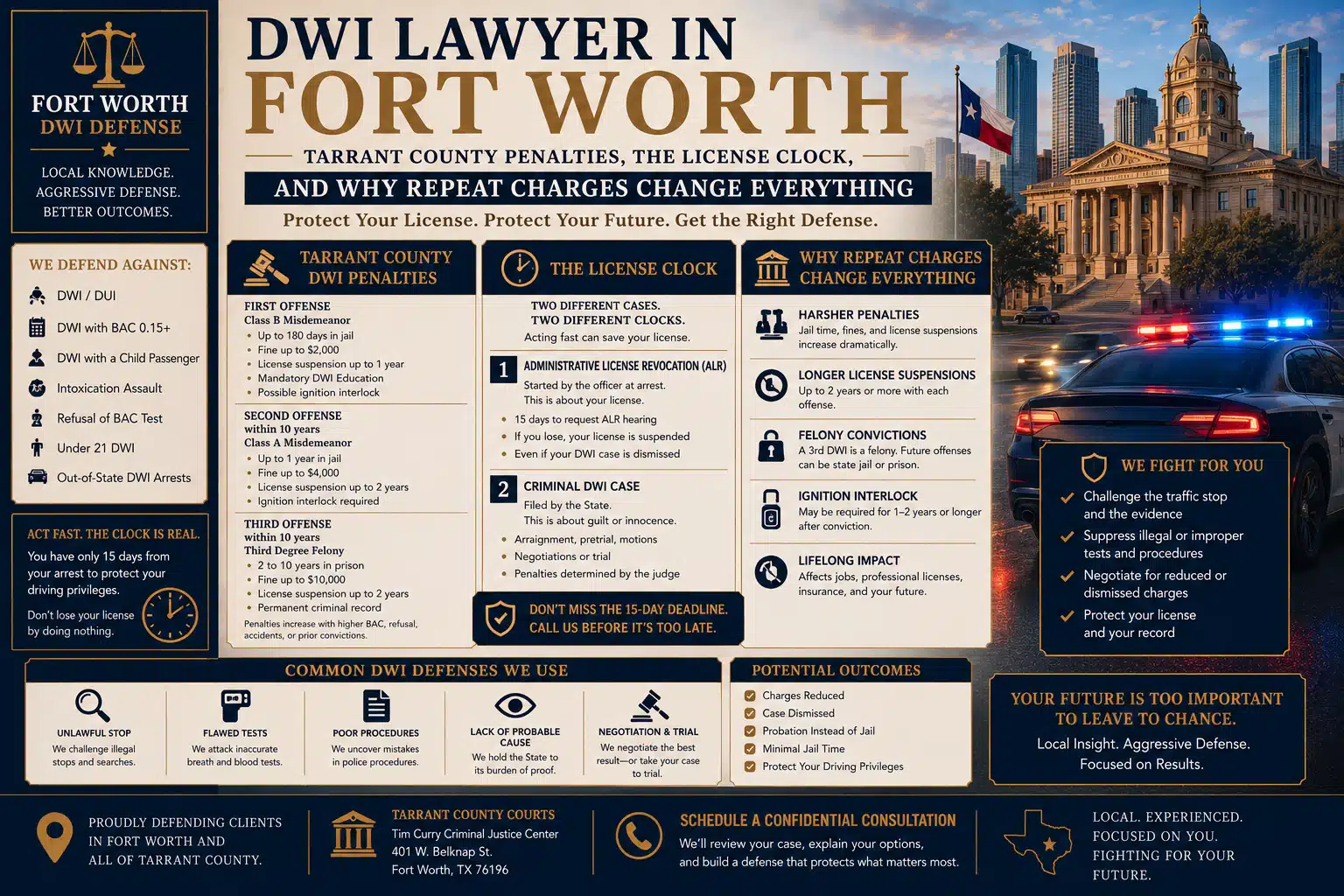
- First offense — Class B misdemeanor: 72 hours to 180 days, up to $2,000, license suspension up to a year, plus the state fine on conviction. At 0.15 or above, Class A: up to a year, larger fines, near-certain interlock.
- Second offense — Class A misdemeanor with a 30-day minimum, up to a year, up to $4,000, longer suspension, mandatory interlock — and prosecutors who negotiate very differently than they did the first time.
- Third offense — third-degree felony: 2 to 10 years in prison, up to $10,000, and a case heard in district court with a grand jury indictment. There is no “old prior” safe harbor: Texas DWI enhancement has no washout period, so a conviction from fifteen years ago still counts.
- Aggravators at any level — a child under 15 in the car (state jail felony), a crash with serious injury (intoxication assault, third-degree felony) or death (intoxication manslaughter, second-degree felony).
The repeat-offense math is the part Fort Worth clients most often underestimate. A second DWI is not “the same thing again with a bigger fine” — it’s mandatory jail exposure, interlock, and a prosecutor’s office with a policy posture. A third is a felony that threatens prison, gun rights, and — for non-citizens — immigration status. If you have any prior, the time for aggressive defense is now, not at the third arrest.
The 15-Day License Deadline Runs on Its Own Clock
Separate from the criminal case, the Texas Department of Public Safety moves to suspend your license the moment you fail or refuse testing. You have 15 days from the notice of suspension — typically served at arrest — to request an ALR hearing. Requesting it freezes the suspension until the hearing and creates the case’s first battlefield: the arresting officer can be subpoenaed and cross-examined under oath long before the criminal case matures, and that locked-in testimony is frequently the most valuable discovery in the file. Miss the deadline and suspension begins automatically around day 40 — 90 days for a first failure, 180 for a first refusal, longer with priors. If suspension lands anyway, an occupational license keeps most clients driving to work, school, and essential duties — vital in a county where almost nobody’s job survives without a truck.
Where Tarrant County DWI Cases Are Won
Every DWI is a chain — stop, roadside investigation, arrest, test — and the defense tests every link:
The stop. Reasonable suspicion is required and checkable: dash and body camera footage from Fort Worth PD and Tarrant County agencies regularly tells a different story than the offense report, and a bad stop suppresses everything after it.
The field tests. The three standardized exercises are validated only under NHTSA protocol, and protocol breaks constantly — instructions rushed, surfaces uneven, medical conditions ignored. An officer’s “six clues” often dissolves under frame-by-frame review.
The breath or blood result. Breath machines demand calibration records and observation periods; rising-BAC timing means your level at testing can exceed your level while driving. Blood cases hinge on warrant validity, chain of custody, and lab work — all discoverable, all challengeable.
The negotiation. Outcomes in defensible Tarrant County cases range from dismissal and acquittal to reductions (obstruction of a highway being the classic) to probation and — for many first offenses — deferred adjudication, which avoids a final conviction and can lead to an order of nondisclosure sealing the record. A DWI conviction, by contrast, can never be expunged in Texas. The gap between those two endings is the whole game, and it’s decided by preparation: we pull the video and the lab file in every case before any plea conversation. Process questions — court settings, timelines, discovery — are covered in our criminal defense FAQs.
DWI and Immigration in Tarrant County: The Second Case Inside the First
The South Freeway corridor is the heart of immigrant Fort Worth, and no DWI conversation at our office skips this: for non-citizens, the criminal case is only half the exposure. A simple first DWI is generally not deportable by itself — but it influences ICE detention decisions and immigration bond, weighs against discretionary relief like DACA and cancellation of removal, and turns dangerous fast with drugs, a child passenger, or priors. Worse, a routine Tarrant County jail booking can trigger an immigration hold before the criminal case even begins. The Piri Law Firm’s crimmigration practice reviews every plea against the client’s immigration file, and when a DWI arrest produces an ICE hold, the criminal defense and the immigration defense run as one strategy — which is precisely why the firm exists. Our criminal defense attorney team builds both files together. Consultations in Spanish and French.
Your First-Week Checklist
- Calendar day 15 for the ALR request — it’s the only deadline that expires this month.
- Write everything down: where you were stopped, what was said, which tests were run, timeline to the test.
- Preserve the evening — receipts, texts, companions who can testify to what you actually drank.
- Go silent about the facts — recorded jail calls and social media posts surface in Tarrant County courtrooms weekly.
- Obey every bond condition — interlock, no-alcohol terms — to the letter; violations re-jail you and harden the court.
- Don’t assume a failed test ends it. Test cases are litigated and won in Fort Worth constantly; nobody should plead before the video and lab records are reviewed. Court records are available through the Tarrant County District Clerk, and general legal information at TexasLawHelp.org.
Why Fort Worth Calls The Piri Law Firm
Michael Piri is a Texas attorney practicing Criminal Defense, Family Law, Personal Injury, and Immigration — verify his licensure on his State Bar of Texas profile. He earned his J.D. from St. Mary’s University School of Law, is fluent in Spanish and French, and defends Tarrant County clients on the criminal and immigration fronts simultaneously. Free 30-minute consultations, flat fees and payment plans, 24/7 availability — because DWI arrests happen at 2 a.m., not 2 p.m. Visit our Fort Worth office page for directions, and read client reviews on our Google Business Profile.
Frequently Asked Questions
Will I lose my license after a Fort Worth DWI arrest?
Not automatically — you have 15 days from the suspension notice to request an ALR hearing, which pauses the suspension. If suspension ultimately occurs, an occupational license usually keeps you driving for work and essentials.
How long do prior DWIs count against me in Texas?
Forever. Texas has no washout period for DWI enhancement — a conviction from decades ago still elevates a new charge, which is why a “second” offense is often really a felony-track warning.
Can a Tarrant County DWI be dismissed or reduced?
Yes — bad stops, flawed field testing, and unreliable breath or blood evidence produce dismissals, and reductions like obstruction of a highway are negotiated regularly. No lawyer can promise it; no one should plead before the evidence is reviewed.
Is deferred adjudication available for DWI in Texas?
For many first offenses, yes (generally not at 0.15+ or with a commercial license). Completed deferred avoids a final conviction and can lead to sealing — a conviction, by contrast, can never be expunged.
Will a DWI get me deported?
A simple first DWI alone generally isn’t a deportable offense, but it affects detention, bond, and discretionary benefits, and aggravated or repeat cases are far more dangerous. Non-citizens should never plead without a crimmigration review.
The Piri Law Firm — Fort Worth Office
4200 South Fwy, Suite 1313, Fort Worth, TX 76115 · (833) 600-0029 · Free 30-minute consultation, 24/7 · Nosotros hablamos español
Contact us | Find us on Google
This article is for general information only and is not legal advice. Reading it does not create an attorney-client relationship.