Hearing an immigration judge say that your application has been denied—or that you have been ordered removed from the United States—can feel final.
It may not be.
Depending on the type of decision, the procedural history of the case, and whether appeal rights were preserved, several options may still be available.
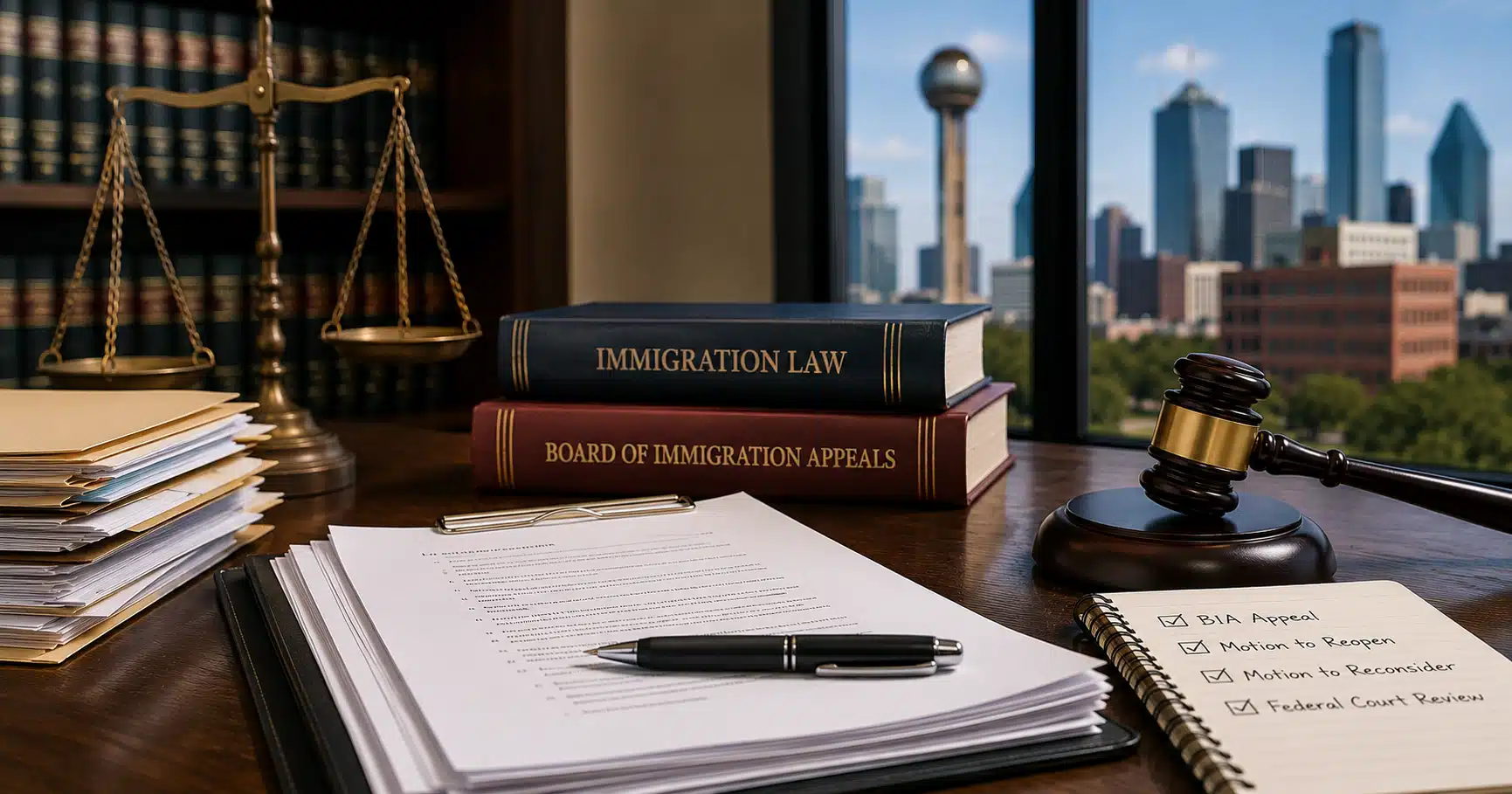
Those options can include an appeal to the Board of Immigration Appeals (BIA), a motion to reopen the immigration proceedings, a motion asking the judge or Board to reconsider a legal error, or eventually a petition asking a federal court of appeals to review a qualifying final removal order.
The critical issue is timing.
For many direct appeals from an immigration judge, the Notice of Appeal must be received by the BIA within 30 calendar days.
If an immigration judge has recently denied your case, a Dallas-Fort Worth BIA appeals attorney can evaluate the ruling and determine which appellate or post-decision options may apply.
Quick Answer: What Can You Do After an Immigration Judge Denies Your Case?
Depending on the circumstances, the main options may include:
- Appealing the immigration judge’s decision to the BIA
- Filing a motion to reconsider
- Filing a motion to reopen based on qualifying new facts or evidence
- Asking for a stay of removal when necessary and legally available
- Seeking federal court review after a qualifying final BIA decision
These remedies are not interchangeable.
The correct choice depends on why the case was denied and what has happened since the immigration judge ruled.
Option 1: Appeal the Immigration Judge’s Decision to the BIA
For many immigration court decisions, the first appellate step is the Board of Immigration Appeals.
The BIA is the administrative appellate body within the Executive Office for Immigration Review.
A BIA appeal generally asks the Board to review whether the immigration judge committed an error in deciding the case.
Potential appellate issues may involve:
- Incorrect interpretation of immigration law
- Application of the wrong legal standard
- Clearly erroneous factual findings
- Credibility determinations
- Treatment of evidence
- Failure to consider an important argument
- Procedural errors
- Incorrect application of controlling precedent
A BIA appeal is not simply a request for a second immigration judge to hear the entire case again.
The focus is primarily on the existing immigration court record and whether the judge made a reviewable error.
For a detailed overview, read BIA Appeals in Dallas: How to Appeal an Immigration Judge’s Decision.
How Long Do You Have to Appeal?
The general deadline for many appeals from an immigration judge is 30 calendar days.
The deadline is particularly strict because the Notice of Appeal generally must be received by the Board within the applicable period.
Merely mailing the appeal before the deadline is not enough if it arrives late.
This is why an immigration judge’s decision should be reviewed as soon as possible.
Read our separate guide to the BIA 30-day appeal deadline for more information.
What Form Starts the BIA Appeal?
An appeal from an immigration judge generally begins with:
Form EOIR-26 — Notice of Appeal from a Decision of an Immigration Judge
The form requires more than basic identifying information.
The appellant must explain the reasons for challenging the immigration judge’s decision.
That makes the Notice of Appeal strategically important.
An attorney may need to evaluate the underlying decision before completing the form so that important appellate issues are properly identified.
What If the Immigration Judge Denied Asylum?
An asylum denial may be appealable to the BIA.
Potential issues can involve:
- Adverse credibility findings
- Whether past persecution was established
- Fear of future persecution
- Nexus to a protected ground
- Particular social group analysis
- Government inability or unwillingness to protect
- Internal relocation
- Changed circumstances
- Withholding of removal
- Convention Against Torture protection
The proper appellate argument depends on what the immigration judge actually decided.
For example, if the judge denied asylum because of an adverse credibility finding, the appeal may focus heavily on whether that finding was adequately supported by the record.
If the judge accepted the testimony but concluded that the harm did not legally qualify as persecution, the appeal may raise a different type of legal question.
What If Cancellation of Removal Was Denied?
Cancellation of removal cases can involve both legal and factual issues.
Depending on the type of cancellation sought, disputes may involve:
- Continuous physical presence
- Good moral character
- Criminal history
- Qualifying relatives
- Exceptional and extremely unusual hardship
- Statutory eligibility
- Discretion
Some aspects of cancellation cases can present complicated limits on judicial review.
That makes it particularly important to identify the precise basis for the immigration judge’s denial before deciding how to proceed.
What If the Immigration Judge Ordered You Removed?
If the judge denied relief and entered an order of removal, preserving appeal rights can become urgent.
When a qualifying direct appeal is timely filed, the removal order is generally stayed while the BIA reviews the merits appeal.
However, stay rules differ depending on the type of proceeding.
Read Can You Stay in the United States While a BIA Appeal Is Pending? for a detailed explanation.
What If You Waived Your Right to Appeal?
At the end of an immigration court hearing, the immigration judge may ask whether the parties reserve or waive appeal.
If you reserve appeal, you preserve the opportunity to pursue BIA review within the applicable deadline.
If you knowingly and validly waive appeal, the judge’s decision can become final much sooner.
Questions sometimes arise about whether a waiver was actually knowing and voluntary.
For example:
- Was interpretation adequate?
- Did the person understand what “waive appeal” meant?
- Was there confusion about the consequences?
- Was counsel ineffective?
- Did another procedural problem affect the waiver?
Those situations require individualized legal analysis.
Do not assume that a purported waiver automatically means there is nothing left to examine.
Option 2: File a Motion to Reconsider
A motion to reconsider is different from an appeal.
It generally argues that the previous decision contained an error of law or fact based on the existing record.
In other words, the argument is essentially:
The decision-maker should reconsider the ruling because the decision itself was legally or factually wrong.
A motion to reconsider ordinarily does not depend on presenting newly discovered evidence.
Instead, it focuses on alleged errors in the prior decision.
When filed with the BIA after a BIA decision, a motion to reconsider is generally subject to a 30-day deadline.
Strict numerical limitations can also apply.
Option 3: File a Motion to Reopen
A motion to reopen serves a different purpose.
Rather than arguing only that the previous decision was wrong, a motion to reopen generally asks for proceedings to be reopened so that qualifying new facts or evidence can be considered.
The motion ordinarily must be supported by evidence showing what has changed or what newly available information warrants reopening.
Examples can include situations involving:
- Material new evidence
- Changed country conditions
- New eligibility for immigration relief
- Previously unavailable evidence
- Certain ineffective-assistance claims
- Certain in absentia removal orders
- Other circumstances recognized by immigration law
For many motions to reopen after a final administrative decision, the general deadline is 90 days, subject to important statutory and regulatory exceptions.
Appeal vs. Motion to Reopen: What Is the Difference?
This distinction is crucial.
A BIA appeal generally asks:
Was the immigration judge’s decision wrong based on the record and law at the time?
A motion to reopen generally asks:
Should the case be reopened because qualifying new facts or evidence now need to be considered?
A motion to reconsider generally asks:
Did the prior decision contain a legal or factual error that should be corrected?
Sometimes a case may involve more than one potential procedural option.
The appropriate strategy depends on the facts, deadlines, and jurisdiction.
Does Filing a Motion to Reopen Automatically Stop Deportation?
Generally, no.
A person should not assume that filing a motion to reopen automatically prevents ICE from executing an already final removal order.
A discretionary stay of removal may need to be requested where legally available.
A 2026 BIA precedent decision confirms that someone with a pending motion to reopen or reconsider may seek a discretionary stay from the adjudicative body with jurisdiction over the motion, and DHS separately has authority over execution of removal orders.
There are specific exceptions, including certain motions to reopen in absentia removal orders.
Because stay rules are highly procedural, anyone facing imminent removal should obtain case-specific legal advice immediately.
What If You Missed Your Immigration Court Hearing?
If you failed to appear and the immigration judge entered an in absentia removal order, different rules may apply.
A motion to reopen may be possible depending on circumstances such as:
- Lack of proper notice
- Exceptional circumstances
- Custody or detention that prevented attendance
- Other legally recognized grounds
In absentia cases are procedurally distinct from ordinary appeals after a fully litigated merits hearing.
They should be analyzed under the specific rules governing reopening of in absentia orders.
What If You Have New Evidence After the Judge’s Decision?
New evidence generally does not simply turn a BIA appeal into another trial.
The BIA ordinarily reviews the record that existed before the immigration judge.
If genuinely material new evidence arises, a motion to reopen may be the more appropriate procedural mechanism.
Examples might include:
- Newly available medical evidence
- Material changes in conditions in the home country
- Previously unavailable records
- A major change in the person’s immigration circumstances
- Newly discovered evidence affecting the original case
The evidence must meet the applicable legal requirements.
Not every new document is sufficient to justify reopening.
What If Your Former Attorney Made Serious Mistakes?
Ineffective assistance of prior counsel can sometimes provide a basis for post-decision relief.
These cases can be complicated.
Immigration law imposes procedural requirements for many ineffective-assistance claims, and the person may need to show both that counsel’s performance was deficient and that the problem mattered to the outcome.
Potential issues might include:
- Failure to file a timely appeal
- Failure to submit critical evidence
- Missing a hearing
- Failing to advise the client about appeal rights
- Filing materially defective applications
- Failing to present available legal arguments
Because these claims can involve strict procedural requirements, they should be evaluated quickly.
Option 4: Federal Court Review
If the BIA issues a final decision dismissing a qualifying appeal, another possible step may be a petition for review in the appropriate U.S. Court of Appeals.
For immigration proceedings completed in Texas, that will commonly be the U.S. Court of Appeals for the Fifth Circuit.
Federal court review is different from a BIA appeal.
The federal court reviews legal issues within the jurisdiction Congress has given it.
The court does not simply conduct another immigration hearing.
How Long Do You Have to File a Federal Petition for Review?
Federal law states that a petition for review of a final removal order must generally be filed not later than 30 days after the date of the final order of removal.
That is another short deadline.
Waiting to evaluate federal review until weeks after the BIA decision can be dangerous.
Does Filing a Petition for Review Automatically Stop Removal?
No.
Federal law specifically provides that filing and serving a petition for review does not automatically stay removal unless the court orders otherwise.
If removal is imminent, counsel may need to evaluate whether a separate motion for stay should be filed with the court.
This is one of the major differences between many direct BIA merits appeals and federal petitions for review.
What Can the Fifth Circuit Review?
Federal judicial review can involve complicated jurisdictional questions.
Depending on the case, issues may include:
- Statutory interpretation
- Constitutional claims
- Questions of law
- Whether the BIA applied the proper legal standard
- Certain procedural questions
- Whether substantial evidence supports particular agency findings
Congress limits federal court review of some categories of immigration decisions.
That means not every argument that could be made to the BIA can necessarily be presented to the Fifth Circuit in the same manner.
Proper issue preservation before the immigration judge and BIA can also become extremely important.
Why the Original Immigration Court Record Matters
Whether the next step is a BIA appeal or federal court review, the original record can determine what arguments are available.
An appellate attorney may review:
- The Notice to Appear
- Applications for relief
- Exhibits
- Government submissions
- Hearing transcripts
- Witness testimony
- Evidentiary rulings
- Immigration judge findings
- Prior legal arguments
- The final decision
The purpose is to identify what happened, what was preserved, and what legal issues remain available for review.
What Happens After You File the BIA Appeal?
Once a direct appeal is filed, the appellate process can include transcription of the immigration court proceedings, issuance of a briefing schedule, preparation of the appellate brief, and review by the Board.
For newer cases, briefing rules changed significantly in 2026.
Read What Happens After You File a BIA Appeal? for a step-by-step explanation of the current process.
Should You Appeal Every Immigration Judge Denial?
Not automatically.
A responsible appellate analysis should determine whether there are legitimate grounds for challenging the decision.
Sometimes the best option may be a direct appeal.
In another case, new evidence may make reopening more appropriate.
In still another case, the person may need to preserve a direct appeal while counsel investigates another remedy.
The strategy should come from the record and the law—not simply from the fact that the result was unfavorable.
Immigration Appeals After a Dallas Immigration Court Decision
The Piri Law Firm represents clients throughout North Texas in immigration appeals and related post-decision matters.
For clients in Tarrant County, learn more about working with a Fort Worth BIA appeals attorney.
Dallas clients can also find information for the firm’s Downtown Dallas BIA appeals practice, Oak Cliff BIA appeals practice, East Dallas BIA appeals practice, and Northwest Dallas BIA appeals practice.
These resources connect back to The Piri Law Firm’s main BIA Appeals practice.
Frequently Asked Questions After an Immigration Judge Denies a Case
Can I appeal an immigration judge’s denial?
Many immigration judge decisions can be appealed to the Board of Immigration Appeals. Whether a particular ruling is appealable depends on the type of decision and whether appeal rights were preserved.
How long do I have to file the BIA appeal?
For many immigration judge decisions, Form EOIR-26 generally must be received by the Board within 30 calendar days.
What if I waived appeal?
A valid waiver can cause the immigration judge’s decision to become final. However, questions may arise about whether a waiver was knowing and voluntary, so the circumstances should be reviewed individually.
Is an appeal the same as a motion to reopen?
No. An appeal generally challenges errors in the existing decision and record. A motion to reopen generally asks for additional proceedings based on qualifying new facts or evidence.
How long do I have to file a motion to reopen?
For many cases, the general deadline is 90 days after the final administrative decision, although important exceptions apply.
How long do I have to file a motion to reconsider?
A motion to reconsider a BIA decision generally must be filed within 30 days, subject to the applicable rules.
Can I take my immigration case to federal court?
After a qualifying final BIA decision, a petition for review may be available in the appropriate federal court of appeals. Texas cases commonly proceed in the Fifth Circuit.
How long do I have to file a federal petition for review?
A petition for review of a final removal order generally must be filed within 30 days of the final order.
Does a federal petition automatically stop ICE from removing me?
No. Filing a petition for review does not automatically stay removal. A separate stay request may need to be considered.
Talk to a Dallas-Fort Worth Immigration Appeals Attorney
An immigration judge’s denial can be a serious setback, but it does not always mean the case is finished.
The next step may involve a BIA appeal, reopening, reconsideration, or federal court review.
The important thing is identifying the correct remedy before the relevant deadline expires.
The Piri Law Firm represents immigrants throughout Dallas-Fort Worth in BIA appeals and related immigration matters.
Learn more about working with a BIA appeals attorney at The Piri Law Firm or call (833) 600-0029 to discuss your case.
This article is for general informational purposes only and does not constitute legal advice. Immigration appellate options, stays, deadlines, motions, and federal court jurisdiction depend on the specific facts and procedural history of each case.