
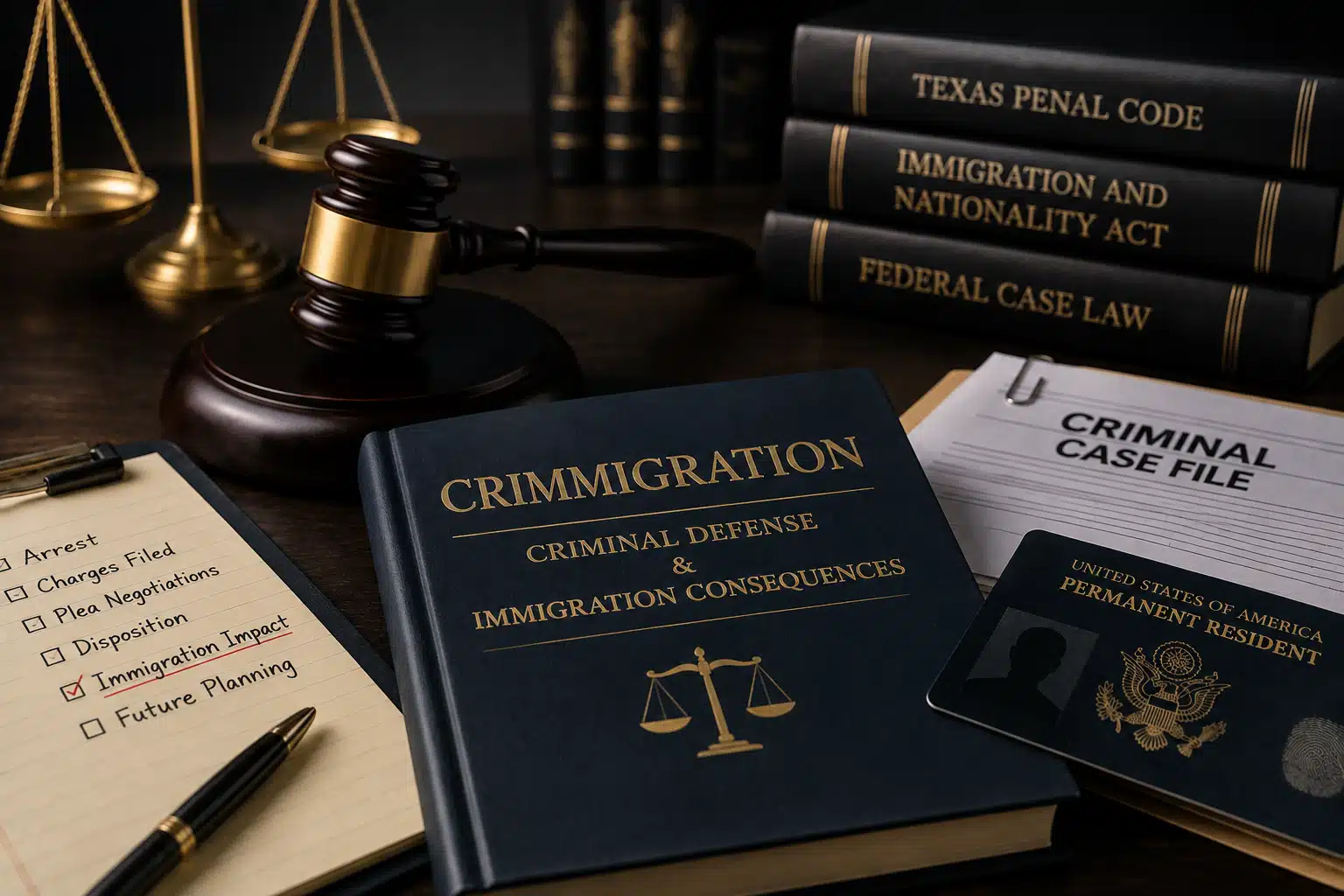
For a non-U.S. citizen, a drug possession arrest in Texas can create consequences far beyond the criminal case.
A controlled-substance conviction can potentially affect deportability, admissibility, lawful permanent resident status, visas, DACA, naturalization, international travel, and eligibility for certain forms of immigration relief.
Drug cases are particularly important in crimmigration law because federal immigration statutes contain specific provisions addressing controlled-substance violations.
That means a plea agreement that seems relatively minor in a Dallas or Fort Worth criminal courtroom could potentially have severe immigration consequences.
An arrest itself does not automatically mean someone will be deported. But a noncitizen should not enter a plea in a Texas drug case until the immigration consequences of the proposed resolution have been analyzed.
The Piri Law Firm’s Dallas-Fort Worth crimmigration practice focuses on this intersection between Texas criminal defense and federal immigration law.
Does a Drug Possession Arrest Automatically Mean Deportation?
No.
An arrest is an accusation.
It is not the same thing as a conviction.
Police may arrest someone because they believe there is probable cause for a drug offense, but the government still has to prosecute the case.
The defense may challenge:
- Whether the search was lawful
- Whether police had probable cause
- Whether the substance belonged to the defendant
- Whether the defendant knowingly possessed it
- Whether the substance was actually illegal
- Laboratory testing
- Chain of custody
- Statements made to police
- Vehicle searches
- Consent searches
- Search warrants
These issues can determine whether prosecutors can prove the criminal charge.
For an immigrant, the outcome of that criminal case can also determine whether serious immigration problems follow.
Why Drug Charges Are Especially Dangerous for Noncitizens
Federal immigration law specifically addresses violations involving controlled substances.
That makes drug offenses different from many other criminal charges.
The immigration consequences may depend on questions such as:
- What substance was involved?
- What Texas statute was charged?
- Was the offense possession, delivery, manufacture, or trafficking?
- What did the charging document allege?
- What offense did the person ultimately plead to?
- Was there a conviction for immigration purposes?
- Does a statutory exception apply?
- What other criminal history exists?
These are technical legal questions.
The everyday description of the offense is not enough.
Someone who says, “It was only a possession case,” may still be facing a serious immigration issue.
Can a Green Card Holder Be Deported for Drug Possession?
Potentially, yes.
Lawful permanent residents can be subject to removal based on certain controlled-substance convictions.
Having a green card does not provide absolute protection against immigration consequences from criminal activity.
A permanent resident charged with possession should therefore tell criminal defense counsel immediately that they are not a U.S. citizen.
That information can affect plea negotiations and defense strategy.
The goal should not merely be:
“How do we keep the client out of jail?”
The strategy should also ask:
“What happens to the client’s immigration status if this plea is accepted?”
Both questions matter.
What About Marijuana Possession?
Marijuana cases require careful immigration analysis.
Changing marijuana laws across the United States have created significant confusion.
Conduct that may be legal under a particular state’s law does not automatically become harmless under federal immigration law.
Immigration law is federal.
A marijuana-related conviction or admission can therefore potentially create immigration consequences even when state marijuana laws have become more permissive.
There is a narrow statutory exception in certain deportability contexts involving a single offense for possession for one’s own use of 30 grams or less of marijuana, but the availability and effect of that exception require individualized analysis.
A noncitizen should never assume a marijuana charge is immigration-safe simply because marijuana laws have changed elsewhere.
Can Possession of THC Cause Immigration Problems in Texas?
Yes.
Texas drug cases increasingly involve THC concentrates, vape cartridges, edibles, and similar products.
People sometimes mistakenly assume these cases are equivalent to possession of a small amount of marijuana.
The criminal classification and immigration analysis may be different.
The exact substance and Texas statute matter.
For immigrants, a THC possession case should therefore receive a specific immigration analysis before any plea agreement is accepted.
What If the Drugs Were Found in Someone Else’s Car?
The prosecution generally must establish legally sufficient possession.
Being physically near drugs does not necessarily prove that someone knowingly possessed them.
Drug cases frequently arise after traffic stops where several people are inside the same vehicle.
Police may find a controlled substance:
- Under a seat
- Inside a console
- In a backpack
- In a door compartment
- In the trunk
- On the floor
- Inside another passenger’s property
The question becomes whether prosecutors can connect the accused person to the substance.
A criminal defense attorney may examine evidence concerning ownership, location, fingerprints, statements, body-camera footage, vehicle ownership, and the behavior of other occupants.
For a noncitizen, defeating the criminal charge can also prevent the immigration consequences that might follow a conviction.
Can Police Search Your Vehicle for Drugs?
The legality of a vehicle search can become a central issue in a possession case.
The Fourth Amendment protects people against unreasonable searches and seizures.
Whether a particular search was lawful depends on the circumstances.
Police may claim authority based on:
- Consent
- Probable cause
- A search incident to arrest
- An inventory search
- A warrant
- Another recognized exception
Defense counsel should examine how the search actually occurred.
If evidence was obtained through an unlawful search, there may be grounds to seek suppression of that evidence.
The firm’s Dallas-Fort Worth criminal defense practice addresses these underlying criminal-defense issues while immigration consequences must also be considered for noncitizen defendants.
Can Deferred Adjudication for Drug Possession Affect Immigration?
Potentially, yes.
This is a particularly dangerous area for noncitizens.
A Texas defendant may believe deferred adjudication means there is no conviction.
Federal immigration law uses its own definition of conviction.
Certain dispositions involving a guilty or no-contest plea or admission, combined with punishment, a penalty, or restraint, can potentially qualify as convictions for immigration purposes.
That means:
“You won’t have a conviction under Texas law”
does not necessarily mean:
“This will not count against you under immigration law.”
The immigration consequences should be analyzed before the plea is entered.
Can a Drug Case Cause ICE Detention?
Potentially.
If a noncitizen is arrested and booked into Dallas County, Tarrant County, or another local jail, immigration authorities may become aware of the arrest.
Depending on the person’s immigration status, criminal history, and other circumstances, ICE involvement may follow.
The person might resolve the criminal bond issue but still encounter immigration custody.
At that point, the family may be dealing with:
- The Texas criminal case
- Immigration detention
- Removal proceedings
Drug-related allegations can be particularly significant in immigration proceedings.
Immediate legal review is important.
Can You Get an Immigration Bond After a Drug Arrest?
It depends.
Not every person in immigration custody is eligible for the same bond process.
Eligibility can depend on:
- Immigration status
- Criminal history
- The particular drug offense
- Prior convictions
- Prior immigration proceedings
- Existing removal orders
- The legal basis for detention
Certain criminal histories may create mandatory-detention issues.
An attorney must review the person’s complete record to determine what options may exist.
Can a Drug Conviction Affect DACA?
Yes.
Criminal history can affect DACA eligibility.
The effect of a drug case depends on the offense, disposition, and other circumstances.
Someone with DACA who is arrested for possession should therefore avoid entering a plea without understanding how the disposition could affect continued eligibility.
The criminal strategy should be coordinated with the immigration strategy from the beginning.
Can a Drug Conviction Affect Naturalization?
Yes.
USCIS reviews criminal history when evaluating naturalization applications.
Drug-related conduct and convictions can create significant issues.
The government may examine not only the existence of a conviction but also other legally relevant conduct and whether the applicant satisfies applicable good-moral-character requirements.
A green card holder with a drug arrest or conviction should have the complete record reviewed before filing for citizenship.
Filing first and investigating later can be risky.
Can a Drug Charge Affect Adjustment of Status?
Potentially.
Controlled-substance issues can affect admissibility, which can become critical when someone applies to adjust status to lawful permanent residence.
The analysis depends on the exact circumstances and criminal record.
This is another example of why a criminal plea cannot be evaluated in isolation.
Someone may successfully avoid jail in criminal court only to discover that the disposition creates a major obstacle in an immigration application.
The firm’s broader immigration law practice addresses these immigration consequences and potential options.
What About Drug Paraphernalia Charges?
Drug paraphernalia cases should also be evaluated carefully.
A defendant should not assume that reducing a possession charge to another drug-related offense automatically eliminates immigration consequences.
Federal immigration analysis can be technical and may depend on the precise statute and record.
Any proposed drug-related plea should therefore be reviewed before acceptance.
What If the Drug Case Is Dismissed?
A dismissal can dramatically change the situation.
If prosecutors cannot prove possession, the search was unlawful, evidence is unreliable, or other problems exist, the case may potentially be dismissed.
A noncitizen should obtain certified documentation showing the final disposition.
Keep those records permanently.
They may later be needed for:
- Naturalization
- Green card applications
- Visa applications
- Adjustment of status
- Immigration court
- International travel
An arrest can remain visible in government records even after a case is dismissed.
Being able to prove the actual outcome is important.
What If You Already Pleaded Guilty to Drug Possession?
Do not automatically assume nothing can be done.
The first step is to obtain the complete criminal record.
That can include:
- Charging documents
- Plea paperwork
- Judgment
- Sentence
- Probation records
- Court docket
- Laboratory reports
- Orders modifying or dismissing the case
Immigration counsel can then determine exactly what disposition occurred and what consequences may follow.
Depending on the circumstances, the analysis may include immigration defenses, eligibility for relief, or possible post-conviction criminal options.
Every case is different.
Why the Plea Negotiation Is Critical
A criminal plea can happen quickly.
The immigration consequences can last for years — or permanently.
For a noncitizen, defense counsel should understand the immigration objective before resolving the criminal case.
That does not mean immigration concerns control every criminal decision.
It means they must be part of the decision.
A proposed plea should be evaluated for:
- Criminal punishment
- Immigration consequences
- Detention consequences
- Future immigration applications
- Travel
- Naturalization
- Potential removal proceedings
This coordinated approach is the foundation of crimmigration defense.
What Should an Immigrant Do After a Drug Arrest in Dallas or Fort Worth?
First, tell your attorney that you are not a U.S. citizen.
Second, identify your exact immigration status.
Third, tell your lawyer about all prior criminal and immigration history.
Fourth, do not accept a plea simply because it avoids jail.
Fifth, preserve all documents related to the arrest and prosecution.
Most importantly, have the immigration consequences analyzed before the criminal case is resolved.
Once a plea has been entered, the available options may become significantly more limited.
Frequently Asked Questions About Drug Possession and Immigration
Can a Drug Possession Charge Get You Deported in Texas?
A drug possession charge alone does not automatically result in deportation. However, certain controlled-substance convictions can create serious grounds of deportability or inadmissibility under federal immigration law. The exact substance, statute, plea, and immigration status matter.
Can a Green Card Holder Be Deported for Drug Possession?
Potentially, yes. Federal immigration law contains specific provisions concerning controlled-substance violations. Lawful permanent residents should obtain immigration advice before resolving a possession case.
Does Deferred Adjudication Protect Me From Immigration Consequences?
Not necessarily. Federal immigration law has its own definition of conviction, and some Texas deferred-adjudication dispositions may qualify as convictions for immigration purposes.
Can Marijuana Possession Affect My Green Card?
Potentially. Federal immigration law continues to regulate marijuana. A narrow exception exists in certain circumstances involving a single offense for possession for personal use of 30 grams or less, but whether it applies requires individual analysis.
Can THC Possession Cause Immigration Problems?
Yes. THC concentrates and other cannabis products can raise significant criminal and immigration issues. The precise substance, Texas offense, and criminal disposition must be reviewed.
Can ICE Detain Me After a Drug Arrest?
Potentially. Immigration authorities may become involved after a noncitizen is arrested and booked into local custody. Drug-related criminal history may also affect immigration detention and bond issues.
Can a Drug Charge Affect My Citizenship Application?
Yes. USCIS reviews criminal history and good moral character during naturalization. Drug-related convictions or conduct can create serious issues that should be evaluated before filing an application.
What Should I Do If My Drug Case Was Dismissed?
Obtain certified documentation showing the dismissal and keep it permanently. Immigration authorities may later request records explaining the arrest and final disposition.
Talk to a Dallas-Fort Worth Crimmigration Lawyer Before Pleading to a Drug Charge
Drug charges can be among the most consequential criminal cases for immigrants.
A plea that appears minor in Texas criminal court may create serious consequences under federal immigration law.
The time to identify those consequences is before the plea is entered.
The Piri Law Firm represents immigrants facing criminal charges throughout Dallas and Fort Worth and evaluates criminal defense strategy alongside potential immigration consequences.
Call (833) 600-0029 for a confidential consultation.
Hablamos Español.