
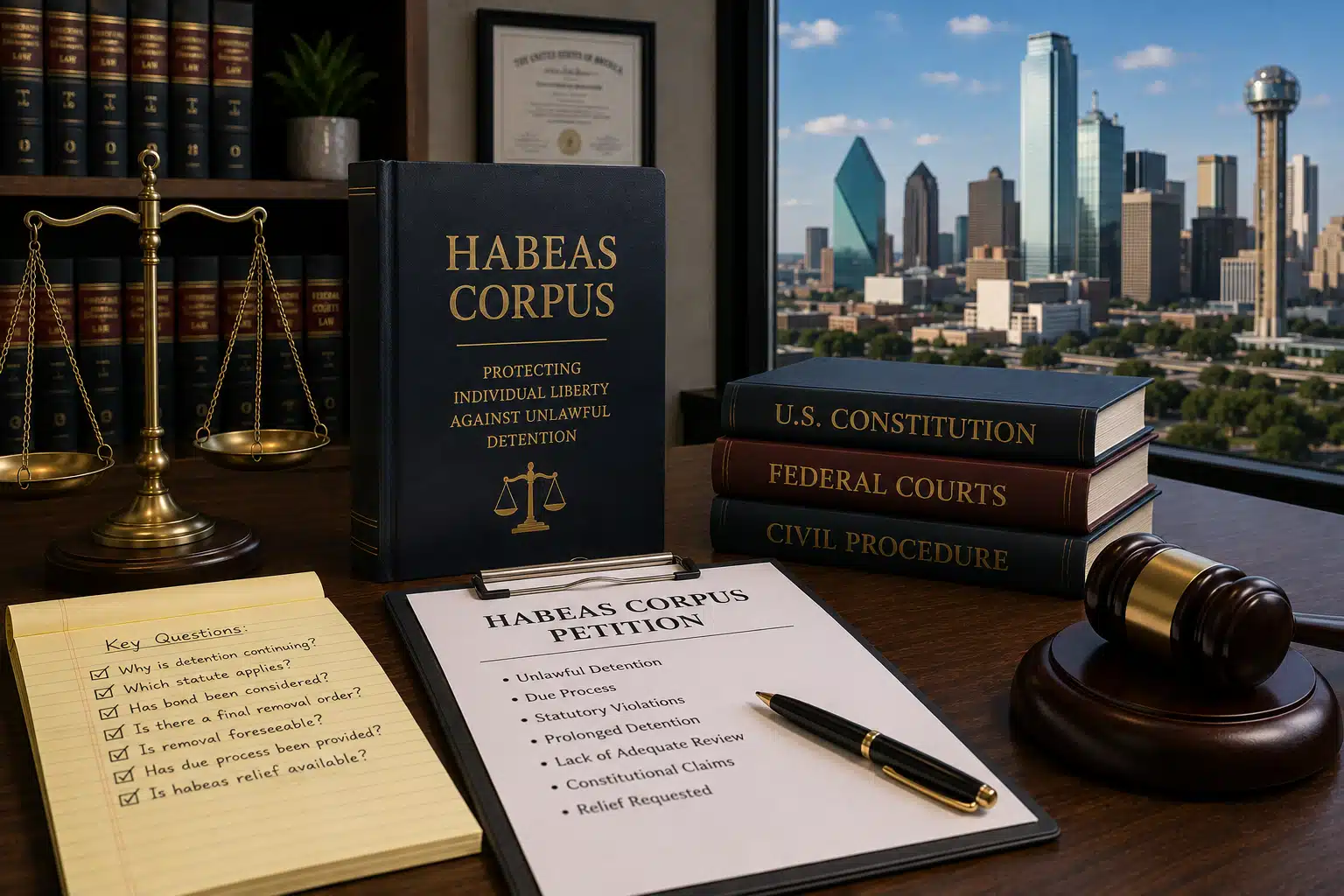
When someone is detained by ICE in Dallas, one of the family’s first questions is usually:
“Can we get a bond?”
But sometimes the answer isn’t that simple.
ICE may say there is no bond.
An immigration judge may conclude that ordinary bond jurisdiction does not exist.
Detention may continue for months.
The detainee may already have a final removal order.
At that point, another question can become critical:
Can a federal court review whether ICE can legally continue holding this person?
In appropriate cases, that is where habeas corpus comes into the picture.
A federal habeas corpus petition can challenge the legality of immigration detention. But habeas is not simply another immigration bond request, and it is not appropriate in every ICE detention case.
The Piri Law Firm represents detained immigrants and their families in immigration habeas corpus and ICE detention matters throughout Dallas-Fort Worth.
Quick Answer: Can You File Habeas Corpus for Someone Detained by ICE?
Potentially, yes.
Federal law provides a habeas mechanism under 28 U.S.C. § 2241 through which a person in custody can challenge detention when there is a legally supportable basis for doing so.
In an immigration case, the key question is not merely:
“Is this person detained?”
Instead, counsel needs to determine:
Why is the person detained, under what legal authority, for how long, and what custody review has already occurred?
Those facts can determine whether federal habeas corpus should be considered.
What Is Habeas Corpus?
Habeas corpus is a legal procedure through which a person in custody asks a court to examine whether that custody is lawful.
In the immigration context, a habeas case can potentially involve issues concerning:
- Statutory authority for detention
- Prolonged immigration detention
- Lack of meaningful custody review
- Post-removal-order detention
- Constitutional due-process issues
- Application of the wrong detention statute
- Other allegedly unlawful federal custody
The precise legal theory depends on the detainee’s individual case.
Is Habeas Corpus the Same as Immigration Bond?
No.
This is one of the most important distinctions for Dallas-Fort Worth families to understand.
An immigration bond hearing generally occurs before an immigration judge when that judge has authority to review custody.
A habeas corpus petition is federal litigation filed in a United States district court.
Bond generally asks whether an eligible detainee should be released under the immigration custody system.
Habeas generally challenges whether the detention itself is lawful under federal law or the Constitution.
Our detailed guide explains immigration bond versus federal habeas corpus in Texas.
Should You Try Immigration Bond First?
That depends on the case.
If an immigration judge has ordinary bond jurisdiction, requesting a bond hearing may be the most direct method of seeking release.
There may be no reason to wait months while the person remains detained.
Our guide explains how to get an immigration bond hearing in Dallas-Fort Worth.
But not every detainee has access to ordinary immigration bond.
That is why counsel first needs to identify the legal basis for detention.
What If ICE Says “No Bond”?
This is often where families begin asking about habeas corpus.
But “no bond” does not identify the legal problem.
It might mean:
- ICE did not authorize release
- DHS claims mandatory detention applies
- The immigration judge lacks ordinary bond jurisdiction
- A final removal order exists
- Another detention statute applies
Those situations are not interchangeable.
Before deciding whether habeas is appropriate, counsel should determine exactly why the detainee does not have ordinary bond.
Read our guide explaining what “no bond” means in ICE detention.
What Is Mandatory Immigration Detention?
Federal immigration law contains provisions requiring detention of certain noncitizens in specified circumstances.
Criminal history frequently becomes important.
But a criminal record does not mean an attorney should simply accept the label “mandatory detention” without examining it.
Counsel may need to review:
- Exact criminal statute
- Plea
- Judgment
- Sentence
- Date of conviction
- Immigration status
- Removal charges
- Prior immigration history
The legal question can sometimes be whether the government has correctly classified the person under the detention statute.
Can Habeas Challenge the Legal Basis for Detention?
Potentially.
Suppose DHS contends that a particular detention statute requires the government to hold someone without ordinary bond.
A habeas case may, depending on the circumstances, raise a threshold legal issue concerning whether that statute actually applies.
That is different from asking a judge:
“Please lower the bond.”
Instead, the issue may be:
“Does federal law authorize detention under this provision in the first place?”
The answer requires individualized legal analysis.
Can Habeas Be Used for Prolonged ICE Detention?
Potentially.
Prolonged immigration detention is one of the circumstances in which federal habeas questions can arise.
But there is no universal number of days after which every ICE detention automatically becomes unlawful.
Counsel should examine:
- Length of detention
- Governing detention statute
- Previous bond proceedings
- Reason for continued detention
- Procedural history
- Whether removal proceedings remain pending
- Whether a final removal order exists
- Whether removal is realistically foreseeable
- Controlling Fifth Circuit and Supreme Court law
Read What Happens When ICE Detention Becomes Prolonged in Texas? for the complete discussion.
Does Six Months Automatically Mean You Can File Habeas?
No.
Families often hear a simplified rule online:
“After six months, ICE has to release you.”
That is not a universal rule.
Six months can be legally significant in certain post-removal-order detention cases, but immigration detention law involves multiple statutes and different procedural circumstances.
A person should not assume that day 181 automatically creates a right to release or an immigration bond hearing.
What If the Person Has a Final Removal Order?
This can significantly change the detention analysis.
Once a removal order becomes administratively final, federal law provides a different framework for detention associated with removal.
Counsel should determine:
- When the removal order became final
- Whether removal is stayed
- Whether ICE has travel documents
- Whether the destination country will accept the person
- Whether removal has been scheduled
- Whether previous removal attempts failed
- How long post-order detention has continued
- Whether custody reviews occurred
Post-removal-order detention is an important area of federal habeas law.
What Is the Zadvydas Rule?
The Supreme Court’s decision in Zadvydas v. Davis addressed detention after a final removal order where removal could not realistically be accomplished.
The decision is frequently associated with a six-month presumptively reasonable period in the particular statutory context addressed by the Court.
But Zadvydas does not mean that every ICE detainee must automatically be released after six months.
For certain post-order detainees, the analysis can focus on whether there is a significant likelihood of removal in the reasonably foreseeable future.
That requires examining the actual removal situation.
What If the Country Will Not Accept the Detainee?
This can become highly important in a post-removal detention case.
Counsel may investigate:
- Travel-document requests
- Consular communications
- Embassy communications
- Whether citizenship has been verified
- Previous failed removal attempts
- ICE custody reviews
- Whether removal has been scheduled
- Diplomatic or logistical barriers
If removal is not realistically foreseeable, continued detention may raise substantial legal issues.
What If a BIA Appeal Is Pending?
A person can remain detained while appealing an immigration judge’s decision to the Board of Immigration Appeals.
The appeal and detention questions should be analyzed separately.
A BIA appeal asks whether the immigration judge’s decision should be reversed or modified.
A habeas case challenges custody.
The Piri Law Firm handles BIA appeals as well as immigration detention matters.
Does Filing a BIA Appeal Release Someone From ICE?
No.
Filing an appeal does not automatically release a detainee.
If the person remains in custody, counsel should separately determine:
- Whether immigration bond is available
- Whether bond has already been denied
- Whether ordinary bond jurisdiction exists
- What statute governs detention
- Whether prolonged detention issues are developing
The merits case and custody case can proceed on different tracks.
Can Habeas Corpus Stop Deportation?
Do not assume that it does.
A habeas petition challenging detention is not automatically a stay of removal.
Challenging:
“ICE’s authority to continue detaining me”
is not necessarily the same as challenging:
“ICE’s authority to remove me from the United States.”
If deportation may be imminent, counsel needs to determine whether separate emergency relief or a stay is necessary.
Is Habeas the Same as Appealing a Deportation Order?
No.
Federal law channels review of final removal orders through specific procedures.
A qualifying petition for review of a final removal order is generally filed in the appropriate federal court of appeals.
For Texas immigration cases, that often means the U.S. Court of Appeals for the Fifth Circuit.
A § 2241 detention petition should not be treated as a substitute for the correct procedure for challenging a final removal order.
Where Is an Immigration Habeas Petition Filed?
This is extremely important.
For a traditional habeas challenge to present physical custody, the detainee’s current place of confinement can determine the proper federal court.
That means the question is not necessarily:
“Where was ICE’s arrest?”
Instead, counsel may need to determine:
“Where is this person physically detained right now?”
Someone arrested in Dallas can be transferred to a detention facility outside Dallas.
That transfer can affect federal habeas procedure.
Does Being Arrested in Dallas Mean You File in Dallas Federal Court?
Not necessarily.
This is a dangerous assumption.
A detainee might:
- Be arrested in Dallas.
- Enter ICE custody through the Dallas Field Office.
- Be transferred elsewhere in Texas.
- Remain physically detained outside Dallas.
The proper court for a traditional § 2241 challenge to present physical custody may therefore not be the Dallas Division merely because the original arrest occurred there.
The actual detention location must be verified.
What If the Person Is Detained at Prairieland?
Someone arrested in Dallas-Fort Worth may be transferred to Prairieland Detention Facility in Alvarado.
Our Prairieland Detention Facility guide explains how families can locate a detainee and begin addressing the immigration case.
If federal habeas litigation is being considered, counsel should carefully evaluate the physical detention location and proper federal forum before filing.
What If ICE Transfers the Person Again?
Track every transfer.
Record:
- Facility
- Address
- Transfer date
- A-Number
- Deportation officer
- Immigration court
- Upcoming hearings
Transfer history can become relevant to federal litigation.
Do not rely on information that was accurate two weeks ago.
Confirm where the person is currently detained.
What If You Cannot Find the Detainee?
Start with ICE’s Online Detainee Locator System.
You will generally want:
- A-Number
- Full legal name
- Country of birth
- Date of birth
Our complete guide explains how to find someone detained by ICE in Dallas-Fort Worth.
Locating the person is particularly important when federal habeas litigation may be involved.
Who Files the Habeas Petition?
Ordinarily, the detained individual is the habeas petitioner.
Families should not assume that a spouse, parent, or other relative can simply file a federal petition in their own name.
Federal “next friend” standing involves additional legal requirements.
If the detainee can communicate with counsel, representation can help avoid unnecessary procedural problems.
Who Is the Respondent?
Determining the proper respondent can be technical.
In a traditional challenge to present physical custody, the immediate custodian is often central to the analysis.
Immigration cases can also involve other federal officials depending on the claims asserted.
Naming the wrong respondent can create unnecessary jurisdictional disputes and delays.
This is one reason copying a generic habeas petition from the internet can be risky.
What Information Goes Into a Habeas Petition?
The exact pleading depends on the case, but counsel generally needs to establish a coherent detention history.
Important information can include:
- Identity of petitioner
- Current detention facility
- Custodian
- Date ICE custody began
- Immigration history
- Criminal history
- Removal proceedings
- Detention statute
- Previous bond proceedings
- Final removal order, if any
- BIA proceedings
- Custody reviews
- Reasons continued detention is challenged
- Federal jurisdiction
- Requested relief
The petition should explain the legal basis for federal court intervention.
What Documents Should the Family Gather?
Try to locate:
- A-Number
- Notice to Appear
- ICE custody paperwork
- Immigration judge decisions
- Bond orders
- BIA decisions
- Final removal orders
- Motions to reopen
- Criminal judgments
- Certified criminal dispositions
- ICE custody-review documents
- Travel-document correspondence
- Passport documents
- Consular correspondence
- Federal court filings
Do not throw away notices simply because they appear old.
Old documents can explain why the person is detained today.
Build a Complete Detention Timeline
Write down:
Date of arrest
Date ICE custody began
Every facility transfer
Bond request
Bond hearing
Bond decision
Immigration hearings
Immigration judge decision
BIA appeal
BIA decision
Final removal-order date
Motions to reopen
Custody reviews
Travel-document requests
Scheduled removal attempts
Federal filings
A complete chronology can be essential to understanding a prolonged detention case.
What Can a Federal Judge Do in a Habeas Case?
The remedy depends on the claim and the legal violation established.
Depending on the circumstances, federal litigation can address issues concerning:
- Authority for continued detention
- Adequacy of custody procedures
- Continued post-removal detention
- Other federal detention issues
A habeas petition does not automatically produce release.
The court must first determine whether the petitioner has established a legal basis for relief.
Can a Federal Judge Order Someone Released?
Potentially, in an appropriate case.
But the requested remedy must fit the legal claim.
In some cases the dispute may concern continued custody itself.
In others, the issue may concern whether constitutionally adequate custody procedures have occurred.
Families should be cautious of anyone promising that filing a habeas petition automatically produces immediate release.
How Fast Is an Immigration Habeas Case?
There is no guaranteed timeline.
Federal litigation can involve:
- Filing the petition
- Service
- Government response
- Motions
- Briefing
- Evidentiary issues
- Court orders
- Appeals
Urgent circumstances can sometimes justify requests for expedited consideration, but speed depends on the case and court.
This is another reason early evaluation matters.
Should You Wait Until Detention Reaches Six Months Before Calling an Attorney?
No.
There can be good reasons to evaluate the detention much earlier.
An attorney may determine that:
- Immigration bond is available immediately
- A bond hearing should be requested
- Mandatory detention is disputed
- A final removal order already exists
- A BIA deadline is approaching
- A motion to reopen should be considered
- A future habeas issue should be documented
- An immediate federal detention issue already exists
The purpose of early review is not necessarily to file habeas immediately.
It is to identify the correct legal strategy.
What If Someone Was Detained After a Dallas County Arrest?
A person can become eligible for release from Dallas County criminal custody and still be transferred to ICE.
The criminal case and immigration custody are separate.
Read our Dallas County ICE hold guide for the process.
If ICE detention then continues, the immigration custody issue should be evaluated independently.
What If the Arrest Happened in Fort Worth?
The same issue can occur after an arrest in Tarrant County.
Someone can post criminal bond and still encounter immigration detention.
Our Fort Worth and Tarrant County ICE hold guide explains what North Texas families should know.
Frequently Asked Questions About Immigration Habeas Corpus
Can you file habeas corpus for someone detained by ICE?
Potentially. A person in ICE custody may seek habeas relief under 28 U.S.C. § 2241 when there is a legally supportable challenge to the detention.
Is habeas corpus the same as immigration bond?
No. Immigration bond generally involves custody proceedings before an immigration judge. Habeas corpus involves federal district court litigation challenging detention.
Does someone have to be detained for six months before filing habeas?
There is no universal six-month waiting requirement applicable to every immigration habeas claim.
Does ICE have to release someone after six months?
No. There is no universal rule requiring release of every immigration detainee after six months.
Can habeas corpus stop deportation?
A detention habeas petition does not automatically stay removal. Separate legal relief may be required if deportation is imminent.
Where is an immigration habeas petition filed?
For a traditional challenge to present physical confinement, the detainee’s current place of confinement is an important factor in determining the proper federal court.
Does an ICE arrest in Dallas mean habeas must be filed in Dallas?
No. If the detainee has been transferred elsewhere, the person’s current physical detention location may control the federal filing analysis.
Can someone file habeas while a BIA appeal is pending?
Potentially. The BIA appeal concerns the immigration case, while habeas can address the legality of detention.
Can a federal judge release an ICE detainee?
Federal courts can grant relief in appropriate habeas cases when a legal basis for relief is established. The exact remedy depends on the claim and governing law.
Is habeas available if an immigration judge says there is no bond jurisdiction?
Potentially, depending on why ordinary bond jurisdiction is unavailable and whether there is a legally supportable federal challenge to continued detention.
Talk to a Dallas–Fort Worth Immigration Habeas Corpus Attorney
If someone is detained by ICE, the analysis should go beyond:
“Does ICE offer bond?”
Counsel should determine:
Why is this person detained?
Which statute governs custody?
Does an immigration judge have bond jurisdiction?
Has bond already been denied?
How long has detention continued?
Is a BIA appeal pending?
Is there a final removal order?
Where is the person physically confined?
Can ICE realistically accomplish removal?
Does continued detention create a federal habeas issue?
The Piri Law Firm represents immigrants and families throughout North Texas in immigration habeas corpus and ICE detention cases.
Call (833) 600-0029 to discuss an ICE detention case.
This article provides general information and does not constitute legal advice. Federal habeas jurisdiction, immigration detention authority, venue, and available relief depend on the facts and current controlling law.