
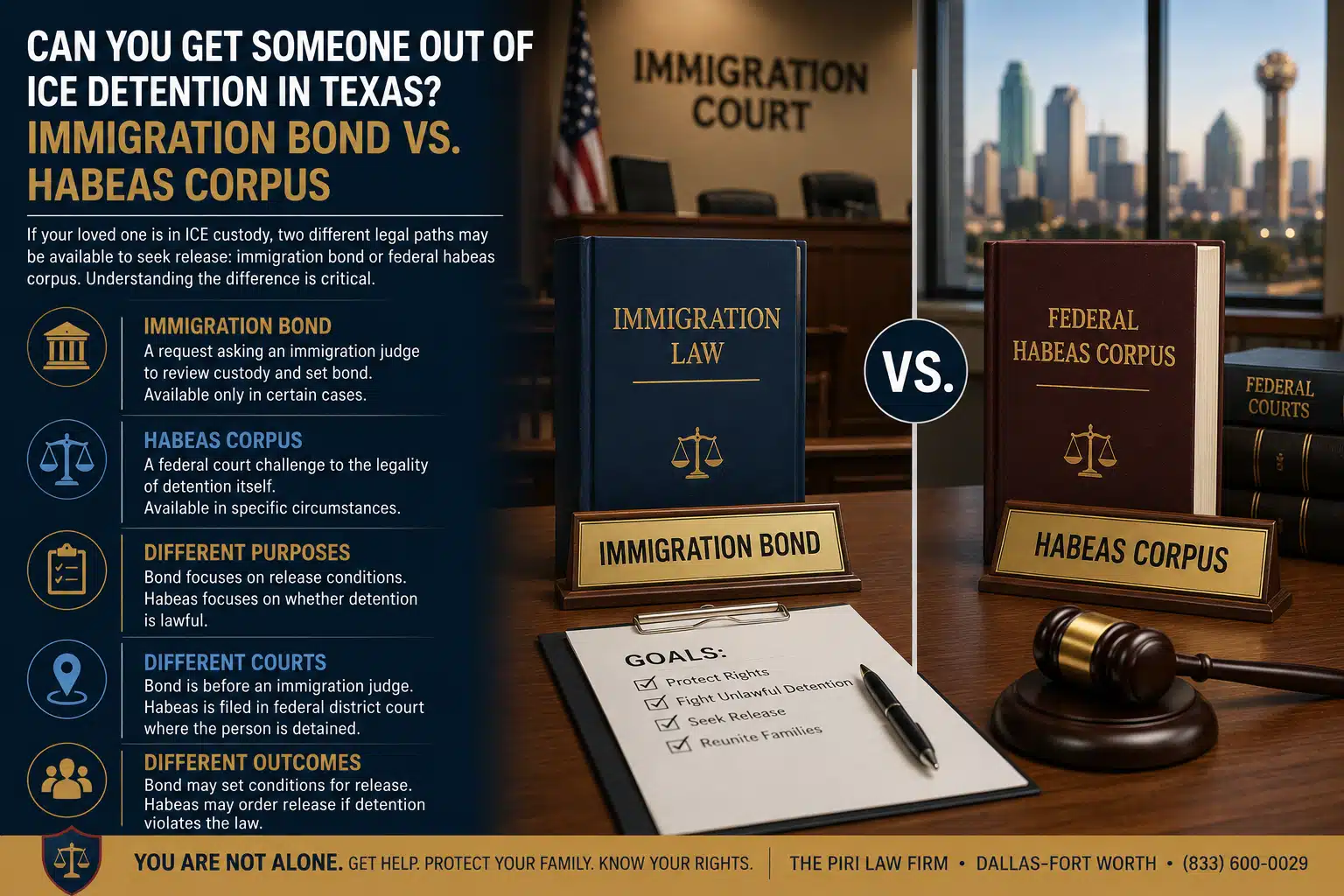
When ICE detains someone in Dallas, Fort Worth, or elsewhere in Texas, the family’s first question is usually simple:
How do we get them out?
The answer can be complicated.
Some immigration detainees may be eligible to ask an immigration judge for bond.
Others may be detained under statutes that restrict an immigration judge’s authority to grant bond.
And in certain circumstances, continued immigration detention may be challenged in federal court through a petition for writ of habeas corpus.
These are not interchangeable procedures.
An immigration bond case and a federal habeas corpus case take place in different courts, involve different legal questions, and can require very different strategies.
If someone you know is currently detained, The Piri Law Firm handles immigration habeas corpus and ICE detention cases throughout Dallas-Fort Worth.
Quick Answer: Immigration Bond vs. Habeas Corpus
The basic difference is:
Immigration bond asks whether an eligible detainee can be released from immigration custody, usually subject to a bond amount and other requirements.
Habeas corpus asks a federal court whether the government’s detention of the person is lawful.
A bond hearing generally occurs before an immigration judge.
A habeas petition generally proceeds before a federal district judge.
Some detainees may have a bond remedy. Some may have a potential habeas claim. In certain circumstances, both procedures may become relevant at different points in the detention.
What Is an Immigration Bond?
An immigration bond can allow an eligible person to be released from ICE custody while the immigration case continues.
The immigration court does not have authority to conduct a bond hearing in every detention case.
Where jurisdiction exists, however, the detainee can seek custody review before an immigration judge.
The bond case is separate from the underlying removal proceeding.
This distinction matters because winning bond does not mean the person has won the immigration case.
It means the person may be permitted to continue fighting that case outside detention.
Who Decides Immigration Bond?
Depending on the circumstances, ICE may initially make a custody determination.
When an immigration judge has jurisdiction, the detainee can seek a bond redetermination from the immigration court.
The judge then evaluates the custody issue under the applicable immigration laws and standards.
The person seeking release should be prepared to present evidence supporting the request.
What Does an Immigration Judge Consider?
The precise legal analysis depends on the case, but bond proceedings commonly involve questions concerning danger and whether the person is likely to appear for future immigration proceedings.
Evidence can include:
- Family relationships in the United States
- Length of residence in Texas
- Employment history
- Community ties
- Criminal history
- Rehabilitation
- Immigration history
- Previous court appearances
- Pending immigration relief
- Proposed residence after release
- Financial support
- Other evidence relevant to custody
A well-prepared bond case should be built around evidence rather than simply asking the judge to release the person because the family needs them home.
Does Everyone Detained by ICE Qualify for Bond?
No.
This is one of the most important things families should understand.
Different immigration detention statutes apply to different categories of people.
Depending on the circumstances, an immigration judge may lack ordinary bond jurisdiction.
Issues can involve:
- Certain criminal convictions
- Mandatory detention provisions
- Manner of entry
- Prior removal orders
- Post-removal-order detention
- Other statutory classifications
The first task in a detention case is therefore identifying why ICE claims it has authority to hold the person.
What Does “No Bond” Mean?
Families often hear that their relative has “no bond.”
That phrase does not necessarily explain what is happening legally.
It could mean that ICE declined to set a bond.
It could mean that the government believes an immigration judge lacks authority to grant one.
It could mean the person is allegedly subject to mandatory detention.
It could involve a final removal order.
Or it could involve another statutory custody framework.
Before determining the next step, counsel should identify the legal basis for the “no bond” determination.
Can an Immigration Judge Order Someone Released?
When the immigration judge has jurisdiction and the detainee satisfies the applicable requirements, the judge may set a bond amount.
The detainee can then potentially secure release after the bond is properly posted and other applicable requirements are satisfied.
The removal case continues after release.
That means the person still needs to:
- Attend immigration hearings
- Comply with applicable release conditions
- Continue pursuing immigration relief
- Keep the court informed of required address changes
- Comply with ICE requirements
Release is not the end of the immigration case.
What Is Habeas Corpus?
Habeas corpus is fundamentally different.
A petition for writ of habeas corpus asks a federal court to review the legality of someone’s detention.
The U.S. Constitution protects the writ of habeas corpus, and federal law provides mechanisms through which people in government custody can challenge unlawful detention.
In immigration cases, habeas litigation may involve questions about whether the government has lawful authority to continue holding the detainee or whether the procedures surrounding detention satisfy federal law and constitutional requirements.
The Piri Law Firm handles immigration habeas corpus cases involving detained immigrants in North Texas.
Where Is an Immigration Habeas Petition Filed?
A habeas petition is filed in federal district court, not immigration court.
That distinction is extremely important.
Immigration judges are part of the Executive Office for Immigration Review within the Department of Justice.
Federal district judges are members of the federal judiciary.
A habeas action therefore moves the detention dispute into an entirely different court system.
Why Does the Detainee’s Location Matter?
Where the detainee is physically confined can be important when determining where a habeas petition should be filed and who the proper respondent is.
This matters particularly in Texas because ICE may transfer someone arrested in Dallas or Fort Worth to a detention facility elsewhere.
For example, a person arrested in Dallas-Fort Worth might later be housed at Prairieland Detention Facility in Alvarado or another Texas facility.
Families should therefore determine the person’s current physical location before assuming where a federal detention challenge belongs.
What Can an Immigration Habeas Case Challenge?
Potential habeas issues depend heavily on the case.
They can include questions involving:
- The statutory authority for detention
- Prolonged detention
- Lack of meaningful custody review
- Post-removal-order detention
- Constitutional due-process concerns
- Whether continued detention remains legally authorized
- Other allegedly unlawful custody
The existence of ICE detention alone does not automatically create a successful habeas claim.
The attorney needs to analyze the particular statutory and constitutional issues involved.
Is Habeas Corpus an Appeal of the Deportation Case?
Not necessarily.
A habeas case challenging detention and an appeal challenging a removal order are different proceedings.
For example, a detainee might simultaneously have:
Removal proceedings before an immigration judge,
a BIA appeal concerning the immigration judge’s decision,
and
a federal habeas case concerning the legality of continued detention.
Those cases may interact, but they address different legal questions.
If the immigration judge has already issued an unfavorable removal decision, read our information about BIA appeals.
Bond vs. Habeas Corpus: The Core Difference
Think about the distinction this way.
Immigration Bond
The central question is generally:
Can this eligible detainee be released under the immigration custody framework?
Habeas Corpus
The central question is:
Does the government have lawful authority to continue this detention under the circumstances?
Those questions can overlap in practical effect because both may ultimately concern release.
But legally, they are very different.
Which Court Handles Each Case?
Immigration bond: Immigration Court / Executive Office for Immigration Review.
Habeas corpus: United States District Court.
For a North Texas detainee, federal habeas litigation may involve the U.S. District Court for the Northern District of Texas depending on the place of confinement and other jurisdictional considerations.
That is why an immigration detention attorney needs to understand both immigration procedure and federal court litigation.
Is Habeas Only Available After Bond Is Denied?
Not necessarily.
Whether habeas is appropriate depends on the legal issue being challenged.
Some cases may involve a prior bond proceeding.
Others may involve situations where the immigration judge allegedly lacks ordinary bond jurisdiction.
Still others can involve detention that has continued for a significant period.
There is no universal rule that every detainee must simply “lose bond first” before federal detention issues can ever arise.
The procedural posture matters.
Can You Use Bond and Habeas Corpus in the Same Case?
Potentially.
A detainee’s legal options can change as the case progresses.
For example, counsel might initially pursue immigration custody review where available.
If detention continues and additional statutory or constitutional issues develop, federal litigation might later become relevant.
Alternatively, the legal basis for detention may make the federal issue important from the outset.
The strategy needs to be based on the specific custody authority rather than a one-size-fits-all sequence.
How Long Does Someone Have to Be Detained Before Habeas Is Available?
There is no single number of days that automatically transforms every immigration detention case into a successful habeas case.
This is an area where families should be cautious about internet claims such as:
“After six months ICE has to release you.”
That is not a reliable universal rule.
The legality of continued detention can depend on:
- Which detention statute applies
- Whether removal proceedings remain pending
- Whether a final removal order exists
- Whether removal is reasonably foreseeable
- Whether litigation or appeals are continuing
- What custody procedures have occurred
- Controlling federal precedent
- Individual case facts
A detention attorney needs to analyze the actual procedural posture.
What About the Six-Month Rule People Talk About?
Families sometimes hear about six months because federal immigration detention law includes important Supreme Court precedent involving prolonged post-removal-order detention.
But that does not mean every ICE detainee automatically becomes entitled to release on day 181.
Different statutory detention frameworks are governed by different rules.
The existence of a six-month benchmark in one legal context should not be applied blindly to every ICE detention case.
What If the Person Has a Final Removal Order?
This can change both bond and habeas analysis significantly.
After a final removal order, a different statutory detention framework may apply.
Counsel may need to determine:
- When the order became final
- Whether removal is being actively pursued
- Whether travel documents are available
- Whether the destination country will accept the person
- Whether a stay prevents removal
- How long detention has continued
- Whether reopening is being pursued
- Whether continued detention remains lawful
Someone with a final removal order should not assume that ordinary immigration bond procedures necessarily apply in the same way they would during pending removal proceedings.
What If the Person Has a Pending BIA Appeal?
A BIA appeal can affect the procedural posture of the removal case.
For many timely direct appeals from immigration judge removal decisions, removal is generally stayed while the appeal is pending.
But an automatic stay of removal is not the same thing as automatic release from detention.
A person can therefore remain detained while litigating a BIA appeal.
For more information, read Can You Stay in the United States While a BIA Appeal Is Pending?.
Can Someone Be Released While Their Deportation Case Continues?
Yes, in appropriate circumstances.
Release from detention and success in the underlying removal case are separate questions.
Someone released on immigration bond may still have months or years of immigration litigation ahead.
Similarly, federal litigation concerning detention does not necessarily resolve whether the person ultimately has a legal right to remain permanently in the United States.
This distinction should be clear to families from the beginning.
What Evidence Should a Family Gather for Bond?
If immigration bond may be available, family members can help tremendously.
Useful evidence may include:
- Proof of lawful-status relatives
- Children’s birth certificates
- Marriage certificate
- Proof of residence
- Lease or mortgage documents
- Employment verification
- Tax returns
- Pay records
- Letters of community support
- Evidence of rehabilitation
- Criminal dispositions
- Medical evidence where relevant
- Evidence of pending immigration relief
The attorney should determine which evidence is strategically useful before submission.
What Information Is Important for a Habeas Case?
A federal detention challenge requires a different record.
Counsel may need information concerning:
- Date ICE custody began
- Every detention facility
- Statutory custody authority
- Immigration judge decisions
- Bond proceedings
- BIA proceedings
- Final removal order
- Requests for release
- ICE custody reviews
- Travel-document efforts
- Government explanations for continued detention
- Federal appellate litigation
- Length and circumstances of detention
A clear detention timeline can be particularly valuable.
What If ICE Detained Someone After a Dallas County Arrest?
First determine whether the person remains in local custody or has already been transferred to ICE.
Our guide to an ICE hold in Dallas County explains the process.
Once ICE takes custody, counsel can determine whether bond, removal defense, reopening, habeas corpus, or another strategy should be evaluated.
What If the Arrest Happened in Fort Worth?
The same principle applies in Tarrant County.
Criminal release and immigration release are separate.
Read ICE Hold in Tarrant County: What Happens After a Fort Worth Arrest? for the Fort Worth-specific process.
What If You Cannot Find the Detainee?
Start with ICE’s Online Detainee Locator System.
The A-Number is usually the most useful identifier.
Our step-by-step guide explains how to find someone detained by ICE in Dallas-Fort Worth.
Finding the detainee’s actual location is particularly important when federal habeas litigation may be considered.
What Happens After ICE Arrests Someone?
If the detention began with a direct ICE arrest rather than transfer from a county jail, the process can involve ICE processing, transfer, custody determination, immigration court proceedings, and potentially bond or federal detention litigation.
Read What Happens After ICE Arrests Someone in Dallas? for the complete process.
Can a Federal Judge Order Release?
In an appropriate habeas case, federal courts have authority to grant relief from unlawful detention.
The exact remedy depends on the legal violation and circumstances.
A court might address the legality of continued custody or require particular procedures.
But filing a habeas petition does not mean automatic release.
The legal claim must be established.
Does Filing Habeas Automatically Stop Deportation?
Do not assume so.
A habeas petition challenging detention and a stay preventing removal are different legal issues.
If removal is imminent, counsel may need to evaluate whether another form of relief or a separate stay request is required.
This is especially important for detainees with final removal orders.
Does Filing Habeas Automatically Get Someone a Bond Hearing?
Not automatically.
The remedy sought depends on the legal theory.
Some detention litigation may concern whether a custody hearing is legally required.
Other cases may directly challenge continued detention.
The requested relief should correspond to the alleged legal violation.
How Quickly Should a Family Contact an Attorney?
Immediately after ICE detention is confirmed.
That does not mean a habeas petition should automatically be filed on the first day.
It means counsel should begin determining:
- Why ICE has custody
- Which statute applies
- Whether bond is available
- Whether a removal order exists
- Whether immigration court proceedings are pending
- Where the person is detained
- What deadlines exist
- Whether federal litigation is or may become appropriate
Early analysis helps preserve options.
Frequently Asked Questions About Immigration Bond and Habeas Corpus
Can you get someone out of ICE detention in Texas?
Potentially. Release options depend on the statutory basis for detention and the person’s immigration and criminal history. Immigration bond, another form of custody review, or federal habeas corpus may be relevant depending on the case.
What is the difference between immigration bond and habeas corpus?
Immigration bond generally seeks release through immigration custody proceedings. Habeas corpus is a federal court action challenging the legality of detention.
Who decides an immigration bond?
When jurisdiction exists, an immigration judge can review the custody determination and potentially set bond.
Who decides an immigration habeas case?
A federal district judge hears a federal habeas corpus petition.
Does every ICE detainee qualify for bond?
No. Some detainees are held under statutes that limit or eliminate ordinary immigration judge bond jurisdiction.
Does “no bond” mean the person cannot be released?
Not necessarily. Counsel needs to determine why bond is unavailable and whether another custody remedy may exist.
Is habeas corpus only for people detained a certain number of months?
No single detention period automatically establishes a successful habeas claim in every immigration case. The applicable statute and procedural circumstances matter.
Can someone file habeas while a BIA appeal is pending?
Potentially. A BIA appeal concerning removal and a federal challenge concerning detention address different legal issues.
Does winning a bond hearing mean the immigration case is over?
No. Bond concerns release from detention. The underlying immigration proceedings continue.
Does winning habeas mean the person gets a green card?
No. Habeas addresses custody. It does not itself grant permanent immigration status.
Talk to a Dallas-Fort Worth ICE Detention and Habeas Attorney
When someone is detained by ICE, asking whether they “have a bond” is only the beginning.
The more important questions are:
What statute is ICE using to detain them?
Does an immigration judge have bond jurisdiction?
Is there already a removal order?
How long has detention continued?
Where is the person physically confined?
Has continued detention created a federal legal issue?
The Piri Law Firm represents detained immigrants and their families throughout North Texas in immigration habeas corpus and ICE detention matters.
Call (833) 600-0029 to discuss the case.
This article provides general information and does not constitute legal advice. Immigration detention statutes, bond jurisdiction, habeas corpus, removal proceedings, and release options depend on the facts of each case.