
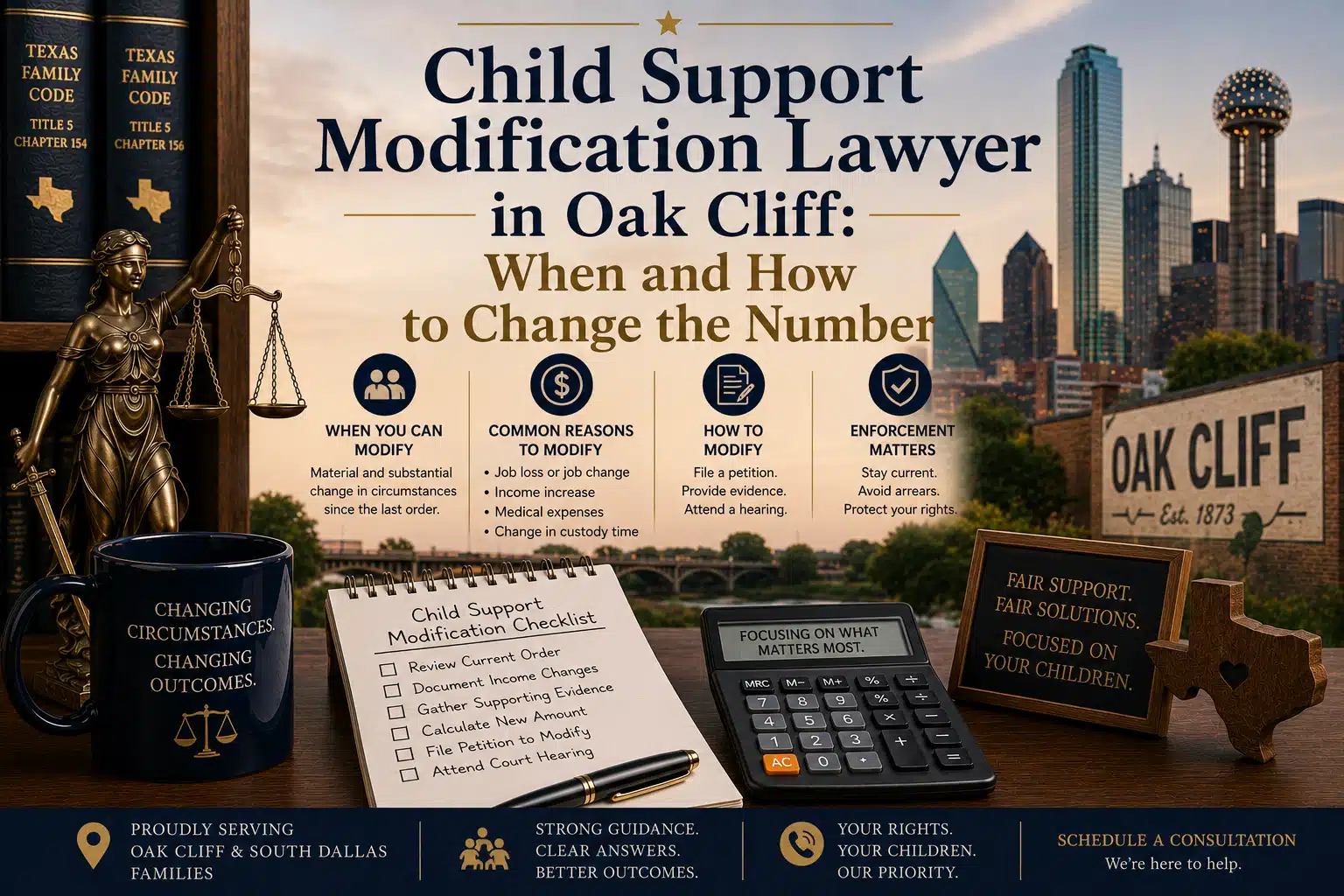
The child support order that made sense three years ago may have nothing to do with your life today. You lost the warehouse job and picked up work that pays half as much. The other parent got a big promotion they never mentioned. The kids now live with you most of the time, but the order still says you pay. At The Piri Law Firm’s Oak Cliff office at 602 S Hampton Rd, modification cases are among the most common family matters we handle — for parents who need the number lowered, parents who need it raised, and parents whose living arrangements have quietly stopped matching the paperwork. This guide explains the legal standard, the process in Dallas County, and the timing mistakes that cost parents thousands. For how support is calculated in the first place, see our child support lawyer page.
The Two Legal Paths to Modification
Under the Texas Family Code, Chapter 156, a court can modify child support in either of two situations:
1. Material and substantial change in circumstances. Something significant changed for the child or either parent since the last order. This is the workhorse ground, available at any time. Classic examples: involuntary job loss or a significant income drop; a substantial raise for the paying parent; the child developing new medical, educational, or special needs; the child moving in with the paying parent; a new child the obligor has a legal duty to support; incarceration; or a change in who carries the child’s health insurance.
2. The three-year rule. If three years have passed since the order was signed and the guideline amount would now differ by 20% or $100 per month from the current order, that difference alone justifies modification — no other change required. This is the cleaner path for parents whose ex’s income has grown steadily while the order stayed frozen.
Two things the statute does not allow: modifying support just because you remarried and have new household expenses (a new spouse’s income isn’t counted, but new bills aren’t a defense either), and modifying retroactively to cover months before you filed.
The Rule That Costs Parents the Most: File First, Explain Later
Texas courts generally cannot change support for any period before the modification was filed. Every month you wait is a month locked in at the old number.
We see the same painful pattern from Hampton Road constantly: a parent loses a job in January, spends six months hoping to find work before “bothering with court,” files in July — and owes six months of arrears at the old amount that no judge can erase, plus interest. Or the reverse: the paying parent’s income doubled two years ago, and the receiving parent only now files — the increase runs from the filing date, not from the raise.
The rule is simple and unforgiving: the day your circumstances change is the day to call a lawyer. Filing costs far less than the arrears that pile up while you wait. And never rely on a handshake — “he said I could pay less while I was laid off” is legally worthless. Only a signed court order changes a court order, and informal arrangements leave the paying parent exposed to an enforcement action for the full difference, with interest.
When the Child Lives With You Now
One of the most common — and most mishandled — Oak Cliff scenarios: the teenager moves in with the paying parent, everyone agrees informally, and the support order keeps running in the background. Legally, the obligor still owes every payment until a court says otherwise, and the arrears are enforceable even though the child was under their roof. The fix is a modification that flips (or at minimum suspends) support and, usually, updates the conservatorship and possession orders to match reality — which is why these cases often travel with a custody modification handled by our child custody lawyer team.
Lowering Support: What Courts Actually Accept
Judges distinguish sharply between can’t pay and won’t pay:
- Involuntary job loss with documented job-search efforts is a legitimate ground.
- Voluntary underemployment is not. A parent who quits a $70,000 job for a $30,000 one — or shifts income into cash work — invites the court to impute income at earning capacity and calculate support on the phantom paycheck.
- Self-employment swings require real records. Tax returns, profit-and-loss statements, and bank records carry weight; “business is slow” does not.
- Incarceration and disability are recognized changes, but they still require filing — nothing adjusts automatically.
If you’ve already fallen behind, a modification filing paired with a realistic arrears plan is almost always better received than silence. The Texas Attorney General’s Child Support Division enforces many Dallas County orders, and enforcement tools — wage withholding, license suspension, contempt — escalate against parents who disappear rather than parents who file.
Raising Support: Building the Case
For receiving parents, the case is built on the other parent’s true income and the child’s actual costs. Discovery can compel pay stubs, tax returns, and bank records; lifestyle evidence (new truck, new house, business ownership) supports imputation when paper income looks suspiciously thin. The three-year rule is a powerful lever here — if the last order predates the paying parent’s career growth by three years or more, the 20%/$100 test often does the work by itself. Increases in the child’s medical, dental, educational, or activity costs, and changes in who provides health insurance, round out the case.
The Process in Dallas County
- Petition to Modify filed with the Dallas County District Clerk under the same cause number as the original order; the other parent is served or waives service.
- Exchange of financial information — pay stubs, tax returns, insurance costs. Many cases resolve here once both sides see the real numbers run through the guidelines.
- Agreement or mediation. Agreed modifications are drafted and entered without a contested hearing; Dallas County courts routinely send disputed cases to mediation first.
- Hearing if needed, where the judge applies the guideline percentages to the proven net resources and rules on the requested change.
Uncontested modifications can wrap up in a couple of months; contested ones with discovery fights take longer. Parents handling simple agreed changes can find forms at TexasLawHelp.org, but any case involving imputed income, self-employment, or arrears is not a do-it-yourself project.
Immigration Status and Support Modifications
Oak Cliff parents ask us regularly: does immigration status affect a modification? No — undocumented parents have the same right to seek (and the same duty to pay) child support as anyone else, and family courts do not report parties to immigration authorities. Status intersects in practical ways we plan for: income documentation for cash-paid work, support compliance as good-moral-character evidence in immigration cases, and contingency planning if a paying parent is detained. Because the firm also practices immigration law, both files get planned together. Consultations available in Spanish and French.
Why Oak Cliff Parents Choose The Piri Law Firm
Michael Piri is a Texas attorney practicing Family Law, Criminal Defense, Personal Injury, and Immigration — verify his licensure on his State Bar of Texas profile. He earned his J.D. from St. Mary’s University School of Law and is fluent in Spanish and French. Free 30-minute consultations, flat fees and payment plans, 24/7 availability. Visit our Oak Cliff office page for directions, and read client reviews on our Google Business Profile.
Frequently Asked Questions
How often can child support be modified in Texas?
There’s no waiting period if you can show a material and substantial change in circumstances. Separately, after three years, a 20% or $100 difference from current guidelines justifies modification on its own.
I lost my job — does my child support automatically go down?
No. Nothing changes until a court signs a new order, and modifications aren’t retroactive past the filing date. File immediately; arrears at the old amount keep accruing while you wait.
My ex agreed I could pay less. Is that enough?
No. Informal agreements are unenforceable, and the unpaid difference accrues as arrears with interest. Any agreement must be entered as a court order to protect you.
The kids live with me now but I’m still ordered to pay. What do I do?
File to modify right away. The support obligation continues until a court changes it — even with the child in your home — and the accrued arrears remain enforceable.
Can support go up if my ex got a big raise?
Yes. A significant income increase is a material change, and after three years the 20%/$100 guideline test often applies automatically. Discovery can compel the income records to prove it.
The Piri Law Firm — Oak Cliff Office
602 S Hampton Rd, Dallas, TX 75208 · (833) 600-0029 · Free 30-minute consultation, 24/7 · Nosotros hablamos español
Contact us | Find us on Google
This article is for general information only and is not legal advice. Reading it does not create an attorney-client relationship.