
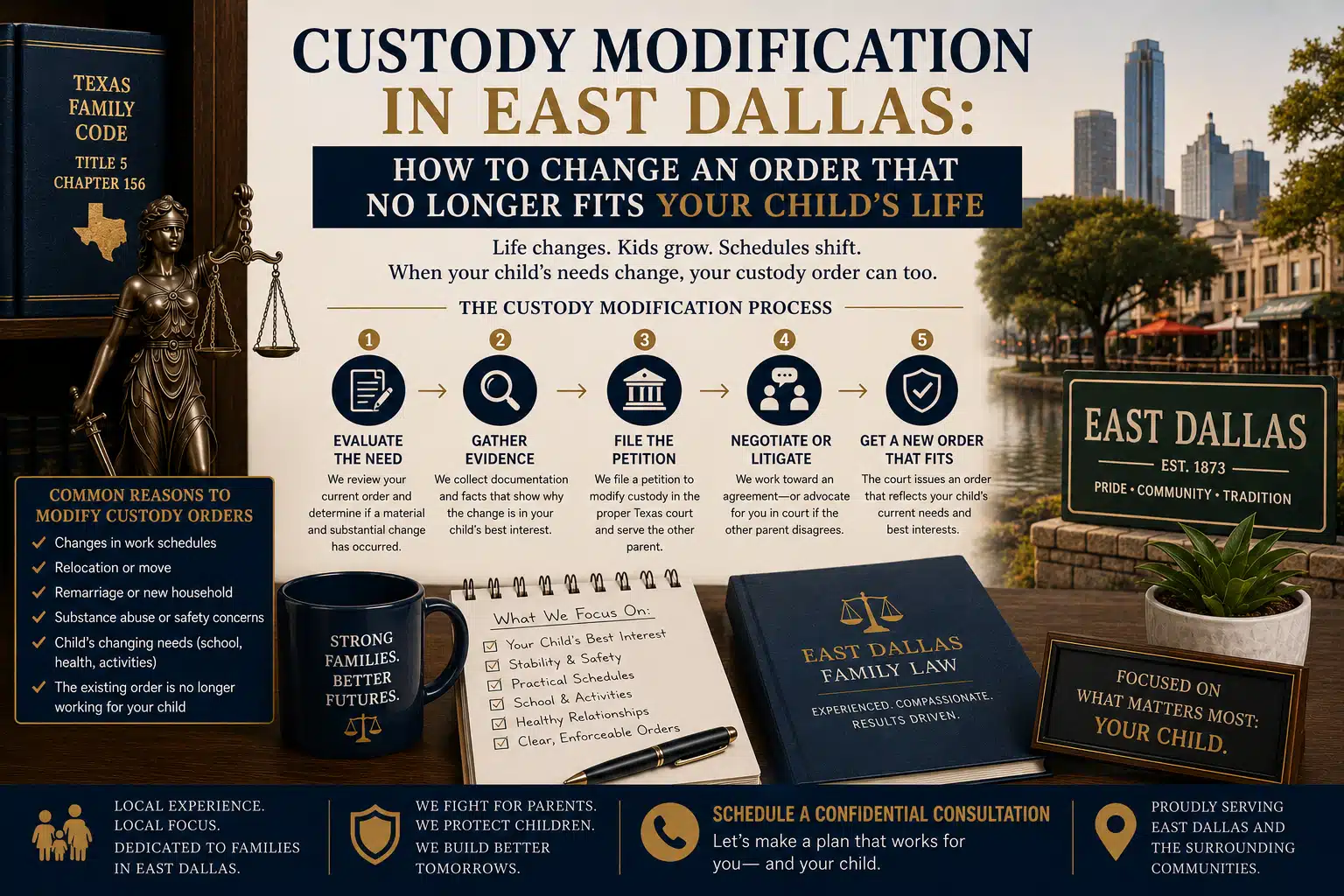
Custody orders are written for the family that existed on the day the judge signed them. Children grow, parents change jobs and partners and addresses, and a schedule built around a toddler in Casa View makes no sense for a teenager at Bryan Adams High. Texas law recognizes this — orders can be changed — but it deliberately makes modification harder than the original case, because children need stability and courts refuse to referee every disagreement. A child custody lawyer at The Piri Law Firm’s East Dallas office at 8021 I-30 Frontage Rd handles modifications on both sides: parents seeking a change, and parents defending an order that’s working. This guide covers the legal standard, the evidence that wins, the emergency track, and the mistakes that sink otherwise good cases.
The Legal Standard: Material and Substantial Change
Under the Texas Family Code, Chapter 156, a court can modify conservatorship or the possession schedule when (1) there has been a material and substantial change in circumstances of the child or a parent since the last order, and (2) the change would be in the child’s best interest. Both prongs must be met — a big change that doesn’t help the child fails, and a good idea with no changed circumstances fails too.
What courts accept as material and substantial, from our East Dallas caseload:
- Relocation — a parent moving for work, or wanting to move the child outside the geographic restriction most Dallas County orders impose
- Work schedule changes that make the current possession calendar unworkable — the parent who switched to nights, the new job with weekend shifts
- The child’s evolving needs — school changes, medical or therapeutic needs, activities the current schedule can’t accommodate
- Safety concerns — substance abuse, family violence, criminal charges, or a dangerous new person in the household
- A child 12 or older who wants to change which parent they primarily live with (more below)
- Voluntary relinquishment — the primary parent has left the child with someone else for six months or more
- Persistent violations of the current order — chronic denied possession can support both enforcement and modification
What doesn’t qualify: ordinary friction, a remarriage by itself, or the mere passage of time. And note a special hurdle — trying to change who designates the child’s primary residence within one year of the order requires an affidavit showing the child’s present environment endangers them or that the primary parent consents or has relinquished care. That one-year gate exists precisely to stop instant re-litigation.
The Child’s Voice: What “My Kid Wants to Live With Me” Actually Gets You
The most misunderstood rule in Texas custody law. At age 12, a child has the right to be interviewed by the judge in chambers — privately, not on the witness stand — about their preferences, and the court must conduct the interview if a parent requests it. But the child’s preference is a factor, not a decision. Judges weigh why the child prefers a change: a mature preference tied to school, stability, or relationships carries real weight; a preference for the house with no rules or the parent promising a car carries very little, and judges have seen every version of both.
Strategic caution: coaching a child, or making them a messenger in the dispute, reliably backfires — judges detect it, and it damages the coaching parent’s case more than the preference helps. The child’s preference should arrive at court organically, supported by the surrounding evidence, not manufactured.
Evidence: What Actually Wins Modifications
Modification cases are decided on documented patterns, not accusations. Build the file before you file:
- A possession journal — dates, times, denials, late returns, no-shows, kept contemporaneously
- The digital record — texts and emails (Texas courts see co-parenting app records constantly), school portals, attendance records
- Third-party witnesses — teachers, coaches, pediatricians, family members who see the child weekly
- Official records where safety is the issue — police reports, CPS findings, criminal dockets, treatment records
And a warning that saves cases: do not engage in self-help. Keeping the child beyond your period, refusing returns, or unilaterally “starting the new schedule” before a court orders it converts you from the reasonable parent into the violator — and hands the other side an enforcement case. The parent who documents and files looks trustworthy; the parent who retaliates looks like the problem. If the concern involves the other parent’s new criminal case — a DWI with the child in the car, a family violence arrest — certified records of those proceedings are among the most powerful modification evidence that exists.
Emergencies: When You Can’t Wait for a Normal Case
Ordinary modifications take months. When a child is in genuine danger — abuse, a parent’s overdose, an arrest with the child present — Texas allows emergency temporary orders, including temporary restraining orders changing possession immediately, followed by a prompt hearing. The emergency track is real but narrow: courts reserve it for endangerment, not for schedule frustrations dressed up in urgent language, and crying wolf damages your credibility for the rest of the case. If your situation is a true emergency, call us the same day — from the I-30 office we can often file in Dallas County within 24 hours. If the danger is immediate, 911 comes before any lawyer, and resources for protective orders are available through TexasLawHelp.org.
The Process and the Realistic Timeline
A modification is filed as a new suit under the original cause number with the Dallas County District Clerk, served on the other parent, and then follows a familiar arc: temporary orders (sometimes), discovery, court-ordered mediation, and — for the minority that don’t settle — a final hearing. Agreed modifications can be done in weeks; contested ones commonly run four months to a year. Support usually travels with the schedule: a possession change often changes the child support math, so modifications of custody and support are typically filed together — our child support lawyer page explains how the guideline numbers shift when primary residence flips.
Immigration Status and Modification in East Dallas
The I-30 corridor serves one of the most diverse populations in Dallas County, so we’ll say it plainly: immigration status is not grounds to take custody from a parent, and it does not bar a parent from seeking modification. Courts apply the same best-interest standard to everyone. Where status genuinely intersects — international travel provisions, contingency planning if a parent faces detention, a co-parent weaponizing status threats in negotiation — the firm’s combined family and immigration practice, including crimmigration defense, handles both dimensions under one roof. Consultations in Spanish and French.
Why East Dallas Parents Choose The Piri Law Firm
Michael Piri is a Texas attorney practicing Family Law, Criminal Defense, Personal Injury, and Immigration — verify his licensure on his State Bar of Texas profile. He earned his J.D. from St. Mary’s University School of Law and is fluent in Spanish and French. Free 30-minute consultations, flat fees and payment plans, 24/7 availability. Visit our East Dallas office page for directions, and read client reviews on our Google Business Profile.
Frequently Asked Questions
How soon after a custody order can I file to modify?
Any time, if there’s a material and substantial change. But changing which parent designates the child’s primary residence within one year of the order requires an affidavit showing endangerment, consent, or relinquishment — a deliberately high bar.
Can my 12-year-old choose to live with me?
Not by themselves. At 12 the judge must interview the child in chambers on request, and a mature, well-reasoned preference carries weight — but the judge decides based on the child’s best interest, and coached preferences backfire.
My ex was arrested — can I change custody?
Possibly. Criminal charges involving violence, drugs, or the child’s safety are classic material changes, and certified court records are strong evidence. In true endangerment situations, emergency temporary orders can change possession immediately.
Can I stop following the schedule while my modification is pending?
No. The current order controls until a judge changes it, and unilateral noncompliance converts your modification case into their enforcement case. Follow the order and let the filing do the work.
How long does a custody modification take in Dallas County?
Agreed modifications can finish in a few weeks. Contested cases with discovery and mediation typically run four months to a year, with temporary orders available in the meantime when circumstances justify them.
The Piri Law Firm — East Dallas Office
8021 I-30 Frontage Rd, Dallas, TX 75228 · (833) 600-0029 · Free 30-minute consultation, 24/7 · Nosotros hablamos español
Contact us | Find us on Google
This article is for general information only and is not legal advice. Reading it does not create an attorney-client relationship.