
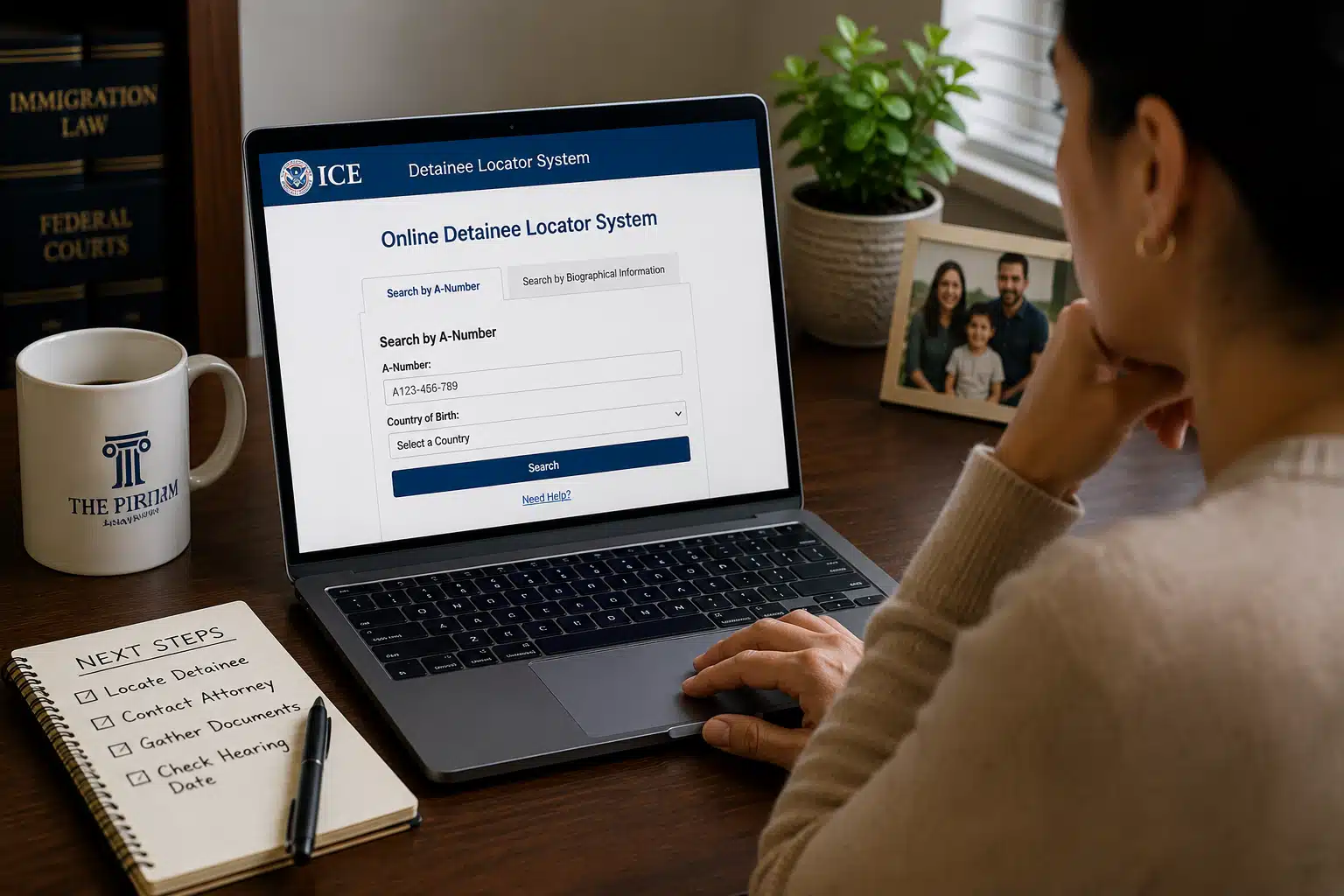
When someone is unexpectedly taken into ICE custody, families often face an immediate problem:
They do not know where the person went.
A family member may have been taken by ICE after leaving a county jail, during an immigration check-in, at home, at work, or following another encounter with immigration officers.
Then the phone calls stop.
The family may know ICE has the person but have no idea whether they are still in Dallas, have been moved toward Fort Worth, are being processed, or have already been transferred to an immigration detention facility somewhere else in Texas.
Fortunately, there are several ways to begin locating someone in ICE custody.
The most important piece of information is often the person’s A-Number.
If your family member has been detained, The Piri Law Firm handles ICE detention and immigration habeas corpus cases throughout the Dallas-Fort Worth area.
Quick Answer: How Do I Find Someone Detained by ICE?
Start with ICE’s Online Detainee Locator System (ODLS).
ICE says there are two primary ways to search:
A-Number + country of birth
or
First name + last name + country of birth
ICE identifies the A-Number method as the best way to search when that number is available. The system uses exact-match information, so spelling and identifying information matter.
ICE Online Detainee Locator System
If the person does not appear immediately, do not automatically assume ICE does not have them. A newly detained person may still be undergoing intake or transfer.
What Is an A-Number?
An A-Number—or Alien Registration Number—is a unique identification number used in the immigration system.
ICE’s detainee-locator guidance describes it as a nine-digit identification number and notes that it may begin with zeros.
For a detained person, this number can be extremely useful because it may connect several parts of the immigration case.
You may need it to:
- Locate the detainee
- Check immigration court information
- Identify previous immigration proceedings
- Communicate with an attorney
- Request immigration records
- Track a pending BIA case
When ICE processes someone into detention, ICE’s detainee handbook instructs detainees to share their A-Number with family and counsel so they can use it to locate the person through ODLS.
Where Can I Find the A-Number?
Before assuming you do not have it, search the person’s existing immigration paperwork.
The A-Number may appear on documents such as:
- Notice to Appear
- Immigration court notices
- Previous removal paperwork
- Employment authorization documents
- USCIS correspondence
- BIA documents
- Prior immigration applications
- Attorney correspondence
ICE specifically notes that an A-Number can be found on the Notice to Appear, Form I-862.
Look for a number marked something similar to:
A 123 456 789
Older paperwork may contain an eight-digit A-Number. Immigration systems may require adding a leading zero when entering an older eight-digit number. EOIR’s practice materials specifically describe that formatting issue for its automated case system.
How to Search the ICE Detainee Locator With an A-Number
If you have the A-Number, this should usually be your first search.
Go to:
Select the A-Number search.
Enter:
The detainee’s A-Number
and
Country of birth
ICE states that an A-Number search is generally preferable because each person has a unique A-Number.
Be careful when entering the number.
A single incorrect digit can prevent you from locating the correct person.
What If I Don’t Know the A-Number?
You can still search.
ICE permits searches using biographical information.
That generally requires the detainee’s:
First name
Last name
and
Country of birth
Depending on the locator interface and results, other identifying information may help distinguish people with similar names.
But name searches can be more difficult.
The Name Must Match ICE’s Record
One of the most common reasons families cannot locate someone is surprisingly simple:
The name does not match.
ICE says ODLS performs an exact-match search.
That can create problems for people with:
- Two surnames
- Hyphenated surnames
- Multiple given names
- Middle names used as first names
- Different spellings
- Maiden names
- Transliteration differences
- Names that were entered incorrectly during processing
Suppose your family knows someone as:
José Martinez
but immigration records identify him as:
José Antonio Martinez-Garcia
Searching the shorter version may not necessarily produce the expected result.
Try the exact name appearing on immigration paperwork.
What If the ICE Locator Says No Records Found?
Do not immediately conclude that the person is not in immigration custody.
First, verify:
- Every digit of the A-Number
- Country of birth
- Exact legal name
- Both surnames
- Hyphens
- Spelling
- Whether an older A-Number needs a leading zero
ICE’s own guidance says that if someone cannot be located through ODLS, the appropriate ICE Enforcement and Removal Operations field office can be contacted.
For Dallas-area cases, ICE currently lists its Dallas Field Office at 8101 N. Stemmons Freeway, Dallas, TX 75247, with the office covering North Texas, East Texas, and the Texas Panhandle.
ICE Dallas Field Office information
How Soon After an Arrest Will Someone Appear in the Locator?
Do not expect every newly detained person to appear immediately.
Someone arrested very recently may still be:
- Going through processing
- Waiting for a custody placement
- Being transported
- Moving between facilities
That means the person’s location can change during the first stages of detention.
If you know ICE arrested the person but ODLS produces no result, continue checking while gathering the person’s immigration records and contacting counsel.
Can ICE Move Someone Out of Dallas?
Yes.
This is particularly important for Dallas-Fort Worth families.
Being arrested in Dallas does not guarantee that the person will remain in Dallas.
ICE can transfer detainees within its detention network.
Prairieland Detention Facility in Alvarado, for example, operates under oversight of ICE Enforcement and Removal Operations Dallas.
Someone arrested in the metroplex can therefore end up outside Dallas County or Tarrant County.
Transfers can also occur after the person has already spent time at another facility.
Why You Should Confirm the Facility Before Driving There
Do not assume that the facility where someone was held yesterday is where they remain today.
Before making a long trip:
- Check ODLS again.
- Confirm the facility.
- Review the facility’s current visitation rules.
- Verify visitation hours.
- Determine what identification visitors need.
This is particularly important when a person is actively being processed or transferred.
How to Check the Person’s Immigration Court Case
Locating the detainee answers one question.
It does not tell you why ICE is holding them.
The next step is often determining whether the person has an immigration court case.
EOIR operates an Automated Case Information System for certain immigration court and BIA cases.
EOIR Automated Case Information System
The system requests an A-Number and nationality.
Depending on the case, it may provide information concerning:
- Upcoming immigration court proceedings
- Case status
- Immigration judge decisions
- BIA proceedings
But there are important limitations.
EOIR states that not all cases or all information are displayed, and its online system provides information about the primary case only. Official documents from the immigration court or BIA remain controlling.
Why Doesn’t the EOIR System Show the Bond Hearing?
Because bond proceedings are treated separately.
EOIR specifically tells users of its Automated Case Information System to contact the local court when they need bond-hearing information.
That means a family should not assume:
No bond hearing appears online = no bond hearing exists.
An attorney may need to contact the immigration court and review the custody proceedings separately.
Finding Someone Is Only Step One
Once you know where the person is detained, the most important legal question becomes:
Why is ICE holding them?
The answer determines what options may exist.
An attorney may need to determine whether the detainee:
- Has pending removal proceedings
- Has a final removal order
- May qualify for immigration bond
- Is allegedly subject to mandatory detention
- Has previously been deported
- Has an in absentia removal order
- Has pending immigration relief
- Can challenge continued detention
- Needs emergency protection against removal
This is why locating the person and reviewing the immigration history should happen together.
For a broader overview, read What Happens After ICE Arrests Someone in Dallas?.
What If the Person Has a Final Removal Order?
This requires quick attention.
Someone with an existing final removal order can be in a very different position from someone whose removal case is just beginning.
An attorney may need to determine:
- When the order was entered
- Whether the person attended the hearing
- Whether proper notice was provided
- Whether an appeal was filed
- Whether reopening may be possible
- Whether circumstances have changed
- Whether removal is imminent
- Whether a stay may be necessary
Do not assume ICE will necessarily give the family weeks or months to investigate these questions.
What If the Person Missed Immigration Court Years Ago?
Some detainees discover only after an ICE arrest that an immigration judge entered a removal order in their absence.
This is called an in absentia removal order.
Depending on the circumstances, a motion to reopen may potentially be available.
Issues can include whether the person received proper notice of the hearing and whether another legally recognized ground for reopening exists.
The immigration court file becomes extremely important.
What If the Person Is Eligible for Bond?
Some detainees can ask an immigration judge to review custody and set an immigration bond.
Others may be held under detention provisions that restrict ordinary immigration judge bond authority.
The fact that someone is in ICE custody does not tell you which category applies.
Counsel may need to review:
- Immigration history
- Criminal history
- Manner of entry
- Prior removal proceedings
- Current charges of removability
- Statutory basis for detention
Our next article in this series will explain immigration bond versus federal habeas corpus and why those are two different ways detention issues can arise.
What If ICE Says There Is No Bond?
Families sometimes hear:
“No bond.”
That phrase requires more investigation.
It could mean ICE has declined to release the person on bond.
It could mean the government believes an immigration judge lacks ordinary bond jurisdiction.
It could involve a prior removal order.
Or it could involve another statutory detention issue.
“No bond” should therefore be treated as the beginning of the legal analysis—not necessarily the end.
When Can Habeas Corpus Become Relevant?
In appropriate circumstances, detention itself may be challenged through a petition for writ of habeas corpus in federal court.
An immigration habeas case can raise questions concerning the legal authority for continued detention or the procedures provided to the detainee.
Habeas corpus is not the same thing as an immigration bond hearing.
A bond proceeding generally takes place within the immigration adjudication system.
A habeas petition is federal litigation challenging custody.
The Piri Law Firm handles immigration habeas corpus cases in Dallas-Fort Worth.
What Documents Should the Family Gather?
While trying to locate the detainee, start building a file.
Look for:
- Passport
- A-Number
- Notice to Appear
- Immigration court notices
- USCIS receipts
- Work permits
- Prior removal documents
- BIA decisions
- Immigration applications
- Marriage certificates
- Children’s birth certificates
- Criminal court dispositions
- Prior attorney information
Do not throw away old immigration documents because they appear outdated.
A document from ten years ago can contain information that becomes extremely important after an ICE arrest.
Should the Family Request the Immigration File?
Sometimes.
Depending on what records are missing, counsel may need records from EOIR, DHS, USCIS, or another agency.
EOIR maintains a Freedom of Information Act/Public Access Link system through which qualifying immigration court records can be requested.
But FOIA is not a substitute for immediate legal action when someone is detained and facing an urgent deadline.
An attorney may need to begin working with the documents already available while additional records are requested.
Can an Attorney Speak With Someone in ICE Detention?
Yes, subject to applicable detention-facility procedures.
ICE’s legal-access guidance recognizes attorney communications and legal visitation for detained individuals. It also instructs legal representatives to use ODLS to locate detainees and, if necessary, contact the relevant ICE field office.
Once the facility is identified, counsel can determine its procedures for:
- Legal calls
- Attorney visitation
- Legal mail
- Document delivery
- Representation paperwork
This is another reason locating the correct facility quickly matters.
What Should You Tell an Immigration Attorney?
When contacting counsel, provide as much concrete information as possible.
Instead of only saying:
“ICE took my husband.”
Try to provide:
- Full legal name
- A-Number
- Date of birth
- Country of birth
- Date of arrest
- Where the arrest occurred
- Current detention facility, if known
- Prior immigration cases
- Prior deportations
- Criminal history
- Upcoming hearings
- Copies of immigration documents
This can significantly speed up the initial case review.
What If ICE Detained Someone After a Dallas County Arrest?
Immigration custody and local criminal custody are separate systems.
A person may first be held by a local law-enforcement agency and later transferred or released into ICE custody.
Once that happens, family members who were previously able to locate the person through a county jail system may suddenly see that the person is no longer there.
That is when checking ODLS becomes especially important.
The next article in this series will address ICE holds and transfers after Dallas County custody in more detail.
What If Someone Was Arrested in Fort Worth?
The same basic search process applies.
Use the ICE Online Detainee Locator rather than assuming someone arrested in Fort Worth will remain in a Tarrant County facility.
ICE’s Dallas Field Office covers North Texas, so immigration enforcement and detention logistics extend across the broader region.
A Fort Worth arrest can therefore lead to detention somewhere else in North Texas or beyond.
Frequently Asked Questions About Finding Someone in ICE Custody
What is the fastest way to find someone detained by ICE?
Start with ICE’s Online Detainee Locator System. When available, use the person’s A-Number and country of birth because ICE identifies this as the best search method.
Can I find someone without their A-Number?
Yes. ODLS also allows a biographical search using identifying information such as first and last name and country of birth. Exact spelling is important.
Why can’t I find someone ICE just arrested?
The person may still be undergoing processing or transfer, or the information being entered may not exactly match ICE’s record.
Can ICE move someone arrested in Dallas to another city?
Yes. ICE detention is not limited to the city where the arrest occurred.
How do I find the detainee’s immigration court date?
EOIR’s Automated Case Information System provides basic information for certain immigration court and BIA cases. However, not every case or proceeding appears in the system.
Will the EOIR website show a bond hearing?
Not necessarily. EOIR specifically directs people seeking bond-hearing information to contact the local immigration court.
What is Prairieland Detention Facility?
Prairieland is an immigration detention facility in Alvarado, Texas, operating under oversight of ICE’s Dallas Enforcement and Removal Operations office.
What should I do after I find the detainee?
Determine why ICE is holding the person, whether there is an existing removal order, whether bond is available, and whether another detention remedy such as federal habeas corpus should be evaluated.
Talk to a Dallas-Fort Worth ICE Detention Attorney
Finding the person is the first problem.
Understanding why they are detained and how to pursue release is the next one.
Once the detainee is located, an attorney can begin evaluating the immigration history, custody authority, bond eligibility, existing removal orders, pending court proceedings, and whether a federal detention challenge may be appropriate.
The Piri Law Firm represents families throughout North Texas in ICE detention and immigration habeas corpus matters.
Call (833) 600-0029 to discuss a detention case.
This article is general information and is not legal advice. Detention locations, procedures, custody authority, and available remedies depend on the individual case.