
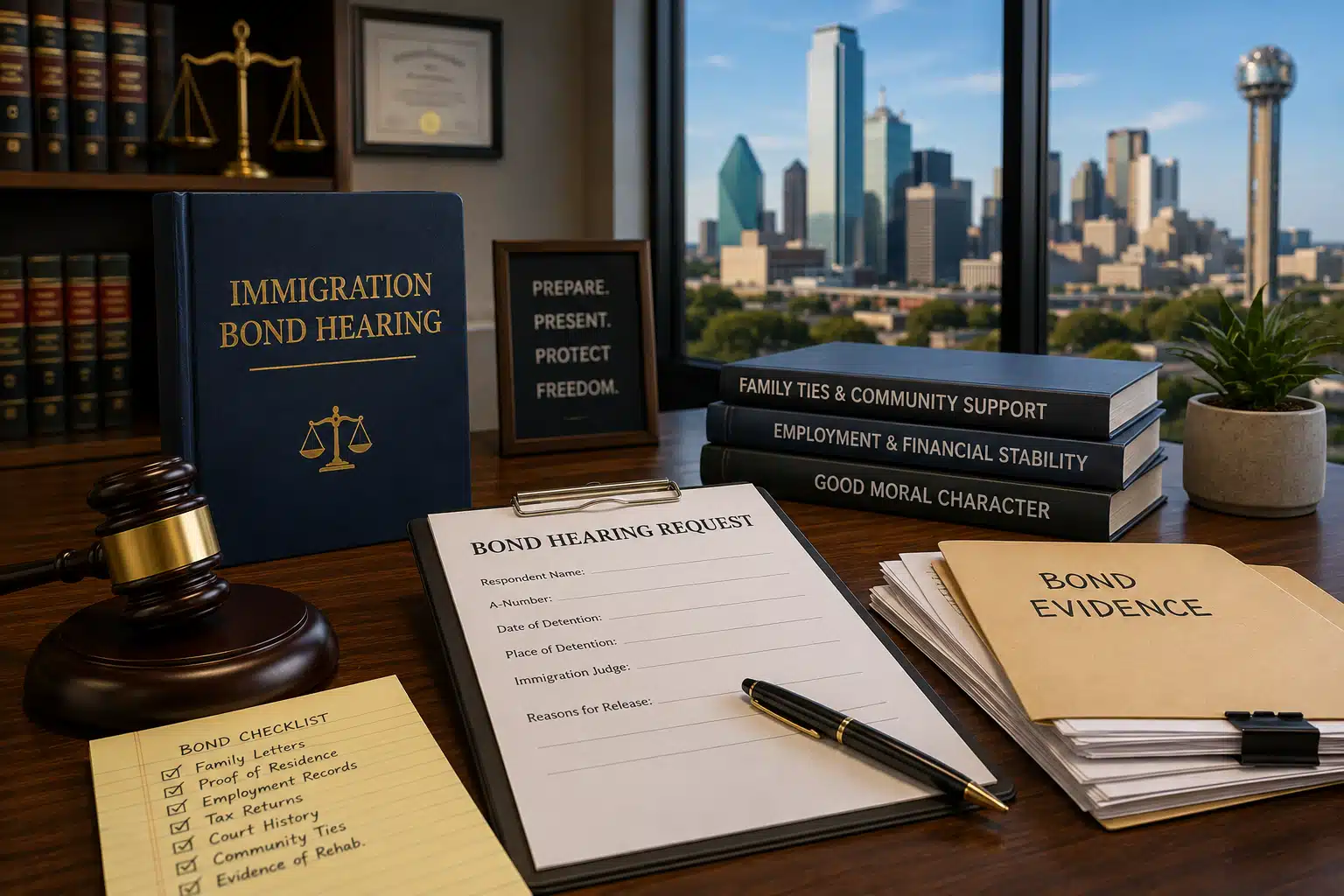
When ICE detains someone in Dallas or Fort Worth, one of the first questions families ask is:
Can we get an immigration judge to set a bond?
For some detainees, the answer may be yes.
An immigration bond can potentially allow an eligible detainee to leave ICE custody while continuing to fight the underlying immigration case.
But an immigration bond hearing does not happen in every case, and not every detainee falls within an immigration judge’s bond jurisdiction.
The first step is determining why ICE is holding the person and whether the immigration court has authority to review that custody decision.
The Piri Law Firm handles ICE detention and immigration habeas corpus cases throughout Dallas-Fort Worth, including cases involving immigration bond and prolonged detention.
Quick Answer: How Do You Request an Immigration Bond Hearing?
EOIR’s Immigration Court Practice Manual provides that a request for bond redetermination may be made orally or in writing.
There is no filing fee for the request.
For detained respondents, where the request is filed generally depends on which immigration court has jurisdiction over the place of detention.
That makes the detainee’s current location important.
Someone arrested in Dallas may later be transferred to an ICE detention facility elsewhere in North Texas.
Before requesting bond, counsel should determine:
- Where the person is detained
- Which immigration court has jurisdiction
- Whether the immigration judge has bond authority
- Which detention statute applies
- Whether ICE has made an initial custody determination
- Whether a final removal order exists
What Is an Immigration Bond Hearing?
An immigration bond hearing is a custody proceeding before an immigration judge.
The issue is not whether the person ultimately wins the immigration case.
The issue is whether the person can be released from ICE custody while that case continues.
EOIR specifically treats bond proceedings as separate from removal proceedings.
This distinction is extremely important.
A person can win bond and later lose the removal case.
Likewise, a person may have a potentially strong immigration case while remaining detained because custody is governed by a separate legal analysis.
Is Immigration Bond the Same as Criminal Bond?
No.
This causes enormous confusion after Dallas County and Tarrant County arrests.
A criminal bond concerns release from state or local criminal custody.
An immigration bond concerns release from federal immigration detention.
Paying the Dallas County or Tarrant County criminal bond does not necessarily prevent ICE from taking custody afterward.
We explain this process in our guides to ICE holds in Dallas County and ICE holds after Fort Worth and Tarrant County arrests.
Who Can Get an Immigration Bond Hearing?
Not every person detained by ICE is entitled to ordinary bond review before an immigration judge.
EOIR’s current practice guidance identifies categories where immigration judges lack bond jurisdiction, including certain arriving aliens and people subject to other statutory detention provisions.
The analysis can depend on:
- Immigration status
- Manner of entry
- Criminal convictions
- Prior removal history
- Existing removal orders
- Current removal charges
- Which detention statute DHS invokes
This is why comparing one detainee’s case to another detainee at the same facility can be misleading.
What Does Mandatory Detention Mean?
Federal immigration law requires detention of certain noncitizens under specified circumstances.
Criminal history is frequently important to this analysis.
But determining whether mandatory detention actually applies can require examining the exact:
- Criminal statute
- Plea
- Judgment
- Sentence
- Disposition
- Immigration status
- Removal charge
Do not rely solely on statements such as:
“It was only probation.”
or
“It was only a misdemeanor.”
Those descriptions may not answer the immigration question.
What If ICE Says “No Bond”?
Families frequently hear:
“ICE gave him no bond.”
That does not necessarily mean the legal analysis is finished.
There is an important difference between ICE declining to set a bond and an immigration judge lacking jurisdiction to review custody.
Counsel should determine:
Did ICE simply refuse release?
or
Does the government contend that the immigration judge legally cannot set bond?
Those are different problems.
Our guide to immigration bond versus federal habeas corpus explains why that distinction can matter.
How Do You Actually Request the Hearing?
EOIR states that a bond redetermination request can be made orally or in writing.
A written request should clearly identify the proceeding as a bond redetermination request rather than mixing it into filings concerning the removal case.
An attorney may also prepare supporting evidence before or in connection with the hearing.
The goal is not merely to obtain a court date.
The goal is to arrive at that court date prepared to establish why release is appropriate under the applicable legal standard.
How Quickly Can You Ask for Bond?
Where ordinary bond jurisdiction exists, a detainee does not have to wait six months merely to make the initial bond request.
Bond redetermination follows the government’s initial custody determination and can be requested while the removal case remains pending.
That is one reason families should seek legal review soon after detention.
Waiting several months because someone told you there is a mandatory waiting period could waste valuable time.
What Evidence Should Be Prepared?
A bond hearing should be treated as a serious evidentiary proceeding.
Depending on the circumstances, useful evidence can include:
- Proof of residence
- Marriage certificate
- Children’s birth certificates
- Employment verification
- Tax records
- Pay records
- Letters from employers
- Community support letters
- Church or organizational involvement
- Criminal dispositions
- Evidence of rehabilitation
- Treatment or counseling records where appropriate
- Evidence of immigration relief
- Evidence concerning prior court attendance
- Proposed residence after release
The exact evidence should be selected strategically.
Submitting a large pile of documents without explaining their relevance is not necessarily the best approach.
Family Ties Can Matter
A detainee with a spouse, children, parents, or other close relatives in Dallas-Fort Worth may be able to document those connections.
Potential evidence can include:
- Marriage certificates
- Birth certificates
- Family photographs
- Proof of shared residence
- School records
- Financial support records
- Statements from relatives
Family ties can help establish that the person has meaningful connections to the community.
But family ties alone do not guarantee bond.
Employment Can Matter
Evidence of stable employment may also be useful.
That might include:
- Employer letter
- Pay stubs
- Tax returns
- Employment records
- Offer of continued employment after release
An employer letter is generally more useful when it provides specific information rather than simply saying the detainee is a good person.
It can explain:
- How long the person worked there
- Their responsibilities
- Reliability
- Whether employment remains available
- Why the employer supports release
Community Support Can Matter
Community evidence may include letters from:
- Religious leaders
- Neighbors
- Teachers
- Coaches
- Employers
- Coworkers
- Community organizations
Again, quality matters more than volume.
A specific letter describing the writer’s relationship with the detainee is generally more useful than a generic form letter.
Criminal History Must Be Addressed Directly
If the detainee has criminal history, pretending it does not exist is rarely an effective strategy.
Counsel should obtain the actual records and determine how to address them.
Important evidence can include:
- Certified disposition
- Sentence completion
- Probation completion
- Counseling
- Substance-abuse treatment
- Anger-management programs
- Employment after the offense
- Time since the offense
- Evidence of rehabilitation
The appropriate presentation depends on the case.
What Does the Judge Consider?
The bond analysis frequently focuses on whether release is appropriate under immigration custody standards, including issues involving danger and appearance at future proceedings.
The immigration judge can consider a variety of evidence relevant to custody.
That is why a good bond presentation usually addresses both:
Why the person is not a danger
and
Why the person will continue appearing for immigration proceedings.
Ignoring either side can weaken the request.
How Do You Show Someone Will Appear for Court?
Evidence can include strong ties to Dallas-Fort Worth and a history of complying with legal obligations.
For example:
- Long-term residence
- Immediate family nearby
- Stable address
- Employment
- Prior court attendance
- Pending immigration relief
- Attorney representation
- Community involvement
The stronger the evidence showing that the detainee has a reason to remain engaged with the immigration process, the better counsel can address flight-risk concerns.
Does Having an Immigration Case Help?
Potentially.
A person with a viable application or defense may have a strong incentive to continue appearing for proceedings.
Depending on the facts, the underlying case could involve:
- Asylum
- Cancellation of removal
- Adjustment of status
- Waivers
- Withholding of removal
- Convention Against Torture protection
- Other immigration relief
The bond hearing does not decide those applications, but their existence can be relevant to the overall custody presentation.
Where Will the Bond Hearing Take Place?
That depends in part on where the person is detained and which immigration court has jurisdiction.
This is especially relevant in Dallas-Fort Worth because ICE can transfer detainees.
Someone arrested in Dallas might later be held at Prairieland Detention Facility.
Our Prairieland Detention Facility guide explains what families should know after a transfer there.
What Happens at the Bond Hearing?
Procedures can vary, but the immigration judge generally considers the custody request and evidence from the parties.
Counsel may present documents and legal argument addressing why release is appropriate.
DHS may oppose the request.
The judge can then make a custody determination within the scope of the judge’s authority.
Families should not think of the hearing as a casual conversation with the judge.
Preparation matters.
How Much Is an Immigration Bond?
There is no single bond amount applicable to every detainee.
The amount depends on the immigration judge’s custody determination and applicable law.
Families should also distinguish between:
being legally eligible for bond
and
being able to afford the amount ultimately set.
Those are separate problems.
Can the Judge Lower a Bond ICE Already Set?
Where the immigration judge has bond-redetermination jurisdiction, the judge can review DHS’s custody determination.
That is one of the primary reasons to request a bond redetermination.
But jurisdiction needs to exist first.
If the immigration judge lacks jurisdiction over the person’s detention, simply requesting a lower amount will not solve that threshold issue.
What If Bond Is Denied?
A denial does not necessarily end every possible legal avenue.
Depending on the case, the custody determination may be appealable to the Board of Immigration Appeals.
Counsel should also examine why bond was denied.
There is a difference between:
The judge considered bond and denied release
and
The judge concluded there was no jurisdiction to consider bond.
Those situations can lead to different next steps.
Can You Ask for Another Bond Hearing Later?
Possibly, but not merely because the detainee wants a second attempt.
EOIR regulations provide that after an initial bond redetermination, a subsequent request generally requires showing that the detainee’s circumstances have materially changed since the prior determination.
That makes preparation for the first bond hearing particularly important.
What Counts as Changed Circumstances?
There is no single list applicable to every case.
Depending on the situation, counsel might evaluate developments involving:
- Criminal proceedings
- Immigration relief
- Family circumstances
- New evidence
- Rehabilitation
- Passage of time
- Other developments affecting custody
The change needs to be legally meaningful to the custody question.
Can the Government Appeal if Bond Is Granted?
Immigration custody decisions can involve BIA review.
The effect of an appeal and whether release occurs immediately can depend on the type of custody case and applicable stay rules.
Counsel should therefore consider not only how to obtain a favorable bond ruling but what happens procedurally after that ruling.
How Is an Immigration Bond Posted?
ICE provides procedures for posting immigration bonds after bond has been authorized.
Current procedures should always be verified directly with ICE before payment because acceptable methods and locations can change.
Do not send money to someone claiming they can privately “pay ICE” without verifying the process.
Does Paying Bond End the Immigration Case?
No.
This is critical.
Bond means the person is potentially released from detention.
It does not mean:
- The removal case was dismissed
- Immigration status was granted
- A deportation order disappeared
- Court hearings can be ignored
After release, the person must continue complying with the immigration process.
What If the Person Has a Final Removal Order?
Ordinary immigration bond may work differently—or may not be available—once a final removal order exists.
Counsel should determine:
- When the order became final
- Whether an appeal is pending
- Whether reopening is possible
- Whether removal is stayed
- Whether ICE is attempting removal
- Which detention statute applies
A detainee with a final order should not assume that the same bond rules apply as they would in a pending removal proceeding.
What If a BIA Appeal Is Pending?
A detainee may remain in custody while a BIA appeal proceeds.
The appeal concerning the removal decision and the custody question are separate.
The Piri Law Firm handles BIA appeals in addition to ICE detention matters.
If the immigration judge recently issued an unfavorable decision, counsel should review the appeal deadline immediately rather than waiting for the bond issue to be resolved.
What If the Person Cannot Get a Bond Hearing?
This is where the detention analysis becomes particularly important.
The attorney should determine why ordinary bond review is unavailable.
If detention continues, questions can arise concerning:
- Statutory custody authority
- Length of detention
- Adequacy of custody procedures
- Final-order detention
- Constitutional due process
In appropriate cases, federal habeas corpus may need to be evaluated.
Immigration Bond vs. Habeas Corpus
These are different legal remedies.
An immigration bond hearing occurs within the immigration court system.
A habeas corpus petition is federal litigation challenging the legality of detention.
Someone who cannot obtain ordinary immigration bond does not automatically have a winning habeas case.
But “no bond” should not automatically end the legal investigation either.
Read ICE Detention in Texas: Immigration Bond vs. Habeas Corpus for the complete comparison.
How Long Can ICE Hold Someone Without Bond?
There is no universal number of days.
Some detainees can request bond relatively early.
Others fall into different detention frameworks.
If detention continues, the legal analysis can change over time.
Our guide explains how long ICE can hold someone in Texas without a bond hearing.
What Should Families Do Immediately?
Once ICE detention is confirmed, families can help by gathering the documents counsel may need:
- A-Number
- Notice to Appear
- ICE custody paperwork
- Criminal dispositions
- Immigration judge decisions
- BIA decisions
- Prior removal orders
- Proof of residence
- Marriage certificate
- Children’s birth certificates
- Employment records
- Tax records
- Community support
- Evidence of rehabilitation
Do not wait until the morning of the bond hearing to begin gathering evidence.
Frequently Asked Questions About Immigration Bond Hearings
How do I request an immigration bond hearing?
Where the immigration judge has jurisdiction, EOIR permits a bond redetermination request to be made orally or in writing. There is no filing fee for the bond request.
Does every ICE detainee get a bond hearing?
No. Immigration judges lack ordinary bond jurisdiction over certain categories of detainees.
Do I have to wait six months to ask for immigration bond?
Not when ordinary immigration-judge bond jurisdiction exists. Initial bond redetermination can be requested without waiting for a universal six-month period.
Is immigration bond the same as criminal bond?
No. Criminal bond concerns release from criminal custody. Immigration bond concerns release from federal immigration detention.
What evidence helps at an immigration bond hearing?
Depending on the case, evidence can include family ties, residence, employment, community support, criminal dispositions, rehabilitation, prior court compliance, and evidence concerning available immigration relief.
Can an immigration judge lower the bond ICE set?
When the judge has bond-redetermination jurisdiction, the immigration judge can review DHS’s custody determination.
Can I request another bond hearing if the first one is denied?
Potentially, but subsequent bond requests generally require showing materially changed circumstances.
Does winning bond mean the deportation case is over?
No. Bond concerns detention. The underlying immigration case continues after release.
What if the immigration judge says there is no bond jurisdiction?
Counsel should determine the legal basis for that conclusion and whether another detention remedy, including potential federal habeas litigation, should be evaluated.
Talk to a Dallas–Fort Worth Immigration Bond Attorney
The most important question after ICE detention is not simply:
“How much is the bond?”
First determine:
Does the person qualify for bond?
Does the immigration judge have jurisdiction?
What evidence should be presented?
Does criminal history create a detention problem?
Is there already a removal order?
What happens if bond is denied or unavailable?
The Piri Law Firm represents immigrants and families throughout North Texas in ICE detention, immigration bond, and habeas corpus matters.
Call (833) 600-0029 to discuss a detention case.
This article provides general information and is not legal advice. Bond jurisdiction, detention authority, procedures, and release options depend on the individual case and current immigration law.