
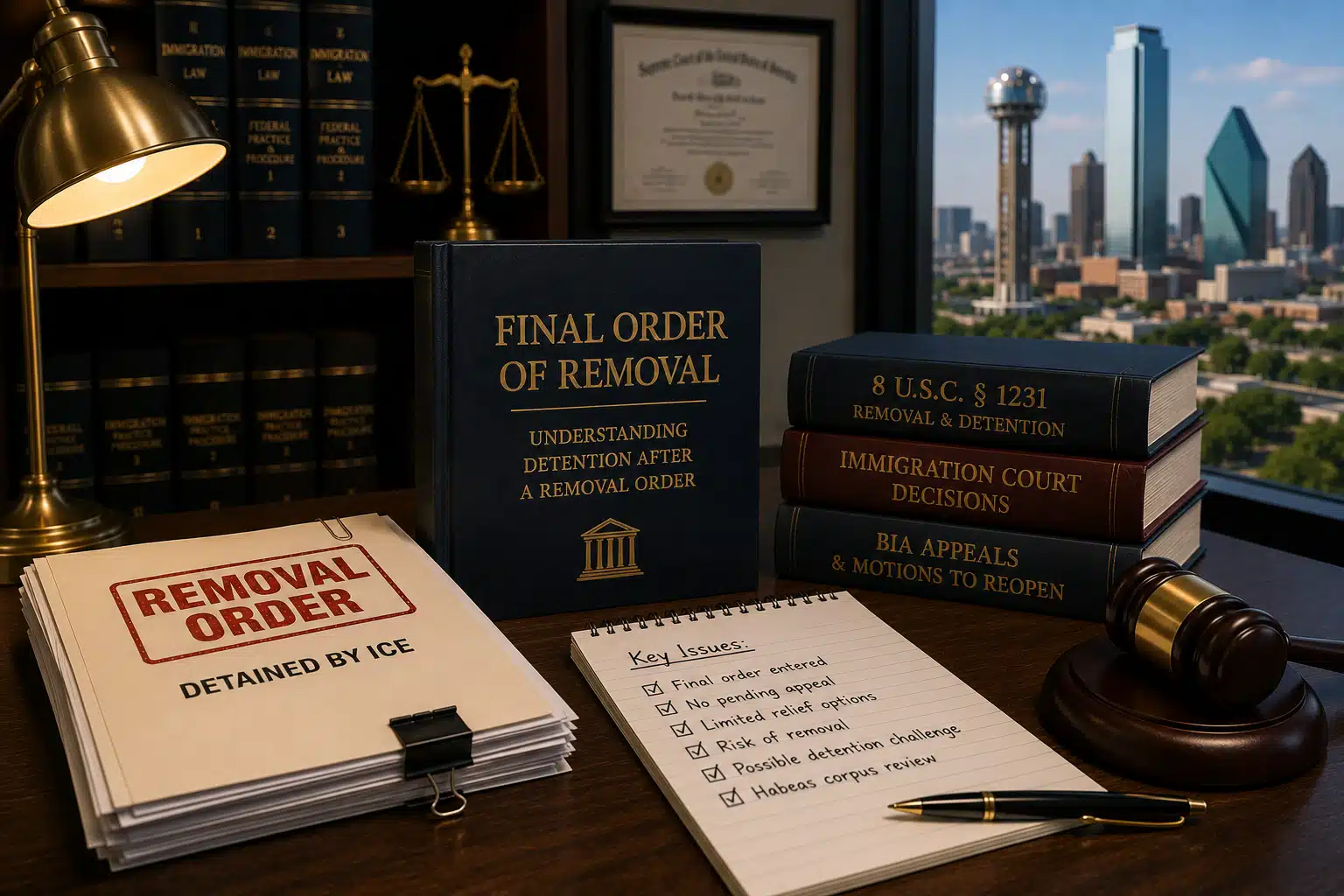
An ICE arrest is frightening by itself.
Then the family learns something they did not expect:
“He already has a final order of removal.”
Sometimes the order is recent.
Sometimes it is years old.
Sometimes the person remembers going to immigration court.
Sometimes they say they never knew a hearing occurred.
And sometimes the first time the family understands the importance of the order is after ICE takes the person into custody.
A final removal order can make an immigration detention case substantially more urgent because ICE may be moving toward actually removing the person from the United States.
But a final order does not answer every question.
Counsel still needs to determine:
When did the order become final?
How was it entered?
Was there an appeal?
Was proper notice provided?
Can the case be reopened?
Is there a stay of removal?
How long has post-order detention continued?
Can ICE realistically accomplish removal?
The Piri Law Firm represents immigrants and their families throughout Dallas-Fort Worth in ICE detention and immigration habeas corpus matters and BIA appeals.
Quick Answer: What Happens When ICE Detains Someone With a Final Removal Order?
When a removal order is administratively final, DHS may generally move toward executing the order.
Federal law under 8 U.S.C. § 1231 establishes a removal-period framework that generally includes a 90-day period during which the government is directed to accomplish removal.
Detention is generally mandatory during the statutory removal period.
But the actual case may be affected by:
- A pending petition for review
- A judicial stay
- A motion to reopen
- An in absentia order
- Withholding or CAT issues
- Travel-document problems
- The destination country’s willingness to accept the person
- Other procedural circumstances
That is why the first step should be obtaining and reviewing the actual immigration record.
What Is a Final Order of Removal?
A removal order directs that a noncitizen be removed from the United States.
The order can become administratively final in different ways depending on the procedural history.
For example, an immigration judge may order removal and no timely BIA appeal is filed.
Or the person may appeal and the Board of Immigration Appeals may dismiss the appeal.
There are other procedural circumstances as well.
The important point is that a final order is different from merely being placed into removal proceedings.
Is a Final Removal Order the Same as an ICE Arrest?
No.
These are separate events.
A person can have a final removal order for years without being continuously detained.
Then ICE may later arrest the person to execute that existing order.
This is one reason families sometimes say:
“But nothing happened for years. Why is ICE doing this now?”
The passage of time alone does not necessarily erase a final removal order.
Can ICE Arrest Someone Years After a Deportation Order?
Potentially, yes.
An outstanding final removal order does not necessarily disappear merely because years have passed.
That means an old immigration case can suddenly become urgent after:
- An ICE encounter
- A local arrest
- A check-in
- Another immigration filing
- Government enforcement activity
Counsel should obtain the old immigration court record rather than relying on the family’s memory of what happened.
What Is the 90-Day Removal Period?
Federal law under 8 U.S.C. § 1231 generally directs DHS to remove a person within a 90-day removal period once that statutory period begins.
Detention is generally required during the removal period.
However, determining exactly when the removal period begins can require analyzing the procedural posture.
The statute addresses circumstances involving administrative finality, judicial review and stays, and release from certain non-immigration confinement.
So do not simply count 90 days from the date ICE arrested the person without first determining whether that is legally the correct starting point.
Does ICE Have to Deport Someone Within 90 Days?
The statute directs the government to accomplish removal during the removal period, but failure to complete removal within 90 days does not automatically mean the person must be released.
Federal law permits continued detention of certain individuals beyond the removal period.
But that does not mean post-removal detention can necessarily continue forever.
That is where prolonged-detention law becomes important.
Can ICE Detain Someone Longer Than 90 Days?
Yes, in circumstances authorized by federal law.
Post-removal detention can extend beyond the initial 90-day period.
However, the Supreme Court has interpreted the statute to avoid authorizing potentially indefinite detention where removal is no longer reasonably foreseeable.
Our guide to prolonged ICE detention in Texas explains this issue in detail.
What Is Zadvydas v. Davis?
Zadvydas v. Davis is a major Supreme Court case concerning detention after a final removal order.
The Court addressed the problem of potentially indefinite immigration detention when the government could not realistically accomplish removal.
The case established an important framework for evaluating certain detention under § 1231(a)(6).
Six months became a presumptively reasonable detention period in that context.
But this is frequently misunderstood.
Does Zadvydas Mean ICE Must Release Everyone After Six Months?
No.
There is no universal six-month automatic release rule.
After the relevant six-month period in a Zadvydas-type case, the detainee generally must provide good reason to believe there is no significant likelihood of removal in the reasonably foreseeable future.
The government then has an opportunity to respond.
So the issue is not merely:
“Has six months passed?”
It is also:
“Can ICE realistically remove this person?”
What Could Prevent ICE From Completing Removal?
Possible issues can include:
- Destination country refuses repatriation
- Citizenship cannot be established
- Travel documents cannot be obtained
- Diplomatic barriers
- Lack of transportation arrangements
- Legal restrictions
- Other obstacles preventing removal
But the existence of paperwork delays does not automatically mean removal is no longer foreseeable.
The facts need to be documented.
What If ICE Has Travel Documents?
That can make removal substantially more imminent.
Families should tell counsel immediately if the detainee reports:
- Passport processing
- Embassy interviews
- Consular interviews
- Travel documents
- Flight information
- Transfer for removal
- Instructions concerning luggage or property
- Scheduled deportation dates
Those facts can change the urgency of the case.
Can You Stop Removal After a Final Order?
Sometimes legal options may remain, but a final order makes timing extremely important.
Potential avenues may include, depending on the circumstances:
- Motion to reopen
- Motion to reconsider
- BIA proceedings
- Federal petition for review
- Request for a stay
- Other appropriate relief
But none of these should be assumed to automatically stop removal.
The procedural posture must be analyzed immediately.
What Is a Motion to Reopen?
A motion to reopen asks the immigration court or BIA to reopen proceedings based on circumstances recognized by immigration law.
The precise requirements depend on the type of case.
Potential issues can involve:
- Lack of notice
- Changed country conditions
- New evidence
- Ineffective assistance claims
- Other recognized grounds
Deadlines and numerical limitations can apply.
Exceptions can also exist.
This is a legal analysis, not simply a request asking the court to give the person another chance.
What If the Person Never Received Notice of Immigration Court?
This can be particularly important when the removal order was entered in absentia.
An in absentia order is generally entered when a person fails to appear for the immigration hearing.
But the fact that the person missed court does not necessarily end the analysis.
Counsel should investigate:
- What address the government used
- Whether the person updated their address
- Where the hearing notice was sent
- Whether notice was returned
- What notices are actually in the court record
- Why the person failed to appear
Lack of proper notice can be highly significant in certain reopening cases.
Does Filing a Motion to Reopen Automatically Stop Deportation?
Do not assume that it does.
A motion to reopen and a stay of removal are separate concepts.
Depending on the procedural posture, additional action may be necessary to prevent removal while the motion is being considered.
If ICE appears to be preparing to remove the detainee, counsel needs to assess the stay issue immediately.
What Is a Stay of Removal?
A stay of removal temporarily prevents DHS from executing a removal order while the stay remains in effect.
Different courts and agencies can have authority to issue stays in different circumstances.
A stay may be:
- Automatic in a specific procedural setting
- Requested administratively
- Requested from the BIA
- Requested from a federal court
- Otherwise governed by applicable law
Do not assume that merely filing an appeal or motion automatically creates a stay.
What If the BIA Just Denied the Appeal?
This can trigger an extremely important deadline.
Federal law generally provides a 30-day deadline for filing a petition for review of a final removal order in the appropriate federal court of appeals.
For Texas cases, that often means the U.S. Court of Appeals for the Fifth Circuit.
The deadline is serious.
Families should not wait several weeks before seeking legal review.
The Piri Law Firm handles BIA appeals and post-BIA immigration matters.
Does Filing a Petition for Review Automatically Stop Removal?
Generally, a petition for review should not be assumed by itself to automatically stay removal.
A separate stay request may be necessary.
That is why a detained case involving a recent BIA denial can require urgent federal appellate analysis.
Can Someone With a Final Removal Order Get Immigration Bond?
Ordinary immigration bond rules may differ once the removal order becomes final.
A person in the post-removal detention framework should not assume that the same immigration-judge bond procedure available earlier in removal proceedings still applies.
This is one reason the exact finality date matters.
If a family is simply told “no bond,” counsel should determine whether the final removal order is the reason.
Read What Does “No Bond” Mean in ICE Detention? for more information.
What If the Person Had Bond Before?
A prior release on immigration bond does not necessarily prevent ICE from detaining the person after the removal order becomes final.
The legal custody framework may change as the immigration case moves through different procedural stages.
Counsel should therefore review both:
- The old bond record
- The current statutory detention authority
Can Habeas Corpus Help Someone With a Final Removal Order?
Potentially.
Federal habeas corpus can become particularly important when the challenge concerns continued detention after the removal order, rather than merely the validity of the removal order itself.
Potential issues can include:
- Prolonged post-removal detention
- Lack of reasonably foreseeable removal
- Statutory detention authority
- Custody procedures
- Constitutional issues
Our guide explains how immigration habeas corpus can apply to ICE detention in Dallas.
Habeas Corpus Does Not Automatically Cancel the Removal Order
This distinction is essential.
A detention habeas case generally challenges custody.
It should not automatically be treated as the procedure for overturning the final removal order itself.
The removal order may need to be addressed through:
- Motion to reopen
- BIA proceedings
- Petition for review
- Other applicable immigration procedures
Meanwhile, detention may present a separate federal habeas issue.
The two tracks can exist at the same time.
What If ICE Cannot Remove the Person?
This can become one of the most important questions after the removal period.
Counsel should investigate whether ICE is actually making progress toward removal.
Evidence might involve:
- Travel-document requests
- Embassy correspondence
- Consular correspondence
- ICE custody-review documents
- Scheduled flights
- Cancelled removal attempts
- Country acceptance issues
- Citizenship disputes
The longer detention continues without a realistic path to removal, the more important this evidence may become.
What If the Detainee Refuses to Sign Travel Documents?
This can hurt the detention challenge.
Federal law addresses situations in which a person fails or refuses to cooperate with efforts necessary to accomplish removal.
The removal period can potentially be extended when the detainee acts to prevent removal.
A detainee considering refusing travel-document procedures should speak with counsel rather than assuming noncooperation will force ICE to release them.
What If the Person Is Afraid to Return to Their Country?
Tell the attorney immediately.
Fear of return can raise issues involving:
- Asylum
- Withholding of removal
- Convention Against Torture
- Changed country conditions
- Motions to reopen
- Other protection-related procedures
The availability of any remedy depends heavily on the person’s procedural history.
Do not assume that a prior removal order means new developments can never matter.
What If Conditions in the Country Have Changed?
Changed country conditions can be significant in certain motions to reopen.
Counsel may need evidence including:
- Country reports
- News reports
- Human-rights documentation
- Expert evidence
- Evidence specific to the detainee
- Evidence showing what changed since the previous proceedings
The issue generally needs to involve genuinely new or materially changed circumstances rather than merely presenting the same claim again.
What If the Person Has Been in the United States for Many Years?
Length of residence can be important to the overall immigration history, but it does not automatically erase a final removal order.
A person who has lived in Dallas for 20 years may still have an enforceable order.
However, long residence may accompany other facts counsel should investigate, such as:
- U.S. citizen family
- New immigration eligibility
- Changed circumstances
- Prior ineffective representation
- Lack of notice
- Other developments since the original proceedings
The complete history matters.
What If the Person Is Married to a U.S. Citizen?
Marriage does not automatically cancel a final removal order.
Potential immigration options depend on factors including:
- Entry history
- Prior orders
- Departures and reentries
- Criminal history
- Existing petitions
- Adjustment eligibility
- Waivers
- Procedural posture
Do not file new applications without understanding how the existing removal order affects the case.
What If the Person Has U.S. Citizen Children?
Having U.S. citizen children does not automatically eliminate a final removal order either.
But family circumstances can be relevant to certain forms of relief and discretionary decisions.
Counsel should document the family situation while separately determining what legal procedure, if any, can address the existing order.
What If ICE Detained the Person After a Dallas County Arrest?
This is a common way an old immigration order can suddenly become critical.
A person may be arrested locally, resolve the criminal custody issue, and then be transferred to ICE based on immigration enforcement.
Our Dallas County ICE hold guide explains what families should know.
The criminal case and old removal order need to be evaluated together because the criminal disposition can also affect immigration options.
What If the Arrest Happened in Fort Worth?
The same situation can occur following Tarrant County custody.
Our Fort Worth and Tarrant County ICE hold guide explains the process.
Again, posting criminal bond does not cancel an immigration removal order.
What If the Person Is at Prairieland?
A Dallas-Fort Worth detainee may be transferred to Prairieland Detention Facility in Alvarado.
If a final order exists, families should determine quickly whether ICE is preparing the detainee for removal.
Our Prairieland Detention Facility guide provides facility-specific information for North Texas families.
What Should Families Ask the Detainee?
Try to determine:
- Did you ever see an immigration judge?
- What did the judge decide?
- Did you appeal?
- Did the BIA issue a decision?
- Did you ever miss immigration court?
- Did you receive hearing notices?
- Have you been deported before?
- Have you returned after deportation?
- Has ICE asked you to sign documents?
- Have you spoken with your consulate?
- Has ICE mentioned travel documents?
- Has ICE given you a removal date?
- Have you received custody-review paperwork?
Write the answers down.
What Documents Should Families Find?
Look for:
- A-Number
- Notice to Appear
- Immigration hearing notices
- Immigration judge decision
- BIA decision
- Removal order
- Prior attorney correspondence
- Motion to reopen
- USCIS filings
- Criminal dispositions
- Passport
- Travel documents
- ICE custody paperwork
- Stay orders
- Federal court documents
Old paperwork can be extremely valuable.
Build a Final-Order Timeline
Create a chronology showing:
Initial immigration proceedings
Immigration judge decision
BIA appeal deadline
BIA appeal filing
BIA decision
Date order became final
Any motion to reopen
Any federal petition for review
Any stay
ICE arrest
Beginning of current detention
Travel-document requests
Custody reviews
Scheduled removal
Failed removal attempts
This timeline allows counsel to understand both the removal case and detention case.
Frequently Asked Questions About Final Removal Orders and ICE Detention
What is a final order of removal?
A final removal order is an administratively final order directing removal from the United States. How an order becomes final depends on the procedural history.
Can ICE arrest someone years after a removal order?
Potentially, yes. An outstanding final removal order does not necessarily disappear simply because years have passed.
Does ICE have 90 days to deport someone?
Federal law generally establishes a 90-day removal period once the statutory removal period begins. However, detention can continue beyond 90 days in circumstances authorized by law.
Does ICE have to release someone after 90 days?
No. Failure to complete removal within 90 days does not automatically require release.
Does ICE have to release someone after six months?
No. Zadvydas does not establish an automatic six-month release rule for every detainee.
Can a final removal order be reopened?
Potentially. Motions to reopen may be available in certain circumstances, but deadlines, procedural requirements, and exceptions depend on the case.
Does filing a motion to reopen automatically stop deportation?
Not necessarily. Counsel should separately determine whether a stay of removal exists or needs to be requested.
Can someone file habeas corpus after a final removal order?
Potentially. Habeas can be relevant when there is a legally supportable challenge to continued detention, particularly in certain prolonged post-removal detention cases.
Does habeas corpus cancel the deportation order?
A detention habeas petition generally should not be treated as automatically cancelling or overturning the final removal order.
What should families do if ICE says removal is scheduled?
Contact immigration counsel immediately and provide the final removal order, BIA documents, prior immigration records, current detention information, and any information about the scheduled removal.
Talk to a Dallas–Fort Worth Attorney About ICE Detention and a Final Removal Order
When someone is detained with a final removal order, waiting can have serious consequences.
Counsel needs to determine:
Is the order actually final?
How was it entered?
Was proper notice provided?
Was there a BIA appeal?
Can the case be reopened?
Does a stay exist?
Is ICE preparing for removal?
When did the removal period begin?
How long has post-order detention continued?
Can ICE realistically accomplish removal?
Could federal habeas corpus become relevant?
The Piri Law Firm represents immigrants and their families throughout North Texas in ICE detention and immigration habeas corpus cases and BIA appeals.
Call (833) 600-0029 to discuss a detained immigration case involving a final removal order.
This article provides general information and does not constitute legal advice. Removal orders, stays, reopening procedures, detention authority, and federal court deadlines are highly fact-specific.