
When someone is arrested by ICE in Dallas or Fort Worth, the family may expect that person to remain somewhere inside the city.
That often isn’t what happens.
A detainee can be transferred outside Dallas or Tarrant County, sometimes before family members even understand where ICE has taken them.
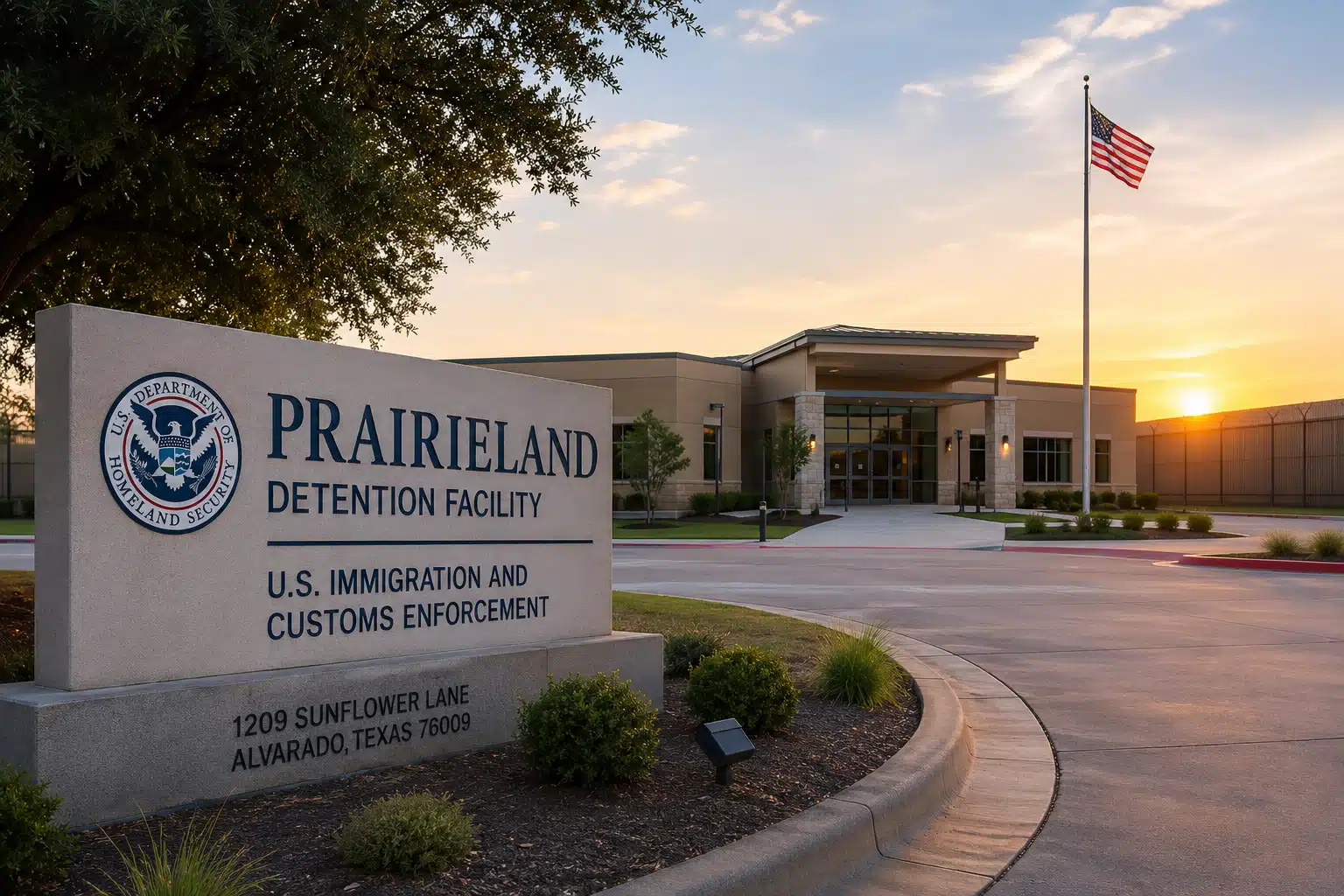
One particularly important detention facility for North Texas families is Prairieland Detention Facility in Alvarado, Texas.
ICE lists Prairieland under its Dallas Field Office at:
1209 Sunflower Lane
Alvarado, TX 76009
(817) 409-3995
If your husband, wife, parent, child, or other family member has been transferred there, locating them is only the first step.
The next questions are usually much more important:
Why is ICE holding them?
Can they get an immigration bond?
Do they already have a removal order?
Is an immigration appeal pending?
Could federal habeas corpus become relevant?
The Piri Law Firm represents detained immigrants and their families in ICE detention and immigration habeas corpus cases throughout Dallas-Fort Worth.
Quick Answer: What Is Prairieland Detention Facility?
Prairieland Detention Facility is an immigration detention facility located in Alvarado, Texas.
ICE identifies it as a detention facility under the Dallas Field Office. Federal inspection records state that the facility opened in 2017 and that ICE Enforcement and Removal Operations began housing detainees there that year under oversight from ERO Dallas.
For Dallas-Fort Worth families, Prairieland is particularly important because someone arrested or taken into immigration custody elsewhere in North Texas can subsequently be transferred there.
An arrest in Dallas does not mean detention will occur in Dallas.
Likewise, someone arrested in Fort Worth does not necessarily remain in Tarrant County.
Where Is Prairieland Detention Facility?
The current address published by ICE is:
Prairieland Detention Facility
1209 Sunflower Lane
Alvarado, TX 76009
Main phone: (817) 409-3995
ICE also lists the Dallas Field Office’s main number as (972) 367-2200.
Official ICE Prairieland Detention Facility page
Because detention information and visitation procedures can change, families should confirm current requirements with the facility before traveling.
How Do I Find Out If Someone Is at Prairieland?
Start with ICE’s Online Detainee Locator System.
The most useful identifying information is generally the person’s:
- A-Number
- Country of birth
- Full legal name
- Date of birth
If you cannot locate the person online but believe they are at Prairieland, ICE says you can call the facility at (817) 409-3995, 24 hours a day, for detainee information.
ICE recommends having the person’s first name, last name, hyphenated names, aliases, date of birth, and country of birth available when calling.
Our complete guide explains how to find someone detained by ICE in Dallas-Fort Worth.
Why Can’t I Find Someone Who Was Just Transferred?
A newly detained person may not immediately appear where the family expects.
There can be a period involving:
- Local jail release
- ICE processing
- Transportation
- Intake
- Facility assignment
- Record updates
For example, someone arrested in Dallas County may disappear from the local jail system before the family has confirmed the new ICE location.
If this happened after a Dallas arrest, read our guide to an ICE hold in Dallas County.
For Fort Worth arrests, see our Tarrant County ICE hold guide.
Can I Call Someone Detained at Prairieland?
ICE states that detainees at Prairieland cannot receive incoming calls.
For an urgent message, ICE instructs callers to contact (817) 409-3995 and provide the detainee’s full name and A-Number, along with the caller’s name and telephone number. The message can then be given to the detainee.
ICE also reports that Prairieland has tablets available for non-confidential messaging.
That distinction is important when communicating about legal matters because ordinary family communications and confidential attorney-client communications are not the same.
Can Families Visit Someone at Prairieland?
Yes, subject to the facility’s rules.
ICE currently states that friends and family visits must be scheduled in advance.
The agency publishes different visitation days based on detainee classification and advises visitors to comply with identification and security requirements.
Because schedules can change, confirm the current visitation day and time before driving to Alvarado.
What Identification Do Visitors Need?
ICE states that adult visitors must present valid, verifiable government-issued identification.
Minors must be accompanied by an adult guardian who is at least 18 years old.
Visitors are subject to facility security procedures and searches, and ICE prohibits visitors from passing items directly to detainees.
Do not bring documents, clothing, electronics, or other property expecting to hand them directly to your family member.
Contact the facility first to determine the correct procedure.
Can an Immigration Attorney Visit a Detainee at Prairieland?
Yes.
ICE currently states that legal visitation at Prairieland does not need to be scheduled in advance and is handled on a first-come, first-served basis.
The currently published attorney visitation hours are:
Monday–Friday: 8:00 a.m.–4:00 p.m.
Weekends and holidays: 8:00 a.m.–12:00 p.m.
ICE also provides procedures for virtual attorney visitation and confidential legal telephone calls.
This can be important when counsel needs to begin reviewing a detention case quickly.
How Does an Attorney Get Information About the Case?
ICE’s Prairieland page currently directs case-information requests involving detainees there to the Dallas Field Office.
ICE also states that an attorney seeking information about a client’s Deportation Officer should have a Form G-28 on file before information can be disclosed.
That is one reason retaining counsel can change how quickly the legal investigation moves.
The attorney can begin determining:
- Why ICE has custody
- Which detention statute applies
- Whether bond is available
- Whether there is a final removal order
- Whether removal proceedings are pending
- Whether a BIA appeal exists
- Whether reopening should be evaluated
- Whether continued detention raises a federal issue
Being at Prairieland Does Not Tell You Why the Person Is Detained
This is critical.
Two people housed at Prairieland may have completely different immigration cases.
One person might have just entered removal proceedings.
Another may already have a final order of removal.
Another may be appealing an immigration judge’s decision.
Another may be attempting to reopen an old case.
Another may be detained while pursuing asylum or another form of relief.
Another may have a custody dispute involving immigration bond.
The detention facility tells you where the person is.
It does not tell you why the government believes it can continue holding them.
Can Someone at Prairieland Get Immigration Bond?
Possibly.
Bond eligibility depends on the legal basis for detention.
Some detainees may be able to ask an immigration judge for bond.
Others may be held under statutes that restrict ordinary immigration-judge bond jurisdiction.
Important factors can include:
- Immigration status
- Manner of entry
- Criminal history
- Prior removal proceedings
- Existing removal orders
- Current charges of removability
- Applicable detention statute
The answer should be based on the person’s actual immigration record rather than what happened in another detainee’s case.
What Does “No Bond” at Prairieland Mean?
Families frequently hear:
“ICE says there is no bond.”
That statement needs to be investigated.
It might mean ICE has not authorized release.
It could mean the government believes mandatory detention applies.
It could mean the immigration judge lacks ordinary bond jurisdiction.
It could involve a final removal order.
Or another custody framework may apply.
“No bond” is therefore not a complete legal explanation.
Read our guide explaining immigration bond versus federal habeas corpus.
How Long Can Someone Be Detained at Prairieland?
There is no single number of days that applies to every detainee.
Some people may seek immigration bond relatively early.
Others may be detained under different statutory provisions.
Someone with a final removal order may fall under a different detention framework from someone whose removal proceedings are still pending.
The length of detention can eventually become legally significant, but there is no universal rule that every ICE detainee automatically receives release after a specific number of months.
Our detailed guide explains how long ICE can hold someone in Texas without a bond hearing.
What Is an Immigration Bond Hearing?
When an immigration judge has custody jurisdiction, a detainee may be able to seek bond redetermination.
A bond case is separate from the underlying removal proceeding.
That means winning bond does not mean the immigration case has been won.
Instead, bond may allow an eligible person to fight the immigration case outside detention.
Evidence may address matters such as:
- Family ties
- Community ties
- Residence
- Employment
- Criminal history
- Rehabilitation
- Court attendance
- Immigration history
- Available immigration relief
- Proposed living arrangements after release
Families can play an important role in gathering this evidence.
What If the Person Has a Criminal Record?
The exact criminal record matters.
Do not simply tell immigration counsel:
“It was just a misdemeanor.”
or
“He got probation.”
The attorney may need the actual:
- Charging instrument
- Statute of conviction
- Plea documents
- Judgment
- Sentence
- Deferred adjudication paperwork
- Dismissal
- Certified disposition
Immigration law can treat criminal dispositions differently from Texas criminal law.
The criminal history may affect both removability and detention.
What If the Person Has a Final Removal Order?
This can make the case significantly more urgent.
Counsel should determine:
- When the order was entered
- Whether the detainee attended the hearing
- Whether notice was proper
- Whether the order was appealed
- Whether reopening may be possible
- Whether removal is imminent
- Whether a stay is available or necessary
- How long post-order detention has continued
Someone with an old removal order may have very different options from someone beginning removal proceedings for the first time.
What If the Removal Order Was Entered Because the Person Missed Court?
That may be an in absentia removal order.
Depending on the circumstances, a motion to reopen can sometimes be pursued.
Potential issues can include lack of proper notice or another legally recognized basis for reopening.
But simply saying:
“I didn’t know about court”
does not automatically erase the removal order.
Counsel needs to obtain and analyze the immigration court record.
What If a BIA Appeal Is Pending?
Detention does not necessarily end merely because a BIA appeal has been filed.
A detainee may continue litigating the underlying immigration case while remaining at Prairieland.
The Piri Law Firm handles BIA appeals and represents clients in the Dallas-Fort Worth area, including dedicated Fort Worth BIA appeals matters. The firm’s published Fort Worth page notes its South Fort Worth presence and North Texas BIA representation.
The appeal and the detention issue need to be evaluated separately.
When Can Habeas Corpus Become Relevant?
Federal habeas corpus can become important in certain immigration detention cases.
A habeas petition is filed in federal district court and challenges the legality of detention.
Potential issues can include:
- Prolonged detention
- Disputes over statutory custody authority
- Lack of adequate custody procedures
- Post-removal-order detention
- Constitutional due-process concerns
- Other allegedly unlawful detention
Habeas corpus is not simply another immigration bond request.
It is federal litigation.
The Piri Law Firm handles immigration habeas corpus cases involving ICE detention in North Texas.
Does Being Detained in Alvarado Matter for Habeas Corpus?
Potentially, yes.
The physical location of a habeas petitioner can matter to federal habeas jurisdiction and venue.
That means an attorney evaluating federal litigation needs to confirm where the person is actually confined, not merely where ICE arrested them.
A person arrested in Dallas but confined in Alvarado is physically detained in a different location from the original arrest.
This is another reason transfer information matters.
What Should Families Gather Immediately?
Do not wait until the attorney has spoken with the detainee to begin collecting documents.
Try to locate:
- A-Number
- Passport
- Notice to Appear
- Immigration court notices
- Immigration judge decisions
- BIA documents
- Prior removal orders
- USCIS receipts
- Work permits
- Green card, if applicable
- Criminal court records
- Marriage certificate
- Children’s birth certificates
- Tax records
- Employment records
- Prior attorney records
Old immigration documents can be extremely important.
Create a Detention Timeline
Write down:
Date of arrest
Where the arrest occurred
Date transferred to ICE
Date transferred to Prairieland
Any previous detention facilities
Immigration hearing dates
Bond requests
Bond decisions
Immigration judge decisions
BIA appeal dates
Removal-order dates
ICE custody reviews
This timeline becomes particularly valuable if detention continues.
Can Prairieland Detainees Get Free Legal Help?
EOIR maintains an official list of pro bono legal service providers.
The July 2026 list for the Dallas Immigration Court specifically states that RAICES accepts cases for people detained at Prairieland Detention Facility. The list also identifies the ABA Commission on Immigration’s detention information resources for detained respondents.
Availability and eligibility can vary, so inclusion on the list does not guarantee representation.
What Should You Tell an Attorney When Calling?
Have as much of the following ready as possible:
- Detainee’s full legal name
- A-Number
- Date of birth
- Country of birth
- Date ICE custody began
- Confirmation of Prairieland detention
- Criminal history
- Prior deportations
- Existing removal orders
- Immigration court dates
- Pending applications
- Copies of immigration paperwork
The more precise the information, the faster counsel can begin determining what type of case exists.
Do Not Wait Until the Next Immigration Hearing
Families sometimes believe nothing can happen until the detainee’s next court date.
That can be a mistake.
Before that hearing, counsel may need to:
- Obtain records
- Analyze bond jurisdiction
- Prepare bond evidence
- Review criminal convictions
- Investigate prior removal orders
- File representation documents
- Evaluate reopening
- Prepare a BIA matter
- Analyze detention duration
- Evaluate federal habeas options
Detention cases often involve multiple legal tracks simultaneously.
Frequently Asked Questions About Prairieland Detention Facility
Where is Prairieland Detention Facility?
ICE lists Prairieland at 1209 Sunflower Lane, Alvarado, Texas 76009.
What is the phone number for Prairieland?
ICE currently lists the facility’s main phone number as (817) 409-3995.
Is Prairieland an ICE detention facility?
Yes. ICE lists Prairieland as a detention facility under its Dallas Field Office.
Can I call a detainee at Prairieland?
Detainees cannot receive incoming calls. ICE provides a procedure for leaving an urgent message through the facility.
Can families visit?
Yes, subject to facility rules. ICE currently requires friends and family visits to be scheduled in advance.
Can an attorney visit?
Yes. ICE currently states that in-person legal visits generally do not require advance scheduling and are handled first come, first served.
Can someone detained at Prairieland get immigration bond?
Possibly. Bond eligibility depends on the statutory basis for detention and the detainee’s individual immigration and criminal history.
Can someone at Prairieland file habeas corpus?
In an appropriate case, a person in immigration detention may seek federal habeas corpus relief challenging allegedly unlawful detention. Whether a viable claim exists depends on the facts, governing statute, procedural history, and controlling law.
Does filing a BIA appeal release someone from Prairieland?
Not automatically. The underlying removal appeal and immigration custody are separate legal issues.
Talk to a Dallas–Fort Worth Attorney About a Prairieland Detention Case
When someone is detained at Prairieland, finding the facility is only the beginning.
The legal investigation needs to answer:
Why is ICE holding the person?
Does an immigration judge have bond jurisdiction?
Is there a final removal order?
Is a BIA appeal pending?
Can an old case be reopened?
How long has the person been detained?
Could federal habeas corpus become relevant?
The Piri Law Firm represents immigrants and their families throughout Dallas-Fort Worth in ICE detention and immigration habeas corpus cases and BIA appeals.
Call (833) 600-0029 to discuss a detention case.
This article provides general information and does not constitute legal advice. Detention procedures, visitation requirements, immigration law, and facility policies can change. Confirm current facility information before relying on it.