
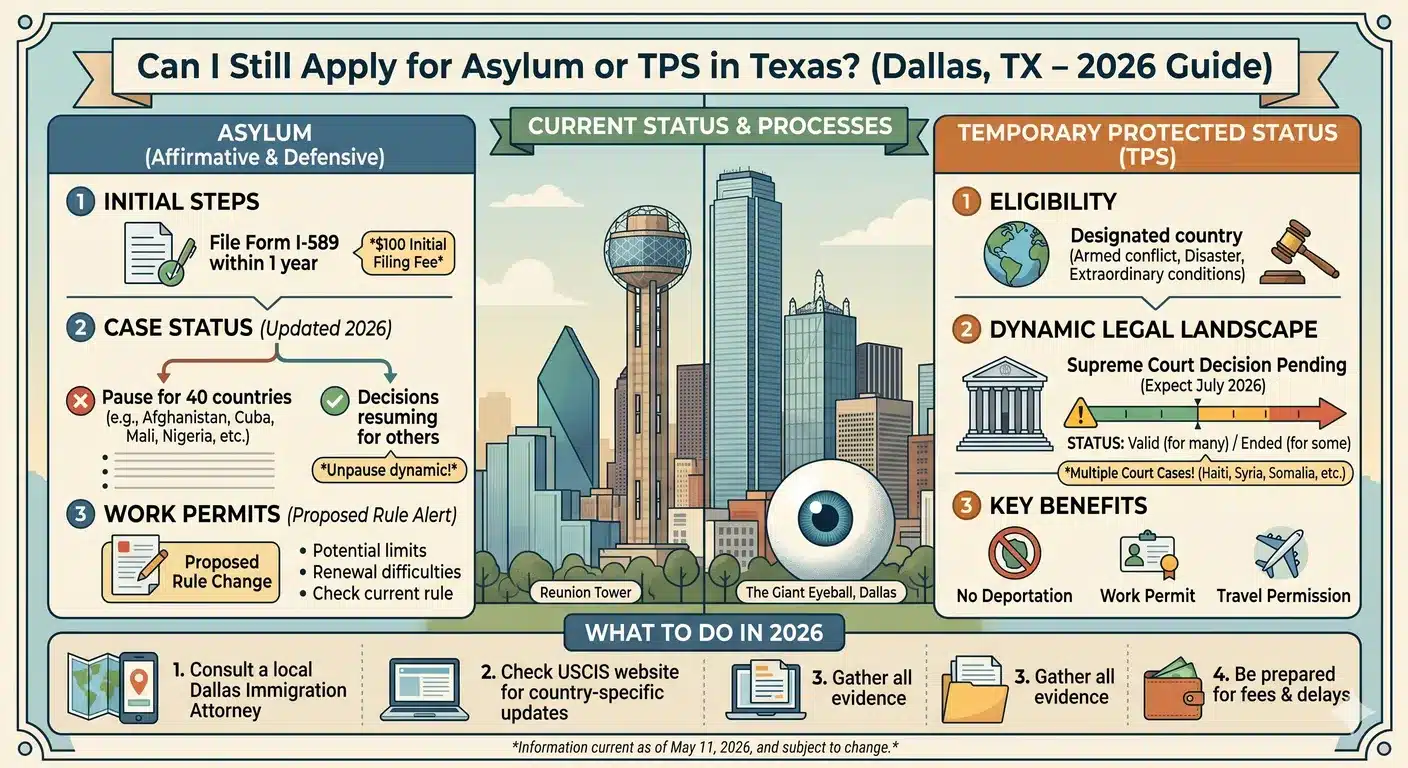
Short answer: Yes. As of May 2026, you can still apply for both asylum and Temporary Protected Status (TPS) while living in Dallas, Texas — but the rules, fees, and processing timelines have changed significantly. Asylum applications (Form I-589) are being accepted nationwide, including for Texas residents, though USCIS has paused decisions on cases from roughly 40 designated countries and a new Annual Asylum Fee (AAF) takes effect May 29, 2026. TPS remains open for new registration only if you are a national of a country with an active, unexpired designation (such as El Salvador, Ukraine, Sudan, Yemen, Somalia, Ethiopia, Burma, Haiti, Lebanon, South Sudan, and Syria as of this writing — most of these are tied up in active court litigation).
If you live in Dallas, Fort Worth, Arlington, Plano, Irving, Garland, or anywhere in North Texas, your case will generally route through the USCIS Dallas Lockbox, the Houston Asylum Office (which covers Texas), or the Dallas Immigration Court depending on your situation. Below is what every Dallas applicant needs to know in 2026.
Can I Apply for Asylum in Texas Right Now?
Yes. USCIS is still accepting Form I-589, Application for Asylum and for Withholding of Removal, from people physically present in the United States. You do not need to be at the border or in detention to apply — and Texas residency does not disqualify you.
To qualify, you must:
- Be physically present in the United States (Dallas counts);
- File within one year of your last arrival in the U.S., unless you qualify for an exception (changed circumstances or extraordinary circumstances); and
- Show past persecution or a well-founded fear of future persecution based on race, religion, nationality, political opinion, or membership in a particular social group.
You can read the official eligibility rules on the USCIS Asylum page and download the form itself from the Form I-589 page.
What Changed in 2026 That Dallas Applicants Need to Know
There are four major changes affecting Texas asylum seekers right now:
1. New Annual Asylum Fee (AAF) effective May 29, 2026. USCIS published an interim final rule on April 28, 2026, establishing a $100 yearly fee for people with a pending I-589. If you do not pay the AAF within 30 days of notification, USCIS will reject your pending asylum application. Missing this fee is now a case-killer, so set calendar reminders.
2. Asylum decisions paused for 40 countries. USCIS is still accepting applications from nationals of every country, but it has frozen decisions (and many work-permit renewals) for nationals of roughly 40 designated high-risk countries while it conducts enhanced vetting under Operation PARRIS, which launched March 30, 2026. You can still file, work the case, and apply for a work permit — you just may wait longer for a final answer.
3. New Dallas Lockbox filing rules. Effective February 20, 2026, certain I-589 filings — including Loss of Derivative Status After Initial Filing and Simultaneous Filings as Principal and Derivative — must now be mailed to either the USCIS Dallas Lockbox or the Chicago Lockbox depending on where you live. North Texas filers generally use the Dallas Lockbox. USCIS allowed a 30-day grace period that ended March 20, 2026, so the new rules are fully in force.
4. No more remote attorney appearances at asylum interviews after May 18, 2026. Your lawyer must now be physically present at your interview at the Houston Asylum Office (which covers Texas) except in narrow circumstances. If you live in Dallas, plan for the drive or hire counsel who appears in Houston regularly. A Dallas asylum lawyer experienced with the Houston Asylum Office is the practical choice for most North Texas residents.
Where Dallas Residents File and Interview
- Affirmative asylum filings are mailed to the USCIS Asylum Intake Unit or the appropriate Lockbox based on the filing category (see the “Where to File” instructions on the USCIS I-589 page).
- Asylum interviews for Texas residents are held at the Houston Asylum Office, which serves Colorado, Oklahoma, New Mexico, Texas, Utah, and Wyoming. As of April 6, 2026, the Houston office no longer offers walk-in information services.
- Defensive asylum (filed as a defense in removal proceedings) is handled at the Dallas Immigration Court, which currently has roughly 100,000 pending cases and asylum wait times that can exceed 1,000 days. If you’ve already received a Notice to Appear, the Dallas Immigration Court process is where your case will play out.
Can I Get a Work Permit While My Asylum Case Is Pending?
Yes. You can file Form I-765, Application for Employment Authorization, 150 days after USCIS receives your I-589, and you become eligible for the actual EAD card once the application has been pending 180 days total — this is called the 180-Day Asylum EAD Clock. Be careful: any continuance you request stops the clock. For nationals of the 40 currently-paused countries, EAD renewals are also delayed, which is one of the biggest practical problems Dallas asylum seekers face in 2026.
Can I Apply for TPS in Texas Right Now?
It depends entirely on your country of nationality. TPS is not open to everyone — it’s only open to nationals of countries that the Secretary of Homeland Security has currently designated. As of May 2026, the following countries have active TPS designations (most are under active litigation, so dates can shift):
- Burma (Myanmar) – Termination blocked by court order; status valid for now
- El Salvador – Valid through September 9, 2026
- Ethiopia – Termination blocked by court order; status valid for now
- Haiti – Termination blocked; Supreme Court ruling expected by July 2026
- Lebanon – Valid through May 27, 2026
- Somalia – Termination stayed by court; valid for now
- South Sudan – Termination stayed
- Sudan – Extended through October 19, 2026
- Syria – Termination stayed by court
- Ukraine – Extended through October 19, 2026
- Yemen – Valid through March 3, 2026 and open for new applications
Countries with TPS designations that have been terminated or are in dispute:
- Venezuela – Both the 2021 and 2023 designations have been terminated; the Supreme Court permitted termination in October 2025. EADs issued before February 5, 2025 with an October 2, 2026 expiration date may still be valid until that date. Litigation continues.
- Honduras, Nepal, and Nicaragua – Terminations took effect in 2025, though litigation continues.
- Cameroon and Afghanistan – Terminated and lapsed, with pending lawsuits.
Always verify your country’s current designation at the official USCIS Temporary Protected Status page before filing — designations can change with little notice.
Who Qualifies for TPS in Dallas?
To file Form I-821, Application for Temporary Protected Status, you must:
- Be a national of a currently designated TPS country (or a stateless person who last habitually resided there);
- Have been continuously physically present in the United States since the most recent designation or redesignation date for your country;
- Have continuously resided in the U.S. since the date specified for your country;
- File during the open registration or re-registration window (late filings are usually rejected); and
- Not be barred by certain criminal convictions or security-related grounds.
The continuous presence and continuous residence dates are country-specific. Read your country’s most recent Federal Register notice carefully — that document controls.
How to Apply for TPS from Dallas
You’ll typically file three things together:
- Form I-821 – the TPS application itself.
- Form I-765 – if you want a work permit (most people do).
- Form I-601 – if you have any inadmissibility issues that require a waiver.
There are approximately 147,000 TPS holders living in Texas, with Venezuelans, Haitians, and Salvadorans making up the three largest groups — and Dallas County hosts one of the state’s largest Venezuelan and Haitian populations. That means USCIS is well-acquainted with Dallas-based TPS filings, but it also means North Texas TPS holders are heavily affected when terminations are announced. A Dallas TPS attorney can confirm whether your country’s current designation, registration window, and continuous-presence dates make you eligible right now.
What Does TPS Get You?
- Protection from deportation during the designation period
- A work permit (EAD)
- Possible travel authorization through Form I-131
What TPS does not get you: a direct path to a green card or U.S. citizenship. If you have a U.S. citizen spouse, parent, or adult child, you may be able to pursue other immigration options through a Dallas immigration lawyer — TPS protects you in the meantime.
Can I Apply for Both Asylum and TPS at the Same Time?
Yes — and in 2026, you often should. Applying for both is fully permitted and is generally smart strategy because:
- TPS gives you a faster work permit. Asylum-based EADs take at least 180 days; TPS-based EADs are typically much faster once your country’s window is open.
- Asylum is a path to a green card. TPS is not. If you win asylum, you can apply for permanent residence one year later.
- They protect against different risks. If your TPS designation gets terminated (as has been happening repeatedly), a pending asylum case can keep you protected from removal.
- They have different filing deadlines. The 1-year asylum filing deadline runs from your last arrival; the TPS registration window depends on your country’s designation date.
You can file them concurrently. Many of the most successful North Texas immigration strategies in 2026 involve stacking multiple forms of relief — asylum, TPS, family-based petitions, U or T visas, VAWA self-petitions, or cancellation of removal — so that if one path closes, another remains open.
Real Risks of Filing in Texas in 2026
Filing for asylum or TPS puts you on the government’s radar. That is the trade-off, and in Texas it matters more than in some other states because:
- ICE and CBP remained at full operational capacity during the 76-day DHS shutdown that ended April 30, 2026, and Texas has aggressive state-level enforcement under Senate Bill 4 (currently being challenged in court).
- Some applicants have been detained at USCIS biometrics or interview appointments. This is rare but real.
- Filing alerts the government to your address. If you have a prior removal order, this can lead to enforcement action.
This is not a reason to skip filing — for most people, the protection from removal that comes with a pending case outweighs the risk — but it is a reason to file carefully and ideally with counsel. Dallas Immigration Court is one of the busiest in the country, and the consequences of a bad filing or a missed deadline are severe. If you’re worried about enforcement risks before filing, talk to a Dallas deportation defense attorney first.
What Dallas Asylum and TPS Applicants Should Do Right Now
- Confirm your country’s current TPS status on the USCIS TPS page. Designations are changing month to month.
- Calendar your 1-year asylum deadline from your last entry. Missing it is the single most common reason cases fail.
- Budget for the new Annual Asylum Fee beginning May 29, 2026 if your asylum case is pending.
- Keep your address current with USCIS via Form AR-11 — interview notices and AAF notifications go to the address on file.
- Document everything. Country-condition evidence, medical records, witness statements, and a detailed personal declaration are what win asylum cases at the Houston Asylum Office and the Dallas Immigration Court.
- Talk to a Dallas immigration attorney before filing, especially if you have prior immigration history, any criminal record, or a country whose designation is in litigation. You can review the full range of services at The Piri Law Firm’s immigration practice areas.
Bottom Line for Dallas Residents
You can absolutely still apply for asylum and TPS from Dallas, Texas in 2026 — the door has not been closed. But the landscape has changed: there are new fees, new lockbox filing rules, paused decisions for nationals of certain countries, terminated designations under active litigation, and mandatory in-person attorney appearances at the Houston Asylum Office. The applicants who succeed in 2026 are the ones who file early, file correctly, watch the deadlines, and get experienced help when the case is complex.
If you’d like to discuss your specific situation, The Piri Law Firm offers a free 30-minute consultation for asylum and TPS cases throughout the DFW metroplex. Call (833) 600-0029 or contact a Dallas immigration lawyer to find out whether you qualify and what your strongest filing strategy looks like under the current rules.
This article is for general information only and does not constitute legal advice. Immigration law changes rapidly, and the rules described above were accurate as of May 2026. For advice on your specific case, consult a licensed immigration attorney.