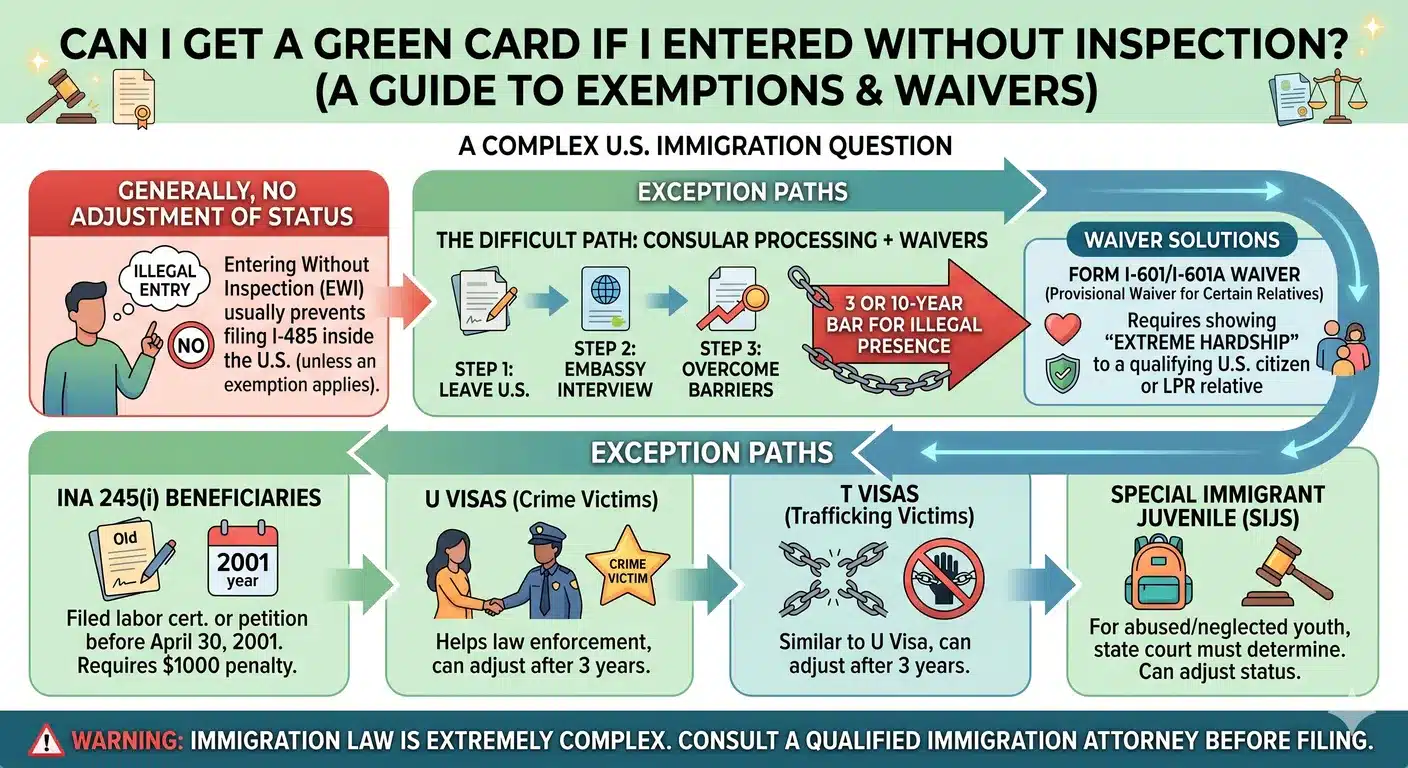
Short answer: If you entered the United States without inspection (EWI), you generally cannot adjust status to a green card from inside the U.S. through the standard process. However, there are four main pathways that may allow you to obtain a green card despite an unlawful entry: (1) INA Section 245(i) grandfathering if a labor certification or immigrant petition was filed on your behalf on or before April 30, 2001; (2) Consular processing with a provisional unlawful presence waiver (Form I-601A), which requires leaving the U.S. for an interview at a U.S. consulate abroad; (3) VAWA self-petitioning if you are the abused spouse, child, or parent of a U.S. citizen or lawful permanent resident; or (4) a U visa or T visa pathway if you are a victim of certain crimes or human trafficking. Asylum status can also lead to a green card after one year. For most people who entered without inspection in Dallas, Texas, the I-601A waiver combined with consular processing in Ciudad Juárez is the most common route.
Let me walk you through each of these in detail so you understand which path may apply to your situation.
What “Entered Without Inspection” Actually Means
Entering without inspection (EWI) means you came into the United States without being inspected and admitted or paroled by a U.S. immigration officer at a port of entry. This includes crossing the border between official checkpoints, being waved through without proper documentation, or otherwise entering in a way that wasn’t recorded by Customs and Border Protection.
This matters enormously because under Section 245(a) of the Immigration and Nationality Act, one of the basic requirements to adjust status inside the U.S. is that you must have been “inspected and admitted or paroled” into the country. If you weren’t, the standard adjustment process is closed to you—unless you fit into one of the specific exceptions discussed below.
If you’re unsure whether your entry counts as an inspection, this is worth discussing with a Dallas immigration attorney. Some entries you might think were unlawful actually count as legal admission, such as being waved through at a border checkpoint, or entering with a borrowed document that the officer accepted.
Pathway 1: INA Section 245(i) — The Grandfather Clause
Section 245(i) of the INA allows certain people who entered without inspection to adjust status inside the United States by paying a $1,000 penalty fee.
To qualify under 245(i), you must show that:
- A labor certification or immigrant visa petition (Form I-130 or I-140) was filed on your behalf on or before April 30, 2001
- That petition was “approvable when filed” (meaning it was non-frivolous and properly filed)
- If filed between January 15, 1998 and April 30, 2001, you must also prove you were physically present in the U.S. on December 21, 2000
If a parent or spouse had a qualifying petition filed before April 30, 2001, you may be “grandfathered” through them—even if that original petition is long expired or unrelated to your current application. This is why it is critical to ask older family members whether any immigration paperwork was ever filed for them decades ago.
Section 245(i) is a powerful but narrow tool. Many longtime Dallas residents qualify and don’t realize it. If you have any documents from the late 1990s or early 2000s related to immigration filings, a Dallas green card attorney can help you determine whether you’re grandfathered.
Pathway 2: Consular Processing With a Provisional Waiver (Form I-601A)
For most people in the Dallas-Fort Worth area who entered without inspection, this is the most realistic pathway to a green card.
How It Works
Because you can’t adjust status inside the U.S., you must obtain your immigrant visa abroad through consular processing at a U.S. embassy or consulate—typically the U.S. Consulate in Ciudad Juárez, Mexico, for Mexican nationals living in Texas. The problem is that once you leave the U.S. after accruing more than 180 days of unlawful presence, you trigger a 3-year bar to returning. More than one year of unlawful presence triggers a 10-year bar.
The provisional unlawful presence waiver, filed on Form I-601A, solves this problem by allowing you to get the unlawful presence waiver approved before you leave the country. That way, you know in advance whether you’ll be allowed back in.
Who Qualifies for I-601A
To file an I-601A, you must:
- Be 17 years of age or older
- Be physically present in the United States
- Have an approved immigrant petition (typically an I-130 filed by a U.S. citizen or lawful permanent resident spouse, parent, or child over 21)
- Have a pending immigrant visa case with the Department of State and have paid the DOS immigrant visa processing fee
- Demonstrate that your U.S. citizen or lawful permanent resident spouse or parent would suffer extreme hardship if the waiver is not granted
What “Extreme Hardship” Means
This is the heart of the case. “Extreme hardship” is more than the normal difficulty of family separation. USCIS looks at factors like:
- Medical conditions of the qualifying relative and availability of treatment in the destination country
- Financial impact, including loss of household income, debts, and inability to sell property
- Educational disruption for U.S. citizen children
- Family ties in the U.S. versus abroad
- Country conditions in the destination country, including crime, violence, and lack of services
- Psychological impact, often documented through a forensic psychological evaluation
A well-prepared I-601A in Dallas typically includes a hardship declaration, medical records, financial documents, country conditions evidence, school records, and a psychological evaluation. This is not a form you want to file without experienced help—an I-601A waiver attorney in Dallas can make the difference between approval and denial.
The Process Step-by-Step
- U.S. citizen or LPR relative files Form I-130 with USCIS
- National Visa Center processing once the I-130 is approved (and a visa is available, if applicable)
- File Form I-601A with USCIS while you remain in the U.S.
- Wait for waiver approval (currently averaging 24-36+ months)
- Attend immigrant visa interview at U.S. Consulate (usually Ciudad Juárez for Texas residents)
- Re-enter the U.S. as a lawful permanent resident
Important Risks to Understand
The I-601A only waives the 3- and 10-year unlawful presence bars. It does not waive other grounds of inadmissibility like fraud, certain criminal convictions, or prior orders of removal. If the consular officer finds another inadmissibility ground at your interview abroad, you could be stuck outside the U.S. This is why a thorough case review before filing anything is so important.
Pathway 3: VAWA Self-Petitioning
The Violence Against Women Act (VAWA) allows certain abused immigrants to self-petition for a green card without their abuser’s knowledge or cooperation—and importantly, VAWA self-petitioners can adjust status inside the U.S. even if they entered without inspection.
You may qualify if you are:
- An abused spouse of a U.S. citizen or lawful permanent resident
- An abused child (under 21 and unmarried) of a U.S. citizen or LPR
- An abused parent of a U.S. citizen son or daughter who is 21 or older
The abuse must constitute “battery or extreme cruelty,” which includes physical violence as well as psychological, emotional, and sexual abuse. VAWA is gender-neutral—men, women, and LGBTQ+ individuals can all qualify.
VAWA cases are confidential by law, and the abuser is never notified. If you’re in the Dallas area and in this situation, speaking with a VAWA attorney in Dallas can be done safely and confidentially.
Pathway 4: U Visa and T Visa Pathways
U Visa (Victims of Certain Crimes)
The U nonimmigrant visa is available to victims of qualifying crimes who have suffered substantial mental or physical abuse and who are helpful to law enforcement in the investigation or prosecution of the crime.
Qualifying crimes include domestic violence, sexual assault, felonious assault, kidnapping, human trafficking, and many others. After holding U status for three years, you can apply for a green card.
The U visa pathway works for people who entered without inspection because the waiver of inadmissibility built into the U visa application (Form I-192) is very broad and can waive almost any ground, including unlawful entry.
T Visa (Trafficking Victims)
The T nonimmigrant visa is for victims of severe forms of human trafficking. Like the U visa, it provides a path to lawful status and eventually a green card, and it can be obtained despite unlawful entry.
Asylum as a Path to a Green Card
If you have a credible fear of persecution in your home country based on race, religion, nationality, political opinion, or membership in a particular social group, you may qualify for asylum. Asylum applicants must generally file within one year of arrival, though there are exceptions.
Once granted asylum, you can apply for a green card one year later. Entering without inspection does not disqualify you from asylum.
What If None of These Apply to Me?
If you entered without inspection and don’t fit into any of the categories above, your options are limited but not zero. Some possibilities include:
- Cancellation of removal if you are placed in removal proceedings and meet the requirements (10 years continuous physical presence, good moral character, and exceptional and extremely unusual hardship to a U.S. citizen or LPR spouse, parent, or child)
- Parole in place for certain military family members
- Deferred action in limited humanitarian situations
- Waiting for a change in law, though this is not a strategy—just a reality some families face
A consultation with a Dallas immigration lawyer is the best way to identify any pathway you might have missed.
Why This Matters Specifically in Dallas, TX
Dallas-Fort Worth is home to one of the largest immigrant populations in the United States, and the local USCIS field office in Irving processes a high volume of adjustment and waiver cases. For Texas residents who entered without inspection, the most common route remains the I-601A waiver paired with consular processing in Ciudad Juárez—a journey that thousands of DFW families have completed successfully when their cases were properly prepared.
Texas residents also benefit from the proximity of the Mexican consulate and a deep legal community familiar with these cases. However, Texas falls under the jurisdiction of the Fifth Circuit Court of Appeals, which tends to be one of the more restrictive circuits on immigration matters, so case preparation needs to be especially thorough.
Common Mistakes to Avoid
- Filing an I-130 without a plan. Approval of the I-130 doesn’t fix your status. You must have a clear roadmap for what comes after.
- Leaving the U.S. without an approved waiver. Doing so triggers the 3/10-year bars immediately and can leave you stranded.
- Assuming marriage automatically fixes everything. Marrying a U.S. citizen does not waive an unlawful entry on its own.
- Filing the I-601A on a weak hardship case. A denial doesn’t put you in removal proceedings, but it costs time and money. Build the strongest possible record the first time.
- Failing to disclose prior immigration violations or criminal history. Anything you hide will likely surface at the consulate.
Next Steps
If you entered the United States without inspection and you’re in the Dallas area, the most important thing you can do is get a clear, honest evaluation of your case before you file anything. Every situation involves unique facts—prior entries and exits, criminal history, family relationships, and timing—that change which pathway is best for you.
The Piri Law Firm handles I-601A waivers, VAWA self-petitions, U visas, family-based green cards, and consular processing for clients throughout the Dallas-Fort Worth area. You can schedule a consultation to review your specific situation and get a concrete plan for moving forward.
A green card is still possible for many people who entered without inspection—it just requires the right strategy.