
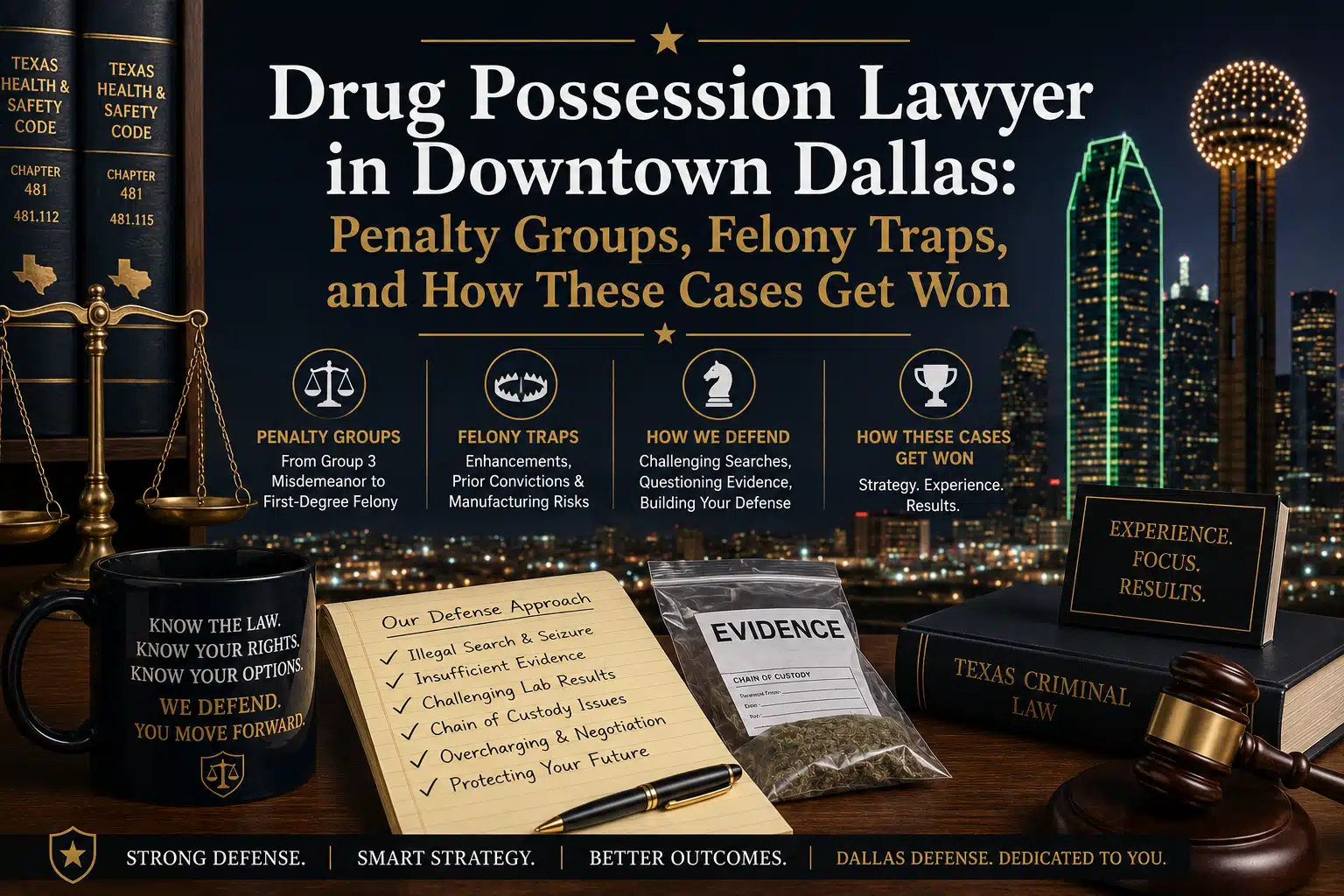
Texas charges drug possession more aggressively than almost any state, and Dallas County’s dockets are full of cases that began with a routine traffic stop on I-35E, Ross Avenue, or a night out in Deep Ellum. The difference between a Class B misdemeanor and a felony can come down to a fraction of a gram — or, in the case of THC vape pens, simply the form the substance takes. A drug possession defense lawyer at The Piri Law Firm, based at our Downtown Dallas office at 2001 Ross Ave, Suite 700, defends these cases from the traffic stop forward — because that’s usually where they’re won.
How Texas Classifies Drugs: The Penalty Groups
The Texas Health and Safety Code, Chapter 481 — the Texas Controlled Substances Act — sorts substances into penalty groups, and the group plus the weight determines the charge:
- Penalty Group 1 — cocaine, methamphetamine, heroin, oxycodone and most opioids: less than 1 gram is a state jail felony (180 days–2 years); 1–4 grams a third-degree felony; 4–200 grams a second-degree felony. Fentanyl and its analogues are treated with particular severity under their own subgroup.
- Penalty Group 2 — MDMA, psilocybin, and — critically — THC concentrates: same felony ladder starting at under 1 gram.
- Penalty Groups 3 and 4 — Xanax, Valium, hydrocodone in certain formulations, and other prescription drugs possessed without a valid prescription: typically Class A misdemeanor at lower weights, felonies above.
- Marijuana (plant form) — its own schedule: under 2 ounces is a Class B misdemeanor (up to 180 days), 2–4 ounces a Class A, and above 4 ounces a felony.
The vape pen trap deserves its own paragraph. Marijuana flower under two ounces is a misdemeanor — but THC oil, wax, edibles, and vape cartridges are Penalty Group 2 concentrates, which means the cartridge in a college student’s pocket is a felony, regardless of how small, and the weight includes adulterants and dilutants (the entire gummy, not just the THC). We see this catch otherwise clean-record clients in Downtown Dallas constantly, and it is one of the most misunderstood rules in Texas criminal law.
Weight thresholds also matter because quantity, packaging, scales, cash, or messages can convert simple possession into possession with intent to deliver — a dramatically more serious charge that we fight to keep out of the case from the first prosecutor conference.
What “Possession” Actually Requires the State to Prove
Possession under Texas law means actual care, custody, control, or management of the substance, plus knowledge that it was contraband. Mere presence near drugs is not legally enough — which is why the passenger in a car where drugs are found under a seat, or the roommate in an apartment where a guest left a bag, has a genuine defense. Texas courts require affirmative links between the accused and the substance: proximity, visibility, ownership of the space, incriminating statements, fingerprints, and conduct. In multi-occupant car and apartment cases, the affirmative-links analysis is often the whole ballgame, and prosecutors who can’t build those links dismiss or lose.
The Fourth Amendment: Where Most Drug Cases Are Really Fought
Nearly every possession case begins with a search — and every search has rules. The most productive defense work in Dallas County drug cases is suppression litigation:
- The stop. Was there actually a traffic violation or reasonable suspicion? Dash and body camera video frequently contradicts the stated basis.
- The prolongation. Officers cannot extend a completed traffic stop to wait for a drug dog or go fishing without new reasonable suspicion — a rule the U.S. Supreme Court made explicit and that gets violated on Dallas roadsides weekly.
- The search. Consent must be voluntary, and “consent” after four officers surround a car at midnight is challengeable. Claimed odor justifications, defective warrants, and searches exceeding their scope are all litigated.
- The lab. The substance must actually be what the field test claimed — field tests are notoriously unreliable — and the lab’s weight, methodology, chain of custody, and analyst credentials are all checkable.
When a suppression motion succeeds, the evidence disappears and the case usually dies with it. That is why we order the video in every case before discussing any plea.
Diversion, Specialty Courts, and Protecting Your Record
Dallas County operates diversion programs and specialty courts for eligible drug cases — options that, for first-time offenders in particular, can resolve a case through treatment and supervision and end in dismissal rather than conviction. Eligibility depends on the charge, criminal history, and the prosecutor’s assessment, and getting a client positioned for the right program early is often more valuable than months of litigation. Where diversion isn’t available, deferred adjudication followed by an order of nondisclosure can keep a case off most background checks, and an outright dismissal can support a full expunction. Which path protects your future best is a case-by-case judgment — and it’s a conversation to have before the first plea offer, not after. Our criminal defense FAQs explain how these record-protection tools differ.
Drug Charges and Immigration: The Most Dangerous Combination
For non-citizens, drug cases are uniquely hazardous. Under federal immigration law, a conviction for virtually any controlled substance offense creates deportability and inadmissibility problems — with only a narrow exception for a single offense involving 30 grams or less of marijuana for personal use. Even outcomes that look harmless in criminal court, including some deferred dispositions, can count as “convictions” for immigration purposes. A green card holder who takes a quick plea to get out of jail can walk into an ICE hold; a visa applicant can become permanently inadmissible.
This is where The Piri Law Firm is built differently: our crimmigration practice analyzes every drug case against the client’s immigration file before any plea, and our criminal defense attorneys negotiate dispositions specifically structured to avoid immigration triggers. If you or a family member is a non-citizen facing a possession charge anywhere in Dallas County, do not plead to anything before getting crimmigration advice.
What to Do After a Drug Arrest in Dallas
- Do not discuss the case with police, cellmates, or on recorded jail calls — “it’s just weed” is a confession.
- Do not consent to any further searches of phones, homes, or vehicles.
- Write down the stop and search details while fresh: what was said, when, in what order.
- Preserve any evidence of prescriptions where relevant.
- Hire counsel before your first setting at the Frank Crowley Courts Building — early positioning for diversion, or early suppression work, shapes everything.
Why The Piri Law Firm
Michael Piri is a Texas attorney practicing Criminal Defense, Family Law, Personal Injury, and Immigration — verify his licensure on his State Bar of Texas profile. He earned his J.D. from St. Mary’s University School of Law and is fluent in Spanish and French. The firm offers free 30-minute consultations, flat fees and payment plans, and 24/7 availability. Visit our Downtown Dallas office page for directions and read client reviews on our Google Business Profile.
Frequently Asked Questions
Is a THC vape pen really a felony in Texas?
Yes. THC concentrates — oils, wax, cartridges, edibles — fall under Penalty Group 2, making possession a felony regardless of amount, even though marijuana flower under two ounces is only a misdemeanor.
Can drug charges be dismissed in Dallas County?
Yes — commonly through suppression of illegally obtained evidence, failure to prove possession through affirmative links, lab problems, or completion of a diversion program. Every route depends on the specific facts.
What’s the penalty for first-time possession of a small amount of cocaine or meth?
Less than one gram of a Penalty Group 1 substance is a state jail felony: 180 days to 2 years in a state jail facility and up to a $10,000 fine — though probation, treatment, and diversion outcomes are often achievable for first offenses.
Will a drug conviction affect my immigration status?
Almost certainly. Nearly any controlled substance conviction creates deportability or inadmissibility, with only a narrow marijuana exception. Non-citizens should never plead without crimmigration advice.
I was a passenger — the drugs weren’t mine. Do I have a defense?
Yes. The state must prove affirmative links showing you knowingly possessed the substance; mere presence in the car is not legally sufficient. Passenger cases are among the most defensible drug charges.
The Piri Law Firm — Downtown Dallas Office
2001 Ross Ave, Suite 700, Dallas, TX 75201 · (833) 600-0029 · Free 30-minute consultation, 24/7 · Nosotros hablamos español
Contact us | Find us on Google
This article is for general information only and is not legal advice. Reading it does not create an attorney-client relationship.