
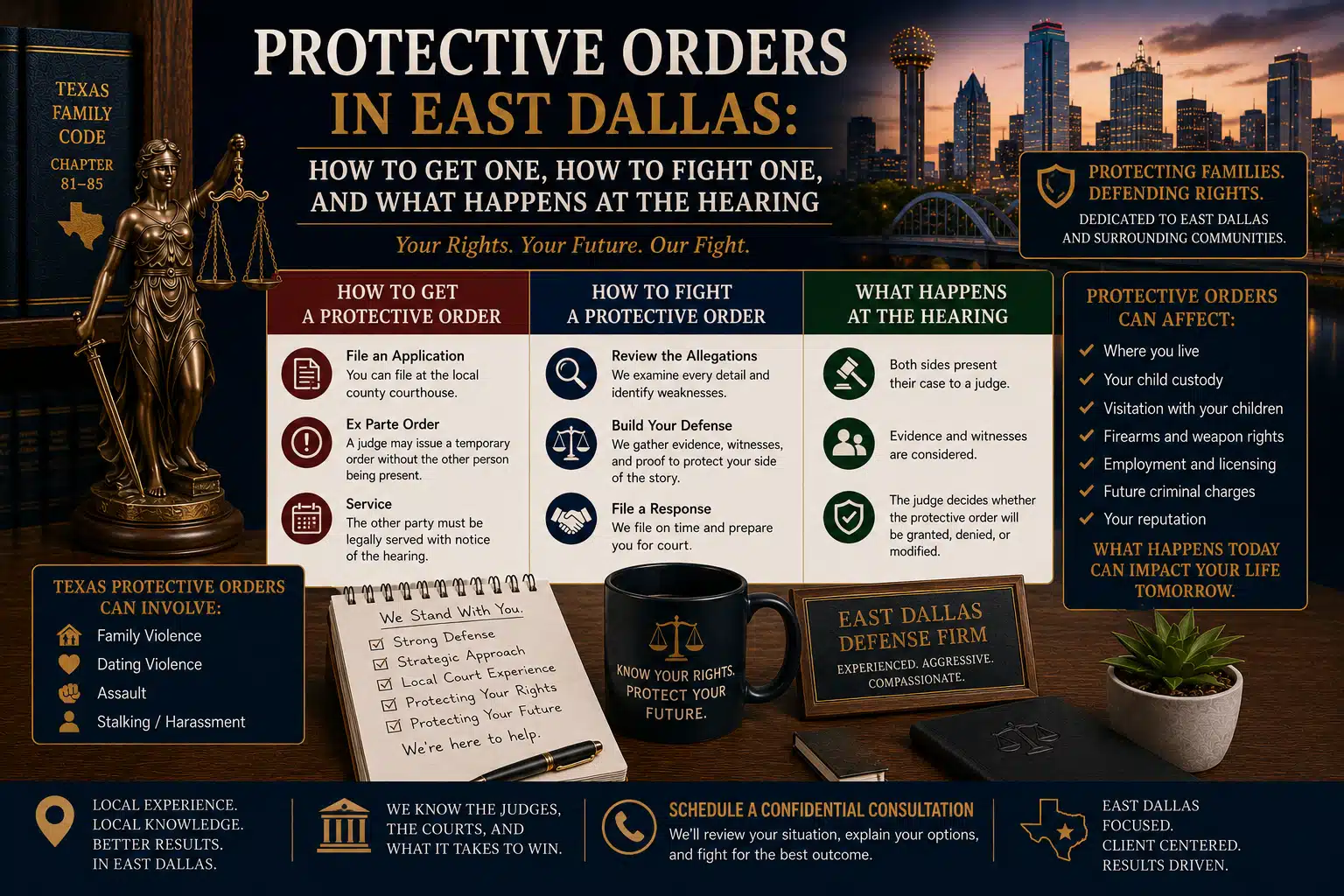
Protective orders sit at the intersection of family law and criminal law, and they arrive at The Piri Law Firm’s East Dallas office at 8021 I-30 Frontage Rd from both directions. Some clients need protection now — from a violent partner, a stalking ex, an escalating situation at home in Casa View or Pleasant Grove. Others have just been served with an application full of allegations they dispute, and are days away from a hearing that could bar them from their home, their children, and their firearms for two years. We represent both, so this guide explains the system honestly from both sides: what protective orders do, how the hearing works, and the mistakes each side makes.
If you are in immediate danger, call 911 first. The legal process described below is for protection going forward; it is not an emergency response.
The Three Kinds of Orders — and Why People Confuse Them
A Magistrate’s Order of Emergency Protection (MOEP) is criminal-side: issued after a family violence arrest, typically lasting 31–91 days, without any application by the victim. If your situation involves a recent arrest, our companion guides on domestic violence defense cover the MOEP in depth.
A civil protective order under Title 4 of the Texas Family Code is what this article is mostly about: an order the applicant (or the Dallas County District Attorney on their behalf) requests from a civil court, requiring proof that family violence has occurred and — under the traditional standard — is likely to occur again. It typically lasts up to two years, and can last longer in cases involving serious bodily injury or repeat orders.
A temporary ex parte order is the emergency version of the civil order: issued the day of filing, without notice to the other side, when the application shows a clear and present danger. It lasts up to 20 days (extendable) — just long enough to bridge to the full hearing where both sides appear.
People also confuse protective orders with restraining orders. In Texas, the standard temporary restraining orders in divorces are property-and-conduct housekeeping with no arrest power. A protective order is different in kind: violating it is a crime, police enforce it on the spot, and it goes into statewide law enforcement databases.
What a Protective Order Actually Does
A Dallas County protective order can prohibit the respondent from committing further violence, communicating with the applicant directly or through others, going near the applicant’s home, workplace, and the children’s schools or daycare, and possessing a firearm — a prohibition with federal teeth under 18 U.S.C. § 922(g)(8). It can also carry affirmative terms: kick-out orders removing the respondent from a shared residence, temporary child support, and mandated counseling or battering intervention programs.
Two consequences deserve emphasis on both sides of the table. First, violation is a separate crime — a Class A misdemeanor, and a felony for repeat violations or violations involving assault or stalking — and the applicant cannot “waive” the order by inviting contact. Second, a protective order finding of family violence echoes into other cases: it rebuts the joint-custody presumption in family court (our child custody lawyer page explains the stakes), it satisfies a spousal-maintenance eligibility gate in divorce, and for non-citizens it can be both a shield (supporting certain immigration relief for victims) and a sword (a deportability ground for respondents who violate one).
If You Need Protection: Building an Application That Holds Up
Applications succeed on documentation, not adjectives. Before filing — or while we file for you — assemble:
- A dated incident chronology: what happened, when, where, who saw it
- Photographs of injuries and property damage, with dates
- The digital trail: threatening texts, voicemails, social media messages, call logs
- Medical records and police report numbers, where they exist
- Witness names — neighbors, family, coworkers who saw or heard incidents
Applications in Dallas County can be filed through the District Attorney’s office (which represents applicants at no cost), through private counsel, or with self-help resources from TexasLawHelp.org and the Texas Attorney General’s protective order program. We add value where cases are contested, where the protective order interacts with a divorce or custody case that needs coordinated strategy, and where immigration issues make the stakes higher — for instance, abuse victims whose status depends on the abuser, for whom protective orders can support VAWA self-petitions and other relief through our immigration practice.
One practical warning for applicants: a protective order is powerful but it is paper. Pair it with a real safety plan — and treat any violation as what it is, a crime to report, not a negotiation.
If You’ve Been Served: The Two-Week Case That Can Shape the Next Two Years
Respondents consistently underestimate protective order hearings — then discover the order they didn’t contest is being quoted in their custody case a year later. If you’ve been served:
Do not contact the applicant. Not to apologize, not to “clear it up,” not through relatives. If a temporary ex parte order is in place, contact is a crime; even without one, contact becomes Exhibit A.
Calendar the hearing and show up with counsel. These hearings happen fast — often within 14 days — and proceed without you if you don’t appear, ending in a default order on the applicant’s evidence alone.
Understand the interplay with any criminal case. The protective order hearing is civil, which means you can be called to testify and cross-examined while criminal charges are pending. Testifying can hand the DA a preview and impeachment material; invoking the Fifth Amendment has its own costs in a civil setting. This sequencing decision — what to contest, what to concede, whether to negotiate terms instead of trying the allegations — is precisely where a firm that handles both the criminal defense and the family side earns its keep.
Know that negotiated outcomes exist. Agreed orders without findings of family violence, mutual stay-away terms, modifications allowing child exchange through a third party — the space between “full order with findings” and “application denied” is wide, and where the evidence is mixed, a structured agreement often beats a coin-flip hearing for both sides.
And if the order issues: follow it perfectly. Move for modification if terms are unworkable; never self-modify. Violations convert a defensible situation into a criminal record, and for non-citizens, a protective-order violation is an independent deportability ground — a trap our crimmigration team sees spring on people who thought a text message was harmless.
The Hearing Itself: What Both Sides Should Expect
Protective order hearings in Dallas County are compressed trials: testimony from the applicant and respondent, exhibits (photos, messages, medical records), sometimes a responding officer or family witness, and cross-examination. The applicant carries the burden of proof by a preponderance of the evidence. Judges decide the same day in most cases. Preparation looks the same on both sides — a coherent chronology, organized exhibits, witnesses who actually appear, and testimony rehearsed enough to survive cross without being coached. The side that treats the hearing like the trial it is usually wins it.
Why East Dallas Calls The Piri Law Firm
Michael Piri is a Texas attorney practicing Family Law, Criminal Defense, Personal Injury, and Immigration — verify his licensure on his State Bar of Texas profile. He earned his J.D. from St. Mary’s University School of Law and is fluent in Spanish and French — and because the firm works both sides of the family/criminal line, protective order strategy gets built with the custody, divorce, criminal, and immigration consequences all on the table. Free 30-minute consultations, payment plans, 24/7 availability. Visit our East Dallas office page for directions, and read client reviews on our Google Business Profile.
Frequently Asked Questions
How long does a protective order last in Texas?
A civil protective order typically lasts up to two years, with longer periods available for serious bodily injury or repeat orders. Emergency ex parte orders last up to 20 days; post-arrest magistrate’s orders run 31–91 days.
How fast can I get a protective order in Dallas County?
A temporary ex parte order can issue the same day the application is filed when it shows a clear and present danger, followed by a full hearing — usually within about two weeks — where the longer order is decided.
What happens if the protected person contacts me first?
The order still binds you. The applicant cannot waive a court’s order, and responding — even to an invitation — is a criminal violation. The legal route is asking the court to modify or vacate the order.
Is a protective order the same as a restraining order?
No. Texas restraining orders in divorces are civil housekeeping without arrest power. A protective order is police-enforceable, criminal to violate, and entered in statewide law enforcement databases.
Will a protective order affect my gun rights?
Yes. A protective order issued after notice and a hearing triggers a federal firearms prohibition for as long as the order lasts — and a conviction for violating one creates further consequences.
The Piri Law Firm — East Dallas Office
8021 I-30 Frontage Rd, Dallas, TX 75228 · (833) 600-0029 · Free 30-minute consultation, 24/7 · Nosotros hablamos español
Contact us | Find us on Google
This article is for general information only and is not legal advice. Reading it does not create an attorney-client relationship. If you are in immediate danger, call 911.