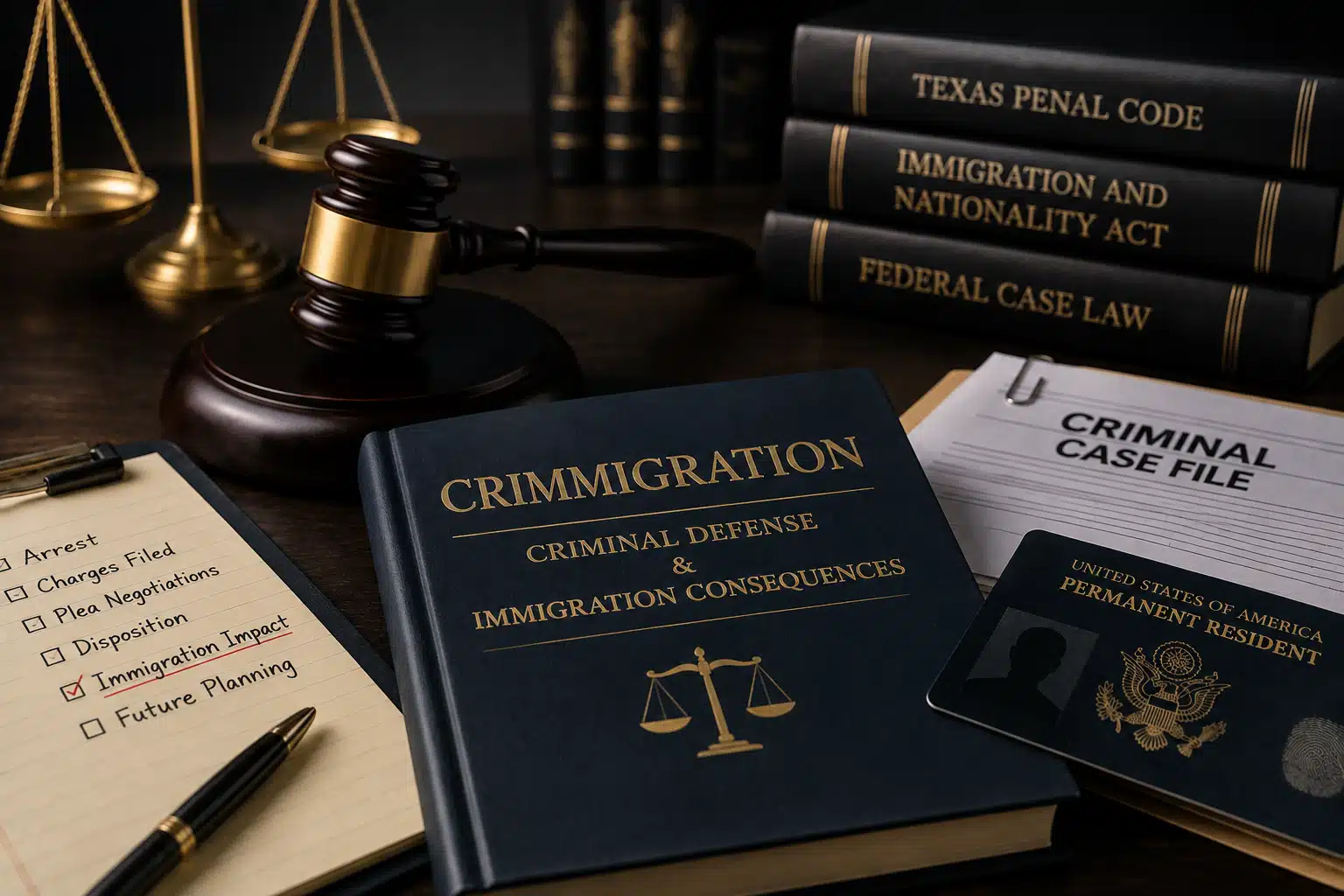

Being arrested in Dallas does not automatically mean you lose your green card.
But for a lawful permanent resident, an arrest can create two legal problems at the same time: the Texas criminal case and the potential immigration consequences that may follow it.
That distinction matters.
The arrest itself is usually not what determines whether a permanent resident can remain in the United States. What happens next — the charge filed, the facts alleged, the plea entered, and the final disposition — can have much greater immigration consequences.
A criminal resolution that appears favorable in Dallas County criminal court may still create serious problems under federal immigration law.
That is why a green card holder facing criminal charges should consider the criminal and immigration consequences before accepting a plea agreement, not after the criminal case is finished.
The Piri Law Firm handles this intersection of criminal and immigration law through its Dallas/Fort Worth crimmigration practice.
Does an Arrest Automatically Cancel a Green Card?
No.
A lawful permanent resident does not ordinarily lose permanent resident status simply because police arrested them.
An arrest is an accusation. It is not the same thing as a conviction.
However, that does not mean an arrest should be treated casually.
Once a noncitizen enters the criminal justice system, several things can happen that may eventually affect immigration status.
The government may examine:
- The criminal charge
- The underlying conduct
- Whether the person admits certain conduct
- The eventual plea agreement
- Whether there is a conviction for immigration purposes
- The sentence imposed
- Previous criminal history
- Previous immigration history
- Travel outside the United States
- Future applications for citizenship or other immigration benefits
The safest question therefore is not simply:
“Will this arrest take away my green card?”
The better question is:
“How must this criminal case be handled so that we protect my immigration status as much as possible?”
That is the central issue in crimmigration defense.
Why Green Card Holders Face Different Risks in Criminal Court
A U.S. citizen facing a criminal charge is primarily concerned about criminal penalties such as jail, probation, fines, and a criminal record.
A green card holder has another layer of risk.
Certain criminal convictions can potentially create grounds of deportability or inadmissibility under federal immigration law.
That means a plea bargain that reduces jail exposure might still create a serious immigration problem.
For example, someone might hear:
“You won’t have to go to jail.”
That sounds like an excellent result.
But if the plea creates a conviction that triggers immigration consequences, the person could later encounter ICE detention or removal proceedings.
This is why permanent residents should tell their criminal defense attorney immediately that they are not U.S. citizens.
The Piri Law Firm’s Dallas/Fort Worth criminal defense practice addresses criminal charges that may also create immigration consequences for noncitizens.
Can a Green Card Holder Be Deported After a Criminal Conviction?
Potentially, yes.
Lawful permanent residence provides substantial rights, but a green card does not provide the same protection from removal that U.S. citizenship does.
Federal immigration law contains numerous criminal grounds that can potentially place a permanent resident at risk.
Depending on the circumstances, these can include certain:
- Crimes involving moral turpitude
- Controlled-substance offenses
- Domestic violence offenses
- Firearms offenses
- Fraud offenses
- Theft offenses
- Aggravated felonies
- Other qualifying criminal convictions
The exact immigration consequence cannot be determined merely by looking at the everyday name of the offense.
The specific Texas statute, charging language, plea, sentence, and immigration history can all matter.
Two defendants charged with seemingly similar crimes may therefore face very different immigration consequences.
The Biggest Mistake: Taking a Plea Before Checking Immigration Consequences
This is one of the most dangerous mistakes a permanent resident can make.
Criminal cases are frequently resolved through negotiated pleas.
A prosecutor may offer:
- Reduced charges
- Deferred adjudication
- Probation
- Time served
- Reduced jail time
- Dismissal of other charges
The offer may look favorable from a purely criminal perspective.
Immigration law, however, has its own definitions and rules.
A disposition that avoids a traditional Texas conviction can still potentially be treated as a conviction under federal immigration law.
That is why a permanent resident should never assume that deferred adjudication means there are no immigration consequences.
Before accepting an agreement, counsel should evaluate how the proposed disposition could affect the client’s immigration status.
Can Deferred Adjudication Affect a Green Card?
Yes, it potentially can.
Texas defendants frequently believe deferred adjudication means they were never convicted.
For some purposes under Texas law, that distinction can be extremely important.
Federal immigration law does not necessarily use Texas’s definition of conviction.
Certain dispositions involving a guilty or no-contest plea or admission combined with some form of punishment, penalty, or restraint can potentially qualify as convictions for immigration purposes even when Texas treats the disposition differently.
This is one reason an immigrant should not evaluate a plea bargain solely according to what appears on a Texas criminal record.
The immigration analysis must happen separately.
What Happens If ICE Becomes Involved After a Dallas Arrest?
An arrest can sometimes bring a noncitizen to the attention of federal immigration authorities.
If ICE becomes involved, the person’s release from Dallas County custody does not necessarily mean they will immediately return home.
There may be an immigration detainer or another immigration enforcement issue.
The person could potentially move from criminal custody into immigration custody.
At that point, the family may suddenly be dealing with:
- The criminal case
- ICE detention
- Possible removal proceedings
Those proceedings require a coordinated strategy.
Families facing that situation should seek help quickly rather than waiting for the criminal case to resolve before investigating the immigration case.
Can You Fight ICE Detention?
Depending on the person’s circumstances, there may be options for seeking release or challenging detention.
The availability of an immigration bond can depend on the individual’s immigration history, criminal history, charges, prior orders, and the legal basis for detention.
Some detainees may qualify for a bond hearing.
Others may face mandatory detention arguments.
In certain circumstances involving prolonged or legally improper immigration detention, federal court litigation may also become relevant.
The important point is timing.
A family should not assume that nothing can be done merely because their loved one has been transferred into immigration custody.
Can an Arrest Affect Green Card Renewal?
An arrest can complicate a green card renewal even when the card itself is merely evidence of permanent resident status.
USCIS may examine criminal history when processing immigration applications.
That means someone with an arrest should be prepared to provide accurate information and, when required, appropriate certified court records concerning the disposition of the case.
Trying to hide an arrest can create additional problems.
Before filing an immigration application after an arrest or criminal case, it may be wise to have both the criminal record and immigration history reviewed.
Can an Arrest Affect U.S. Citizenship?
Yes.
This is an area permanent residents frequently overlook.
Many green card holders eventually intend to become U.S. citizens through naturalization.
Naturalization requires USCIS to examine eligibility requirements that include good moral character during the applicable statutory period, while certain conduct can have consequences beyond that period as well.
A criminal arrest or conviction can therefore affect a future citizenship application even if the person was never placed into removal proceedings immediately after the criminal case.
This creates another reason to think beyond the immediate criminal charge.
A plea that resolves today’s Dallas criminal case may affect tomorrow’s naturalization application.
Should a Green Card Holder Travel After an Arrest?
International travel deserves careful consideration after certain criminal cases.
Permanent residents generally have significant travel rights, but particular criminal histories can create issues when a person seeks admission after returning from abroad.
Someone who has been arrested or convicted should therefore avoid assuming that previous international travel means future travel will be problem-free.
Before leaving the United States, an immigration attorney can review the criminal disposition and immigration history to determine whether travel may create additional risk.
This can be especially important when the criminal case involves drugs, theft, fraud, violence, or another offense that may fall within federal immigration grounds.
What If the Criminal Case Is Dismissed?
A dismissal is generally much better than a conviction.
But immigrants should still preserve documentation showing exactly what happened.
Obtain certified records demonstrating the disposition of the case.
Those documents may later become important during:
- Naturalization
- Green card renewal
- Adjustment of status
- Visa processing
- International travel
- Immigration court proceedings
Do not assume the government will automatically have a complete or accurate explanation of the criminal case years later.
Keep your own records.
What If the Green Card Holder Already Pleaded Guilty?
The situation should still be reviewed.
Do not assume it is too late.
The first step is usually obtaining the complete criminal record, including:
- Charging documents
- Plea paperwork
- Judgment
- Sentence
- Probation documents
- Court docket
- Any dismissal or modification orders
An attorney can then compare the criminal disposition with the person’s immigration history.
Depending on the circumstances, the analysis may involve immigration defenses, removal relief, appeals, or potentially post-conviction criminal options.
Criminal Defense and Immigration Defense Should Be One Strategy
This is the central principle behind crimmigration.
A green card holder arrested in Dallas does not really have a criminal problem and then an immigration problem.
The person has one interconnected legal problem.
The criminal strategy affects the immigration strategy.
The immigration history affects what outcomes should be pursued in criminal court.
The best opportunity to protect permanent resident status may therefore occur before the criminal case is resolved.
A lawyer evaluating the case should understand questions such as:
- What immigration status does the client have?
- How long has the client been a permanent resident?
- How long has the client lived in the United States?
- Does the client have prior convictions?
- Has the client traveled internationally?
- Is there an existing removal order?
- Could the proposed plea trigger deportability?
- Could it create inadmissibility?
- Could it affect naturalization?
- Could it affect eligibility for immigration relief?
Those questions should influence criminal negotiations from the beginning.
What Should a Green Card Holder Do Immediately After an Arrest in Dallas?
If you are a lawful permanent resident who has been arrested, take several precautions immediately.
Do not assume your green card protects you from immigration consequences.
Do not accept a plea agreement without an immigration analysis.
Tell your criminal attorney that you are not a U.S. citizen.
Do not sign immigration documents you do not understand.
Preserve every document relating to the criminal case.
Most importantly, obtain advice from an attorney who understands how Texas criminal law and federal immigration law interact.
The Piri Law Firm focuses on exactly this intersection through its Dallas/Fort Worth crimmigration practice, along with its broader immigration law practice and criminal defense representation.
Frequently Asked Questions About Green Cards and Dallas Arrests
Can You Lose Your Green Card Because You Were Arrested in Dallas?
An arrest alone does not ordinarily terminate lawful permanent resident status. The greater concern is what happens with the criminal case, including the charge, plea, conviction, sentence, and whether the resulting disposition creates consequences under federal immigration law.
Can a Green Card Holder Be Deported for a Criminal Conviction?
Yes. Certain criminal convictions can create grounds for removal under federal immigration law. The result depends on the particular offense, statute, disposition, sentence, immigration history, and other circumstances.
Is Deferred Adjudication Safe for a Green Card Holder?
Not necessarily. Federal immigration law has its own definition of a conviction. Some Texas deferred-adjudication dispositions can therefore have immigration consequences even though the outcome may be treated differently for certain purposes under Texas law.
Can ICE Detain a Green Card Holder After an Arrest?
Potentially. Lawful permanent residents can become subject to immigration detention or removal proceedings in certain circumstances. Whether ICE can detain someone and whether that person may seek release depends on the particular facts and legal basis for detention.
Can a Dallas Arrest Affect Citizenship Later?
Yes. USCIS reviews criminal history and good moral character when evaluating naturalization applications. An arrest or criminal disposition should therefore be reviewed before a permanent resident applies for U.S. citizenship.
Should I Accept a Plea Bargain If I Have a Green Card?
A permanent resident should understand the immigration consequences before accepting a criminal plea. A deal that appears favorable in criminal court may still create serious immigration consequences.
Can I Travel Outside the United States After a Criminal Case?
It depends on the offense, disposition, and immigration history. Certain criminal histories can create complications when a permanent resident returns to the United States. The case should be reviewed before international travel.
What Should I Do If I Already Pleaded Guilty?
Obtain the complete criminal record and have the disposition reviewed by a lawyer familiar with both criminal and immigration law. Depending on the circumstances, immigration defenses, post-conviction options, or other forms of relief may still need to be evaluated.
Talk to a Dallas Crimmigration Lawyer Before the Criminal Case Is Resolved
A Dallas arrest does not automatically take away your green card.
But what happens after the arrest can determine whether the criminal case remains a manageable legal problem or becomes a threat to your ability to remain in the United States.
For lawful permanent residents, the goal should be to identify immigration consequences while there is still time to influence the criminal outcome.
The Piri Law Firm represents immigrants facing criminal charges throughout Dallas and Fort Worth and coordinates criminal and immigration strategy when a client’s legal status is at risk.
Call (833) 600-0029 for a confidential consultation.
Hablamos Español.